


Minister Without Portfolio Lin Wan-i (林萬億) yesterday said that it would be best to give the Chiang Kai-shek Memorial Hall new functions and meaning, instead of dismantling it.
Lin, tasked with overseeing issues related to the transformation of the memorial hall, made the remarks after renewed calls from families of victims of the 228 Incident to dismantle the structure.
There is no timetable to decide the fate of the national historic site yet, as the Ministry of Culture is still compiling files that relate to its transformation, Lin said, adding that inter-departmental meetings would be held after the ministry submits its recommendation.
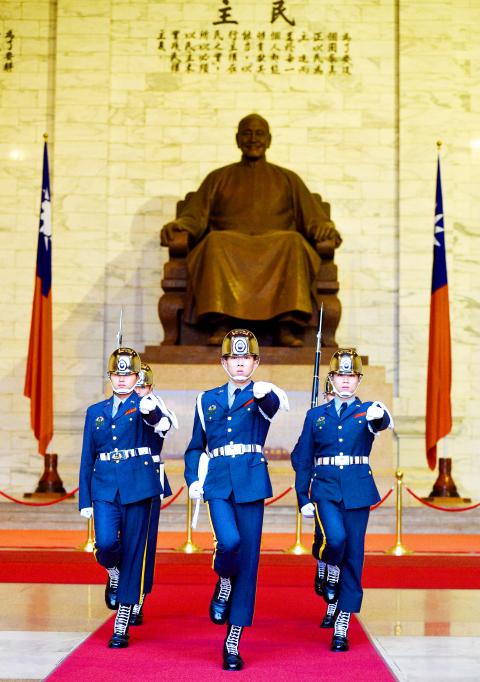
Photo: Peter Lo, Taipei Times
There are many suggestions regarding the memorial hall’s transformation — issues such as its new name, new functions and how to deal with Chiang Kai-shek’s (蔣介石) statue, Lin said, adding that suggestions from the victims’ families would be respected, but at the same time, they should be viable.
Asked if dismantling the memorial hall is an option being considered by the government, Lin said that, instead of removing it or deserting it, the best thing would be to give the structure new functions and positive implications.
The memorial hall, a 250,000m2 attraction in the heart of Taipei, was completed in 1980 in memory of Chiang, who moved the Republic of China government to Taiwan in 1949 after fleeing China following his defeat in the Chinese Civil War.
However, families and relatives of victims persecuted during the Martial Law period have been calling for the memorial hall to be dismantled as they see Chiang as a violator of human rights who should not be treated as a national hero.
“We all know that the [statue of the] persecutor is inside the structure,” Liao Ying-hao (廖英豪), a grandson of a victim of the Incident, said during a commemorative event on Friday.
“It remains a stab in the heart for the victims unless the structure is removed,” he said, urging the government to make a decision soon.
The Incident refers to an uprising that began Feb. 28, 1947, which led to a bloody government crackdown.
Presidential Office spokesman Ting Yun-kung (丁允恭) on Friday said that the Legislative Yuan is working on a plan to remove the autocratic characteristics of the memorial hall.
The government aims to eventually come up with a solution that would promote social reconciliation and the country’s unity, Ting said.

ANOTHER EMERGES: The CWA yesterday said this year’s fourth storm of the typhoon season had formed in the South China Sea, but was not expected to affect Taiwan Tropical Storm Gaemi has intensified slightly as it heads toward Taiwan, where it is expected to affect the country in the coming days, the Central Weather Administration (CWA) said yesterday. As of 8am yesterday, the 120km-radius storm was 800km southeast of Oluanpi (鵝鑾鼻), Taiwan’s southernmost tip, moving at 9kph northwest, the agency said. A sea warning for Gaemi could be issued tonight at the earliest, it said, adding that the storm is projected to be closest to Taiwan on Wednesday or Thursday. Gaemi’s potential effect on Taiwan remains unclear, as that would depend on its direction, radius and intensity, forecasters said. Former Weather Forecast

As COVID-19 cases in Japan have been increasing for 10 consecutive weeks, people should get vaccinated before visiting the nation, the Centers for Disease Control (CDC) said. The centers reported 773 hospitalizations and 124 deaths related to COVID-19 in Taiwan last week. CDC Epidemic Intelligence Center Director Guo Hung-wei (郭宏偉) on Tuesday said the number of weekly COVID-19 cases reported in Japan has been increasing since mid-May and surpassed 55,000 cases from July 8 to July 14. The average number of COVID-19 patients at Japan’s healthcare facilities that week was also 1.39 times that of the week before and KP.3 is the dominant

The Chinese Communist Party’s (CCP) working group for Taiwan-related policies is likely to be upgraded to a committee-level body, a report commissioned by the Mainland Affairs Council (MAC) said. As Chinese President Xi Jinping (習近平) is increasingly likely to upgrade the CCP’s Central Leading Group for Taiwan Affairs, Taiwanese authorities should prepare by researching Xi and the CCP, the report said. At the third plenary session of the 20th Central Committee of the CCP, which ended on Thursday last week, the party set a target of 2029 for the completion of some tasks, meaning that Xi is likely preparing to

US-CHINA TRADE DISPUTE: Despite Beijing’s offer of preferential treatment, the lure of China has dimmed as Taiwanese and international investors move out Japan and the US have become the favored destinations for Taiwanese graduates as China’s attraction has waned over the years, the Ministry of Labor said. According to the ministry’s latest income and employment advisory published this month, 3,215 Taiwanese university graduates from the class of 2020 went to Japan, surpassing for the first time the 2,881 graduates who went to China. A total of 2,300 graduates from the class of 2021 went to the US, compared with the 2,262 who went to China, the document showed. The trend continued for the class of 2023, of whom 1,460 went to Japan, 1,334 went to


 RSS
RSS