

Schools throughout the country are to be disinfected before the start of the new semester tomorrow, as part of the government’s efforts to prevent the spread of COVID-19, the Environmental Protection Administration (EPA) said yesterday.
As of Saturday, 87 percent of the disinfection work had been done at schools offering kindergarten to grade 12 (K-12), and by yesterday evening that figure would have risen to 99 percent, it said.
After that, only some schools in Taitung County and on the outlying islands would be left, but that work would be done today, the agency said.
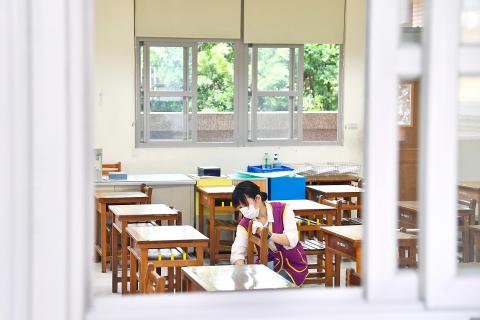
Photo: CNA
The start of the spring semester was postponed for two weeks, with the reopening of K-12 schools postponed until tomorrow and most universities due to open on Monday next week, as the government stepped up its COVID-19 prevention efforts.
Meanwhile, pediatricians in Taipei and Changhua County on Saturday were asked to give personal hygiene advice to students preparing to return to school.
Children often forget to wash their hands after touching handrails, elevator buttons or other surfaces, said Tai Chi-shan (戴季珊), a pediatrician at Taipei’s Shu Tien clinic.
They could be infected by scratching their noses, rubbing their eyes or eating with unwashed hands, she said.
Some people only wet their hands when they wash them, she said, adding that they should use soap and scrub for at least 30 seconds before rinsing and drying their hands to effectively clean them.
A person’s hands should also be washed before putting on a surgical mask, she added.
The mask should cover the nose and mouth and fit snugly, she said, adding that when removing a mask, a person should hold on to the ear loops and turn the mask inside out before tossing it into a trashcan and washing their hands.
Maintaining a regular schedule, balanced diet and exercise can all help to boost the immune system, she added.
Separately, Changhua Christian Hospital pediatric neurologist Chang Tung-ming (張通銘) said that besides washing their hands regularly, people could prevent infections by disinfecting their jackets.
Jackets come into direct contact with the environment, but are typically not washed every day, he said.
Thus, when students return home from school, they should remove their jackets at the entrance and spray them with rubbing alcohol before hanging them in a well-ventilated space, such as a balcony, for about two hours before wearing them the next day, he said.
As for school uniforms and gym clothes, which are washed every day, students should change out of them — and place them in a laundry basket — as soon as they return home, he said.
Everyone should do the same while epidemic prevention efforts are ongoing, he said.
To prevent bacteria and viruses from being brought into the home, clothes that are not washed daily should be sprayed with disinfectant and hung in a well-ventilated area, while clothes that are should be changed as soon as a person enters their home, he said.
Additional reporting by CNA
A total of 400 foreign “high- level” professionals have been naturalized as Republic of China (Taiwan) citizens over the past decade as the government has eased nationality rules to attract talent from a wider range of fields, the Ministry of the Interior said yesterday. The 400th high-level professional, who works in the electronics industry, was approved for ROC citizenship on Aug. 26, the MOI said. The MOI quoted the newly naturalized citizen as saying that Taiwan is a leader in fields such as semiconductors, electronics manufacturing, artificial intelligence development and energy technology. He also said
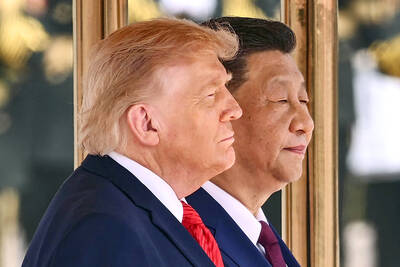
China has warned that it could cancel a planned US-China leaders’ summit if Washington approves new arms sales to Taiwan, a Japanese media outlet quoted sources as saying yesterday. US President Donald Trump, “apparently eager to showcase some diplomatic achievements ahead of November’s midterm congressional elections, places great importance on holding the summit with Chinese President Xi Jinping (習近平),” Japan’s Kyodo News reported. “While preparing for Xi’s upcoming trip, China has restated its position that the Taiwan issue is a ‘red line’ in bilateral relations,” the report said. The report said that when Xi met with Trump in Beijing in May, Xi said
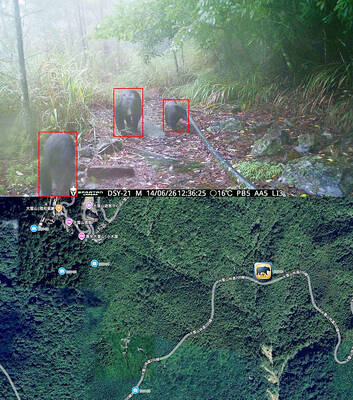
RARE PEEK: The footage released showed one of the bears staying in a cave for as long as 70 days, providing the first record of Formosan black bear’s overwintering The Forestry and Nature Conservation Agency yesterday released tracking records of released Formosan black bears for the first time, showing that they get much closer to human settlements than previously thought. The agency said it had captured two bears, Da Qu-ali (達古阿里) and Aziman (阿里曼), in indigenous villages in Hualien County and began to track them with a camera-mounted satellite collar after releasing them back into the wild. The results confirmed that the bears have moved from deep mountain areas into lowland hills closer to human communities, leading to an increase in human-bear conflicts, it said. The agency has introduced artificial intelligence-assisted early

DIPLOMATIC TOUR: Chinese President Xi Jinping began a series of overseas visits last month to Kyrgyzstan, Egypt and India, aimed at securing leverage, an official said Recent Chinese diplomatic and military moves are aimed at creating pressure ahead of a planned meeting between Chinese President Xi Jinping (習近平) and US President Donald Trump, National Security Council adviser Huang Chung-yen (黃重諺) said. Trump when visiting China in May extended an invitation to Xi to visit Washington on Sept. 24. China is yet to officially announce plans for Xi’s visit to the US. In an interview with the Liberty Times (sister paper of the Taipei Times) on Thursday, Huang said Xi’s overseas visits, China’s “gray zone” activities along the First Island Chain and efforts to expand its trade surplus with the


 RSS
RSS