


Last year was one that Taiwanese soccer fans would like to forget, with the men’s national team in disarray after calamitous results and a stumbling finish with the head coach being sacked.
The year began with a bright outlook, with the Chinese Taipei Football Association (CTFA) in January appointing Englishman Louis Lancaster to the top coaching job.
Lancaster had been with the players for more than a year, working as deputy to fellow Englishman Gary White, who was in charge from September 2017 to September 2018.
CTFA secretary-general Fang Ching-ren (方靖仁) said at the time that they received applications from other highly qualified foreign coaches, but Lancaster was chosen because he knew the players, had experience with the national squad and was familiar with Taiwanese soccer culture.
Lancaster said he wanted to help Taiwan improve their results and qualify for major Asian tournaments.
“My goal is to lead a team which can compete against other elite teams of Asia, and a team that Taiwanese fans can be proud of,” he said.
His philosophy was for Taiwan to play “attacking football,” with players pressing deep into the opposition’s zone.
Throughout last year, Lancaster had talked of instructing the team to “go on the attack right at the starting whistle,” while urging players to fully express themselves on the pitch.
“When playing attacking football, we will get more wins, but I want to win games in entertaining style,” he said.
However, Taiwan under his charge suffered several lopsided defeats in the qualifiers for the 2022 FIFA World Cup and lost several against countries with lower FIFA rankings.
It began with international friendlies, but the team could not implement Lancaster’s “attacking football” on the pitch as the players misfired for a scoreless tie in an away match against Myanmar in March.
Later that month, the visiting Solomon Islands netted the only goal from a penalty as Taiwan lost in Taipei.
In two matches in June, Taiwan were held 1-1 by Nepal at home, although they grabbed their only win of the year, 2-0 over Hong Kong, with forward Chen Hao-wei (陳浩瑋) scoring a brace, but the result meant little and both sides had made a lot of changes.
The real test came in September, when the World Cup qualifiers began. Taiwan had high hopes for their home matches in Group B, but were beaten 1-2 by Jordan on Sept. 5 at Taipei Municipal Stadium, and five days later they were outplayed at the same ground by Nepal, with forward Anjan Bista netting a brace, and the players and home fans stunned by the 0-2 defeat.
That opened the floodgates of criticism and finger-pointing, with Lancaster’s role coming under scrutiny. The chatter on fan sites was that Nepal were better in almost every facet of the game, and played with good pace and purpose, which was lacking in the home players.
Fans wrote that it was tough to stomach the loss and that Taiwan had no excuse because of Nepal’s much lower ranking. Moreover, they have far fewer financial and material resources, while the CTFA reportedly received about NT$400 million (US$13.22 million) from the government over the preceding three years.
The results only went downhill from there: visiting Australia pounding Taiwan 7-1 at the Kaohsiung National Stadium on Oct. 15.
There were even more calamitous results in the Middle East in November, with Kuwait almost reaching double digits in a 9-0 thumping in Kuwait City, while Jordan won 5-0 in Amman.
The Group B table has Taiwan dead last and already out of contention, with five losses from five matches. They let in 25 goals and scored only two.
After an executive meeting in December, the CTFA announced Lancaster’s sacking, despite his one-year contract being set to end this month, and opened the role to Taiwanese and foreign applicants.
There has been speculation that senior players had underperformed under Lancaster, with online commenters writing that captain and midfielder Chen Po-liang (陳柏良) had been lethargic during the qualifiers, not getting back on defense.
Others said that Lancaster had the wrong approach, as Taiwanese players do not have the skill and technical ability to carry out “attacking football” and a “high-pressing game.”
By pouring men up on attack, oppositions were able to exploit gaping holes at the back, they wrote, pointing to video evidence that they said showed Taiwan’s defense getting easily picked apart, as they lacked pace and did not react swiftly enough to the movement of opposition players.

The military has spotted two Chinese warships operating in waters near Penghu County in the Taiwan Strait and sent its own naval and air forces to monitor the vessels, the Ministry of National Defense (MND) said. Beijing sends warships and warplanes into the waters and skies around Taiwan on an almost daily basis, drawing condemnation from Taipei. While the ministry offers daily updates on the locations of Chinese military aircraft, it only rarely gives details of where Chinese warships are operating, generally only when it detects aircraft carriers, as happened last week. A Chinese destroyer and a frigate entered waters to the southwest

A magnitude 6.1 earthquake struck off the coast of Yilan County at 8:39pm tonight, the Central Weather Administration (CWA) said, with no immediate reports of damage or injuries. The epicenter was 38.7km east-northeast of Yilan County Hall at a focal depth of 98.3km, the CWA’s Seismological Center said. The quake’s maximum intensity, which gauges the actual physical effect of a seismic event, was a level 4 on Taiwan’s 7-tier intensity scale, the center said. That intensity level was recorded in Yilan County’s Nanao Township (南澳), Hsinchu County’s Guansi Township (關西), Nantou County’s Hehuanshan (合歡山) and Hualien County’s Yanliao (鹽寮). An intensity of 3 was
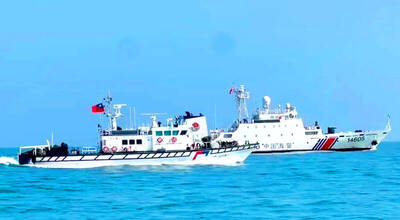
Instead of focusing solely on the threat of a full-scale military invasion, the US and its allies must prepare for a potential Chinese “quarantine” of Taiwan enforced through customs inspections, Stanford University Hoover fellow Eyck Freymann said in a Foreign Affairs article published on Wednesday. China could use various “gray zone” tactics in “reconfiguring the regional and ultimately the global economic order without a war,” said Freymann, who is also a nonresident research fellow at the US Naval War College. China might seize control of Taiwan’s links to the outside world by requiring all flights and ships entering or leaving Taiwan
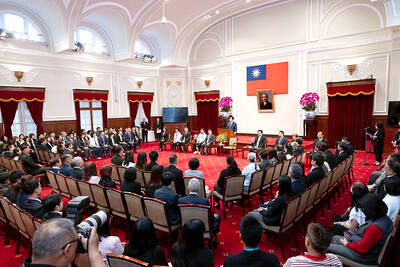
The next minimum wage hike is expected to exceed NT$30,000, President William Lai (賴清德) said yesterday during an award ceremony honoring “model workers,” including migrant workers, at the Presidential Office ahead of Workers’ Day today. Lai said he wished to thank the awardees on behalf of the nation and extend his most sincere respect for their hard work, on which Taiwan’s prosperity has been built. Lai specifically thanked 10 migrant workers selected for the award, saying that although they left their home countries to further their own goals, their efforts have benefited Taiwan as well. The nation’s industrial sector and small businesses lay


 RSS
RSS