


Among universities nationwide, National Taiwan University (NTU) has enrolled the most international students for the 2019 academic year, a Ministry of Education report released on Friday said.
NTU topped the enrollment list of national universities with 2,970 international students, followed by National Cheng Kung University with 1,899, National Chengchi University with 1,581, National Taiwan Normal University with 1,476 and National Tsing Hua University with 1,440.
Among private higher education schools, Ming Chuan University came first with 1,957 international students, closely followed by Tamkang University with 1,868, I-Shou University with 1,480, Feng Chia University with 1,425 and Chinese Culture University with 1,326.
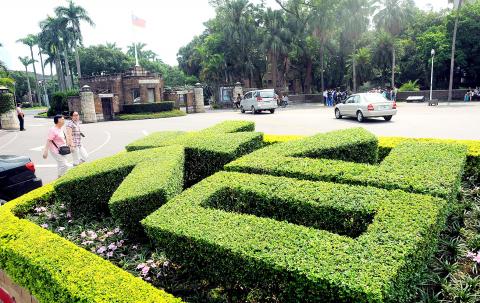
Photo: Lin Cheng-kung, Taipei Times
For local technical colleges, National Taiwan University of Science and Technology has the most international students with 1,515, followed by Minghsin University of Science and Technology with 1,247 and National Taipei University of Technology with 1,045.
The ministry defines international students as foreign nationals, people from Hong Kong, Macau and China, and overseas compatriot students.
According to the Regulations Regarding Study and Counseling Assistance for Overseas Chinese Students in Taiwan (僑生回國就學及輔導辦法), the term “overseas compatriot student” refers to a student of Chinese or Taiwanese descent who has come to Taiwan to study, who was born and lived overseas until the present time, or who has been living overseas for six or more consecutive years in the immediate past and obtained permanent or long-term residency status overseas.
Department of Higher Education Director-General Chu Chun-chang (朱俊彰) said that he expects the number of international students in Taiwan to rise in the foreseeable future, as the government promotes the New Southbound Policy and the internationalization of the tertiary education sector increases.
According to the ministry, the census was part of an annual report that records 44 different aspects relating to university affairs in Taiwan for the 2019 academic year.

PRAISE: Japanese visitor Takashi Kubota said the Taiwanese temple architecture images showcased in the AI Art Gallery were the most impressive displays he saw Taiwan does not have an official pavilion at the World Expo in Osaka, Japan, because of its diplomatic predicament, but the government-backed Tech World pavilion is drawing interest with its unique recreations of works by Taiwanese artists. The pavilion features an artificial intelligence (AI)-based art gallery showcasing works of famous Taiwanese artists from the Japanese colonial period using innovative technologies. Among its main simulated displays are Eastern gouache paintings by Chen Chin (陳進), Lin Yu-shan (林玉山) and Kuo Hsueh-hu (郭雪湖), who were the three young Taiwanese painters selected for the East Asian Painting exhibition in 1927. Gouache is a water-based
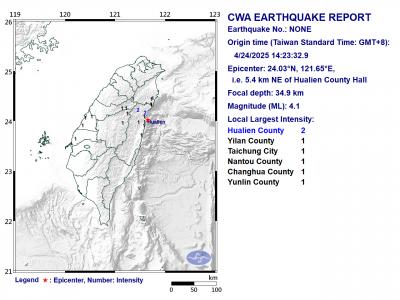
A magnitude 4.1 earthquake struck eastern Taiwan's Hualien County at 2:23pm today, according to the Central Weather Administration (CWA). The epicenter of the temblor was 5.4 kilometers northeast of Hualien County Hall, at a depth of 34.9 km, according to the CWA. The earthquake's intensity, which gauges the actual effect of a temblor, was the highest in Hualien County, where it measured 2 on Taiwan's 7-tier intensity scale. The quake also measured an intensity of 1 in Yilan county, Taichung, Nantou County, Changhua County and Yunlin County, the CWA said. There were no immediate reports of damage or injuries.
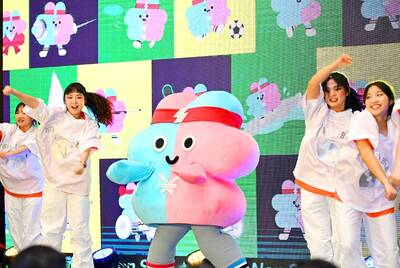
OFF-TARGET: More than 30,000 participants were expected to take part in the Games next month, but only 6,550 foreign and 19,400 Taiwanese athletes have registered Taipei city councilors yesterday blasted the organizers of next month’s World Masters Games over sudden timetable and venue changes, which they said have caused thousands of participants to back out of the international sporting event, among other organizational issues. They also cited visa delays and political interference by China as reasons many foreign athletes are requesting refunds for the event, to be held from May 17 to 30. Jointly organized by the Taipei and New Taipei City governments, the games have been rocked by numerous controversies since preparations began in 2020. Taipei City Councilor Lin Yen-feng (林延鳳) said yesterday that new measures by
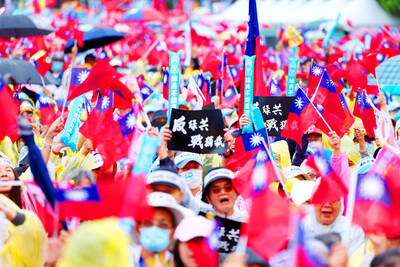
‘WORSE THAN COMMUNISTS’: President William Lai has cracked down on his political enemies and has attempted to exterminate all opposition forces, the chairman said The legislature would motion for a presidential recall after May 20, Chinese Nationalist Party (KMT) Chairman Eric Chu (朱立倫) said yesterday at a protest themed “against green communists and dictatorship” in Taipei. Taiwan is supposed to be a peaceful homeland where people are united, but President William Lai (賴清德) has been polarizing and tearing apart society since his inauguration, Chu said. Lai must show his commitment to his job, otherwise a referendum could be initiated to recall him, he said. Democracy means the rule of the people, not the rule of the Democratic Progressive Party (DPP), but Lai has failed to fulfill his


 RSS
RSS