


China’s Taiwan Affairs Office (TAO) yesterday rejected a request from Lee Ching-yu (李凈瑜) that her husband, democracy advocate Lee Ming-che (李明哲), be given funeral leave to attend his father’s funeral in Taiwan.
Granting Lee Ming-che funeral leave “would contravene related laws,” office spokesperson Ma Xiaoguang (馬曉光) told a routine news conference in Beijing yesterday.
The prison has already provided the family with a detailed explanation regarding the matter, he said.
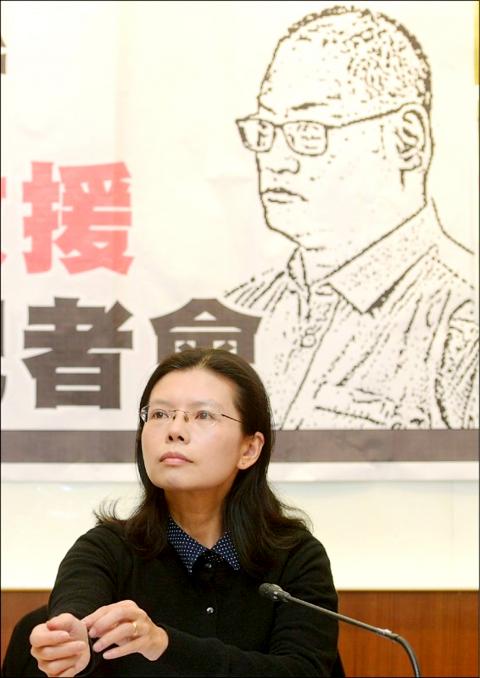
Photo: Chung Li-hua, Taipei Times
Lee, who in September 2017 was sentenced to a five-year term for subversion of state power, is now in Chishan Prison in Hunan Province.
Lee Ching-yu (李凈瑜) on Monday visited him at the prison, and also appealed to authorities to grant him leave.
As guarantee that he would return to complete his sentence, she offered to stay in prison in his stead.
“China’s response was just like what we had expected,” she said yesterday in a statement.
“By applying for a funeral leaving, I was treating Chinese authorities as if China were a civilized government, hoping that it would at some point conform to the standards of the civilized world, but such expectations were clearly my fantasy,” she said, adding that she hopes Taiwanese would remember this moment.
Although her husband wants to attend the funeral, he refused to let her stand-in for him at the prison, she said.
She was willing to be a hostage to the Chinese government because she wanted it to know that “Taiwanese are not afraid of going to prison,” she said.
Following the era of presidents Chiang Kai-Shek (蔣介石) and Chiang Ching-kuo (蔣經國), Taiwanese know that freedom always comes at a cost, she said.
Meanwhile, a coalition of human rights groups including Amnesty International, the Taiwan Association for Human Rights and the Judicial Reform Foundation questioned the legal basis for the Chinese decision.
Chinese prisons have previously allowed inmates to take funeral leaves, including Nobel Peace Prize laureate Liu Xiaobo (劉曉波), they said in a joint statement.
“When the TAO said granting funeral leaves would be illegal, exactly which laws was it referring to?” the groups asked.
Mainland Affairs Council Minister Chen Ming-tong (陳明通) on Tuesday said that the council would continue to provide assistance to Lee Ching-yu and expressed hopes that Chinese authorities would grant Lee Ming-che funeral leave for humanitarian reasons.
Additional reporting by Chung Li-hua

Considering that most countries issue more than five denominations of banknotes, the central bank has decided to redesign all five denominations, the bank said as it prepares for the first major overhaul of the banknotes in more than 24 years. Central bank Governor Yang Chin-lung (楊金龍) is expected to report to the Legislative Yuan today on the bank’s operations and the redesign’s progress. The bank in a report sent to the legislature ahead of today’s meeting said it had commissioned a survey on the public’s preferences. Survey results showed that NT$100 and NT$1,000 banknotes are the most commonly used, while NT$200 and NT$2,000

The Centers for Disease Control (CDC) yesterday reported the first case of a new COVID-19 subvariant — BA.3.2 — in a 10-year-old Singaporean girl who had a fever upon arrival in Taiwan and tested positive for the disease. The girl left Taiwan on March 20 and the case did not have a direct impact on the local community, it said. The WHO added the BA.3.2 strain to its list of Variants Under Monitoring in December last year, but this was the first imported case of the COVID-19 variant in Taiwan, CDC Deputy Director-General Lin Ming-cheng (林明誠) said. The girl arrived in Taiwan on

South Korea is planning to revise its controversial electronic arrival card, a step Taiwanese officials said prompted them to hold off on planned retaliatory measures, a South Korean media report said yesterday. A Yonhap News Agency report said that the South Korean Ministry of Foreign Affairs is planning to remove the “previous departure place” and “next destination” fields from its e-arrival card system. The plan, reached after interagency consultations, is under review and aims to simplify entry procedures and align the electronic form with the paper version, a South Korean ministry official said. The fields — which appeared only on the electronic form

The Ministry of Foreign Affairs (MOFA) is suspending retaliation measures against South Korea that were set to take effect tomorrow, after Seoul said it is updating its e-arrival system, MOFA said today. The measures were to be a new round of retaliation after Taiwan on March 1 changed South Korea's designation on government-issued alien resident certificates held by South Korean nationals to "South Korea” from the "Republic of Korea," the country’s official name. The move came after months of protests to Seoul over its listing of Taiwan as "China (Taiwan)" in dropdown menus on its new online immigration entry system. MOFA last week


 RSS
RSS