


A lawyer, an acoustic singer and an Aboriginal duo on Saturday won awards in an annual songwriting competition that promotes Taiwan’s native languages.
Thirty compositions, 10 for each category, were chosen from 215 pieces for the finals of the Taiwan Music Composition and Songwriting Contest, which is in its 16th year, the Ministry of Culture said.
In the Hoklo (also known as Taiwanese) category, 49-year-old Su Ming-yuan (蘇明淵), who is a lawyer, beat his competitors who performed hip-hop, rock and soul songs in the most widely spoken language in Taiwan other than Mandarin.
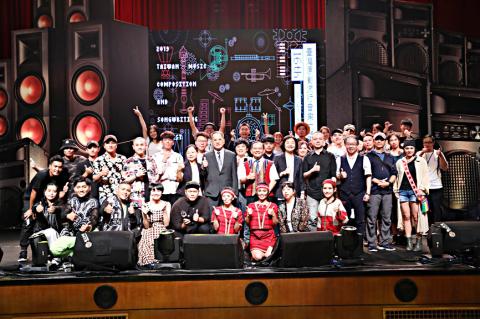
Photo: CNA
Accompanied by a cello, harmonium and set of drums, Su played an acoustic guitar while he sang his winning composition, Wu Ken Te Jih Tou Hua (無根的日頭花), which can be translated as “Sunflower Without Roots.”
The song tells of his personal story, Su said.
As a child, he grew up in Kaohsiung and went to Taipei to study law after graduating from high school.
Even though he has settled down in Taipei, the song describes his reminiscence for his hometown, he said.
“We all know that the sunflower continues to face the sun even if you cut off its roots,” he said. “So my heart is like a sunflower, it still feels for my hometown.”
In the Hakka category, 25-year-old acoustic guitar singer Chen Yen-chu (陳彥竹) reclaimed the title after winning it in 2017.
Her winning song, Niang Hua Pai Pai (娘花白白), which was performed as a solo, was written for her grandmother, who told her that the spirits of her late grandfather and uncle have been visiting the family’s farmland in Chiayi this year in the form of two black drongo birds.
In the indigenous languages category, a duo called Vusum Hana performed an upbeat and funky song named Jia Pe La (甲呸辣), which was not originally an Aboriginal term, but is used in the community to describe a person who takes advantage of friends by eating and drinking free of charge when they come to visit.
The duo, 27-year-old Suyu (林忠培) and 25-year-old Vulu (呂傑), cousins from a Paiwan community in Pingtung County, said the song is based on their observations of the people around them.
“We indigenous people have a culture where we share things, but sometimes the people who we share things with take it for granted and take advantage of people,” Suyu said.
“However, the song was not intended to create negativity, because the lyrics say: ‘I take advantage of you and you take advantage of me, but we are still very good friends,’” Vulu said.
The winners were given a cash prize of NT$300,000 each.

UPGRADE: The Kang Ding-class frigate is replacing its Chaparall missiles with Tien Chien II and Hua Yang VLS, which would provide it with long-range, 360° air defense Taiwan plans to produce 1,200 to 1,376 Hai Chien II missiles (海劍二, Sea Sword II) — also known as TC-2N — to serve as the standard air defense system of the navy’s surface combatant fleet, a source said yesterday. Last week, the Hai Chien II, the naval version of the Tien Kung II missile (天劍二, Sky Sword II), completed a live-fire test in waters off the National Chungshan Institute of Science and Technology’s Jiupeng facility (九鵬) in Pingtung County’s Manjhou Township (滿州). The MIM72 Chaparral and other dated air defense missiles that currently arm Taiwanese ships have inadequate range to combat Chinese

REASONS FOR TRAVEL: An assistant professor said that proposed amendments to penalize drivers if they used drugs overseas would not deter people from traveling People who operate a motor vehicle under the influence of marijuana would have their driver’s license revoked, even if they used the substance while overseas, the Ministry of Transportation and Communications said yesterday, citing proposed amendments to the Road Traffic Management and Penalty Act (道路交通管理處罰條例). The amendments would also authorize the government to revoke the licenses of people determined to have used Category 1 or Category 2 narcotics, even if they were not operating a vehicle while under the influence of drugs, as well as ban them from taking the license test for three years, the ministry said. People aged 18 or

GLOBALGIVING: ‘ Caving to external pressure is not acceptable for an organization that has cultivated justice reform and human rights for 30 years,’ one NGO said A slew of non-government organizations (NGOs) have withdrawn from the GlobalGiving fundraising platform after it announced it would use “Chinese Taipei” instead of “Taiwan” from next month. The Taiwan Good Rice Association wrote on Facebook on Friday that it was informed on April 28 via a teleconference call of the change, which was made because the platform wanted to operate in China. Taiwan Good Rice is to terminate all cooperative relationships with GlobalGiving in response to the platform’s “unilateral and non-negotiable” decision to remove references to Taiwan, the NGO said. “Taiwan is in the official name of Taiwan Good Rice Association and the

HEAVY WEATHER: Typhoon Jangmi is due to crash straight into the Ryukyus as airlines look to shift flights to larger aircraft or cancel flights to Okinawa entirely Taiwan’s international air carriers announced flight adjustments over the weekend as Typhoon Jangmi is forecast to hit the Ryukyu Islands today and tomorrow. The Central Weather Administration (CWA) upgraded Jangmi from a tropical storm to a typhoon at 8am yesterday, with the eye located 580km south of Naha city. It was moving north at 19kph. Today, China Airlines’ CI-120, CI-121, CI-122 and CI-123 flights between Taoyuan and Naha, Okinawa, have been canceled as well as CI-132 and CI-133 between Kaohsiung and Naha. EVA Air’s BR-112, BR-113, BR-186 and BR-185 flights between Taoyuan and Naha are also canceled. Low-cost carrier Tigerair Taiwan canceled IT-230,


 RSS
RSS