


A Council of Agriculture-led delegation is to travel to Moscow on Wednesday next week to take part in a two-day promotion of Taiwanese agricultural products.
Russia imports more than US$28 billion in agricultural produce, while yam exports to Russia could reach NT$300 per kilogram, the council said.
The quality of Taiwanese produce is undeniable, and while China, the US and Japan would remain the major export destinations for the nation’s agricultural products, the council is ready to develop a new market in Russia, as much of the produce grown in Taiwan is not found there, council Deputy Minister Chen Tien-shou (陳添壽) said.
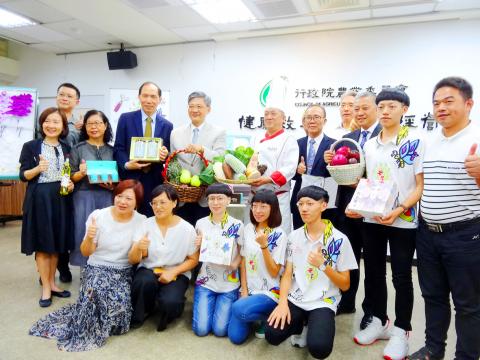
Photo: CNA
Department of West Asian and African Affairs Director Ali Yang (楊心怡) at the Ministry of Foreign Affairs (MOFA) said that the number of Russian tourists visiting Taiwan last year increased by 85 percent, or 10,000 individuals, from 2017.
MOFA Commonwealth of Independent States Section Director Chao Shih-hsuan (趙世絢) said that more than 8,000 Russian tourists arrived in the first half of the year, and more are expected before the end of the year.
Russian commercial representatives were impressed with Taiwanese produce and enjoyed mangoes, wax apples and pineapples, Yang said.
They were able to take some mangoes with them when they returned home, after they were cleared by the Bureau of Animal and Plant Health Inspection and Quarantine, she said.
Russians really likes mangoes, council Department of International Affairs section official Tang Shu-hua (唐淑華) said.
Russia’s predominate crop is potatoes, largely due to that nation’s climate, and the majority of the fruits and vegetables available there are imported, Tang said.
Russia imported US$28 billion in agricultural produce in 2017, while fruit imports last year reached US$5 billion, Tang said.
There are buyers even when retail prices for imported sweet potatoes reach NT$300 per kilogram, while a cluster of Taiwanese grapes has sold for NT$6,000, showing that Russia is a promising market, Tang added.
Local agricultural unions said that they support the delegation’s trip, as there could be a market in Russia in the fall for Taiwanese cabbage.
Orchid growers are also hoping to develop a direct export market in Russia for moth orchids.
At present, Taiwanese moth orchids are sent to Netherlands and then exported to Russia, Taiwan Floriculture Exports Association executive director Chuang Ping-huang (莊炳湟) said.
Since such orchids are a high-value product, growers could earn a higher revenue if they could be shipped directly to Russia, Chuang said.
Chang Shu-yi (張淑逸), an official with the Ministry of Economic Affairs’ Bureau of Foreign Trade, said that about 20 Russian importers of tea, coffee and agricultural produce have been invited to next week’s promotion.
The bureau was also planning to invite representatives of Russian chain supermarkets to visit Taiwan in October, Chang said.

ANOTHER EMERGES: The CWA yesterday said this year’s fourth storm of the typhoon season had formed in the South China Sea, but was not expected to affect Taiwan Tropical Storm Gaemi has intensified slightly as it heads toward Taiwan, where it is expected to affect the country in the coming days, the Central Weather Administration (CWA) said yesterday. As of 8am yesterday, the 120km-radius storm was 800km southeast of Oluanpi (鵝鑾鼻), Taiwan’s southernmost tip, moving at 9kph northwest, the agency said. A sea warning for Gaemi could be issued tonight at the earliest, it said, adding that the storm is projected to be closest to Taiwan on Wednesday or Thursday. Gaemi’s potential effect on Taiwan remains unclear, as that would depend on its direction, radius and intensity, forecasters said. Former Weather Forecast

As COVID-19 cases in Japan have been increasing for 10 consecutive weeks, people should get vaccinated before visiting the nation, the Centers for Disease Control (CDC) said. The centers reported 773 hospitalizations and 124 deaths related to COVID-19 in Taiwan last week. CDC Epidemic Intelligence Center Director Guo Hung-wei (郭宏偉) on Tuesday said the number of weekly COVID-19 cases reported in Japan has been increasing since mid-May and surpassed 55,000 cases from July 8 to July 14. The average number of COVID-19 patients at Japan’s healthcare facilities that week was also 1.39 times that of the week before and KP.3 is the dominant

The Chinese Communist Party’s (CCP) working group for Taiwan-related policies is likely to be upgraded to a committee-level body, a report commissioned by the Mainland Affairs Council (MAC) said. As Chinese President Xi Jinping (習近平) is increasingly likely to upgrade the CCP’s Central Leading Group for Taiwan Affairs, Taiwanese authorities should prepare by researching Xi and the CCP, the report said. At the third plenary session of the 20th Central Committee of the CCP, which ended on Thursday last week, the party set a target of 2029 for the completion of some tasks, meaning that Xi is likely preparing to

US-CHINA TRADE DISPUTE: Despite Beijing’s offer of preferential treatment, the lure of China has dimmed as Taiwanese and international investors move out Japan and the US have become the favored destinations for Taiwanese graduates as China’s attraction has waned over the years, the Ministry of Labor said. According to the ministry’s latest income and employment advisory published this month, 3,215 Taiwanese university graduates from the class of 2020 went to Japan, surpassing for the first time the 2,881 graduates who went to China. A total of 2,300 graduates from the class of 2021 went to the US, compared with the 2,262 who went to China, the document showed. The trend continued for the class of 2023, of whom 1,460 went to Japan, 1,334 went to


 RSS
RSS