


Taiwan’s oldest bodybuilder, Huang A-wen (黃阿文), nicknamed “Monster Grandpa,” has had a career spanning four decades, which is virtually a history of the sport in Taiwan.
The 66-year-old works as a bodybuilding coach and writes for the US-based Bodybuilding.com as its only Taiwanese contributor. He also appeared on television alongside octogenarian bodybuilder Jim Arrington of California in 2014.
He became aware of bodybuilding during its early years in Taiwan, Huang said, adding that contests were held infrequently near the Presidential Office Building in Taipei.

Photo: CNA
Later, he and a friend from high school went to a bodybuilding contest organized by a club for US military personnel at the Zhongshan Soccer Stadium, he said.
“I figured out what bodybuilding was when watching that event,” he said.
He decided to become a bodybuilder, but soon found that finding information about the sport was a struggle against press censorship.
“People had trouble finding magazines that bore images of women in bikinis and bodybuilding magazines were a big no-no,” he said. “People interested in the sport had to borrow or share the few rare copies they had.”
Finding gym equipment was also difficult and bodybuilding enthusiasts had to make do with what they could build in their backyard, Huang said.
“We poured concrete into tires and stuck a bamboo pole through them for dumbbells; for protein supplement, we ate soybeans and eggs, because there were no protein shakes like those available today,” he said.
During college, he joined a weightlifting and bodybuilding club and obtained formal training, but people made fun of him, Huang said.
“A common jibe was how the large chest muscles I had were going to sag in my old age,” Huang said. “The joke is on them, though, I am pretty sure the people who made fun of me are the ones sagging now.”
After completing his mandatory military service, Huang found an administrative job at a school and trained at night, putting himself through a strict regimen of diet and exercise, and eventually rose to become one of the nation’s leading bodybuilders in international contests.
Although retired, Huang runs a gym and continues to exercise, which has become a way of life for him.
“Your body becomes what you have done for it,” he said, adding that exercise, morning fruit shakes and three protein-rich meals a day of chicken, beef and eggs have helped him maintain a powerful physique.
He advised young people who want to get into shape to start working out, as there are no shortcuts or secrets to building muscles, except hard work, Huang said.
“Old people, myself included, would do well to stop reminiscing about the strong body and energy of our youths and start exercising right now, especially starting from the legs,” he said. “A few leg exercises while watching TV goes a long way in keeping yourself mobile and making you happier.”
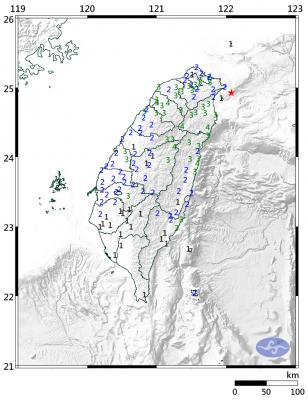
A magnitude 6.1 earthquake struck off the coast of Yilan County at 8:39pm tonight, the Central Weather Administration (CWA) said, with no immediate reports of damage or injuries. The epicenter was 38.7km east-northeast of Yilan County Hall at a focal depth of 98.3km, the CWA’s Seismological Center said. The quake’s maximum intensity, which gauges the actual physical effect of a seismic event, was a level 4 on Taiwan’s 7-tier intensity scale, the center said. That intensity level was recorded in Yilan County’s Nanao Township (南澳), Hsinchu County’s Guansi Township (關西), Nantou County’s Hehuanshan (合歡山) and Hualien County’s Yanliao (鹽寮). An intensity of 3 was

Instead of focusing solely on the threat of a full-scale military invasion, the US and its allies must prepare for a potential Chinese “quarantine” of Taiwan enforced through customs inspections, Stanford University Hoover fellow Eyck Freymann said in a Foreign Affairs article published on Wednesday. China could use various “gray zone” tactics in “reconfiguring the regional and ultimately the global economic order without a war,” said Freymann, who is also a nonresident research fellow at the US Naval War College. China might seize control of Taiwan’s links to the outside world by requiring all flights and ships entering or leaving Taiwan
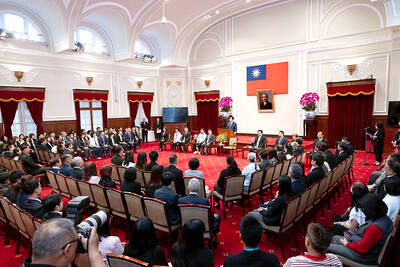
The next minimum wage hike is expected to exceed NT$30,000, President William Lai (賴清德) said yesterday during an award ceremony honoring “model workers,” including migrant workers, at the Presidential Office ahead of Workers’ Day today. Lai said he wished to thank the awardees on behalf of the nation and extend his most sincere respect for their hard work, on which Taiwan’s prosperity has been built. Lai specifically thanked 10 migrant workers selected for the award, saying that although they left their home countries to further their own goals, their efforts have benefited Taiwan as well. The nation’s industrial sector and small businesses lay
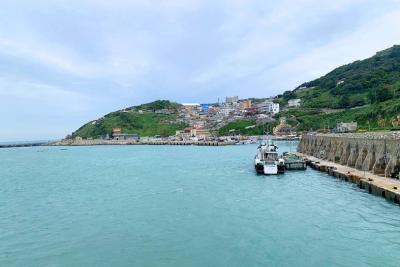
Taiwan has activated backup communications for its northernmost territory, the remote and strategically located island of Dongyin (東引), after poor weather conditions apparently shifted the wreckage of a ship onto an undersea cable causing it to break. The vulnerability of undersea communication cables linking Taiwan with its outlying islands has been a persistent cause of concern for Taipei, whose government has on several occasions blamed Chinese ships for intentionally causing damage. Dongyin, home to about 1,500 people, sits in a strategic position at the top of the Taiwan Strait and the island has a heavy military presence. It does not have an


 RSS
RSS