


A group of 76 academics yesterday established an alliance that aims to help gather public feedback to facilitate the development of government policy.
The Taiwan Citizen Front (台灣公民陣線) is to hold seminars, publish books and participate in movements to “communicate with the public, facilitate the adoption of public views by political parties, and promote social cohesion and a sense of community among Taiwanese,” it said.
The group said it launched the initiative yesterday to mark the fifth anniversary of the Sunflower movement.
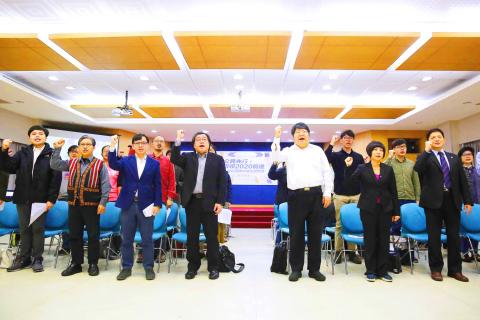
Photo: CNA
The group is confident that a majority of Taiwanese wish to preserve the nation’s sovereignty and de facto independence, and to deepen democratization, it said.
The results of last year’s local elections reflected the public’s sense that it is concerned over a lack of economic reform and discontent with “shallow” democratization, it said.
“Taiwan has undergone political democratization, but that democratization has yet to seep through to the economic, social and cultural levels,” group member Lai Chung-chiang (賴中強) said. “Because of this, conservative elements can quickly assemble and counterattack.”
At the same time, Taiwan faces threats from China, which seek to weaken its democracy, Lai said, adding that the group is “very worried” and felt compelled to take action.
The group would aim to bolster progressive values and to promote a national identity rooted in such values, including sustainability and equality, it said.
It would also aim to help establish a majority consensus on major political issues by engaging the public and political parties by means of talks, seminars and publications, the group said.
It said it has listed five immediate goals: promoting an innovative economy driven by progressive values; promoting government investment in individuals and families through social policies; establishing a mechanism to protect Taiwan’s democracy; creating a mechanism for citizen response to information warfare; and offering an online public-governance platform.

ANOTHER EMERGES: The CWA yesterday said this year’s fourth storm of the typhoon season had formed in the South China Sea, but was not expected to affect Taiwan Tropical Storm Gaemi has intensified slightly as it heads toward Taiwan, where it is expected to affect the country in the coming days, the Central Weather Administration (CWA) said yesterday. As of 8am yesterday, the 120km-radius storm was 800km southeast of Oluanpi (鵝鑾鼻), Taiwan’s southernmost tip, moving at 9kph northwest, the agency said. A sea warning for Gaemi could be issued tonight at the earliest, it said, adding that the storm is projected to be closest to Taiwan on Wednesday or Thursday. Gaemi’s potential effect on Taiwan remains unclear, as that would depend on its direction, radius and intensity, forecasters said. Former Weather Forecast

As COVID-19 cases in Japan have been increasing for 10 consecutive weeks, people should get vaccinated before visiting the nation, the Centers for Disease Control (CDC) said. The centers reported 773 hospitalizations and 124 deaths related to COVID-19 in Taiwan last week. CDC Epidemic Intelligence Center Director Guo Hung-wei (郭宏偉) on Tuesday said the number of weekly COVID-19 cases reported in Japan has been increasing since mid-May and surpassed 55,000 cases from July 8 to July 14. The average number of COVID-19 patients at Japan’s healthcare facilities that week was also 1.39 times that of the week before and KP.3 is the dominant

The Chinese Communist Party’s (CCP) working group for Taiwan-related policies is likely to be upgraded to a committee-level body, a report commissioned by the Mainland Affairs Council (MAC) said. As Chinese President Xi Jinping (習近平) is increasingly likely to upgrade the CCP’s Central Leading Group for Taiwan Affairs, Taiwanese authorities should prepare by researching Xi and the CCP, the report said. At the third plenary session of the 20th Central Committee of the CCP, which ended on Thursday last week, the party set a target of 2029 for the completion of some tasks, meaning that Xi is likely preparing to

US-CHINA TRADE DISPUTE: Despite Beijing’s offer of preferential treatment, the lure of China has dimmed as Taiwanese and international investors move out Japan and the US have become the favored destinations for Taiwanese graduates as China’s attraction has waned over the years, the Ministry of Labor said. According to the ministry’s latest income and employment advisory published this month, 3,215 Taiwanese university graduates from the class of 2020 went to Japan, surpassing for the first time the 2,881 graduates who went to China. A total of 2,300 graduates from the class of 2021 went to the US, compared with the 2,262 who went to China, the document showed. The trend continued for the class of 2023, of whom 1,460 went to Japan, 1,334 went to


 RSS
RSS