


As Beijing grows wary of pro-independence groups seeking to forge closer ties in Taiwan and Hong Kong, activists say they are coming under increased surveillance and harassment from pro-China media outlets and unofficial “operatives.”
Visits to Taiwan in January by several Hong Kong rights advocates, including Tony Chung (鍾翰林), generated heavy coverage by two pro-China newspapers, including detailed reports of their movements and meetings.
The coverage prompted Taiwan to investigate the activities of the Hong Kong-based Wen Wei Po and Ta Kung Pao on “national security” grounds.
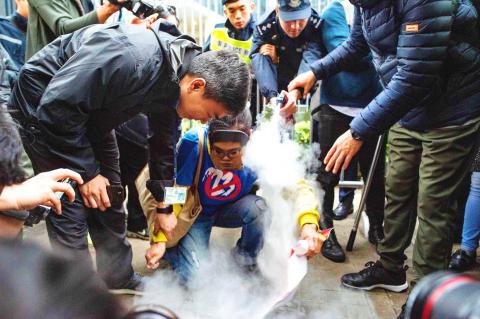
Photo: AFP
The government found that the newspapers committed “unlawful” acts, including invasive surveillance, and spread “fake news.”
Officials said that journalists from the papers would be banned from traveling to Taiwan for up to three years if the media outlets did not provide a “reasonable explanation” for their activities there.
An examination of both papers’ articles show that at least 25 people linked to anti-China and independence causes have been the subject of intense coverage, including covert photography and the reporting of personal details, in Taiwan in the past three years.
The Ta Kung Pao and Wen Wei Po did not respond to a request for comment.
Such papers, which typically take a pro-Beijing stance, would be expected to pay close attention to people pursuing causes that upset the Chinese government.
However, rights advocates say that their coverage stretches into the realm of harassment, including surveillance on overseas trips, and publishing details of their private lives, including homes, work and daily movements.
“It’s obvious that there’s intervention from outside forces with an aim to intimidate people,” Mainland Affairs Council Deputy Minister Chiu Chui-cheng (邱垂正) said, referring to the coverage from the pro-China papers.
The coverage raised concerns about the activities of “Chinese and Hong Kong intelligence operatives” in Taiwan, including people working for pro-China media outlets, Chiu said.
Activists have also been physically attacked during trips to Taiwan.
In July last year, two Taiwanese were convicted of assaulting Hong Kongers meeting with independence advocates in Taiwan. Three Hong Kong men were later named in Taiwanese media coverage as helping facilitate the attack.
“I was followed until I almost left the airport,” Andy Chan (陳浩天), convener of the Hong Kong National Party, said of his time in Taiwan. “There are operatives for China everywhere.”
In an annual report to the US Congress, the US-China Economic and Security Review Commission in November last year said that since President Tsai Ing-wen (蔡英文) took office in 2016, Beijing has feared “collusion between ‘separatist forces’ in Taiwan and Hong Kong.”
“Beijing is trying everything in its power to prevent this,” said a security source in the government, who declined to be named.
The source and a second security official involved in national security say that China has been quietly ramping up the number of intelligence operatives in Taiwan and Hong Kong.
Wu Jieh-min (吳介民), a Taiwanese academic who has researched civil movements in Taiwan and Hong Kong, and was barred from entering Hong Kong for an academic conference in late 2016, said Beijing is “very worried about the exchange of ideas.”
“If the ideas of civil society are not hindered, their power will be greatly enhanced,” Wu said.
Wu said that mass, protracted protests in Taiwan and Hong Kong in 2014 that railed against Chinese interference were a catalyst for deepening activist ties on both sides.
China’s Taiwan Affairs Office and its main representative body in Hong Kong, the Liaison Office, did not respond to requests for comment.
The Wen Wei Po has also paid close attention to foreigners in contact with Hong Kong rights advocates.
In December last year, Wen Wei Pao reporters and photographers covered the daily activities of Kevin Carrico, an Australia-based political scientist, during a visit to Hong Kong in which he met with independence advocates, and featured him on the front page.
“I was a little creeped out by the fact that the article discussed my presentation. There were only 15 people there,” Carrico said of a private meeting in the basement of a Hong Kong building.
He said that there had been “a real escalation of Beijing’s political operations in Hong Kong.”
Activists in Taiwan and Hong Kong describe an increase in unknown individuals shadowing their meetings and events, sometimes taking photographs or recording their conversations.
In some cases, activists have been attacked and the assailants identified.
Two Taiwanese, Chang Chih-min (張志民) and China-born Zhang Xiuye (張秀葉), in July last year were found guilty of a 2016 assault on two Hong Kong independence avocates, Andy Chan and Jason Chow (周祖菴), at a Taipei hotel.
Zhang and Chang were convicted of defamation and fined NT$6,000 and NT$8,000 respectively. Chang was also found guilty of “intimidating and endangering the safety” of Chan.
Zhang and Chang were among at least eight people who beat Chan and Chow and called them China “traitors” at the Caesar Park Hotel, Taipei court documents show.
Chan said he was at the hotel to meet with a journalist with a little-known Hong Kong publication called Pacific Magazine.
Zhang is a senior member of the Chinese Concentric Patriotism Party, which advocates unification of Taiwan and China.
“It was purely an accident” that they ran into Chan at the hotel, Zhang said.

LOUD AND PROUD Taiwan might have taken a drubbing against Australia and Japan, but you might not know it from the enthusiasm and numbers of the fans Taiwan might not be expected to win the World Baseball Classic (WBC) but their fans are making their presence felt in Tokyo, with tens of thousands decked out in the team’s blue, blowing horns and singing songs. Taiwanese fans have packed out the Tokyo Dome for all three of their games so far and even threatened to drown out home team supporters when their team played Japan on Friday. They blew trumpets, chanted for their favorite players and had their own cheerleading squad who dance on a stage during the game. The team struggled to match that exuberance on the field, with
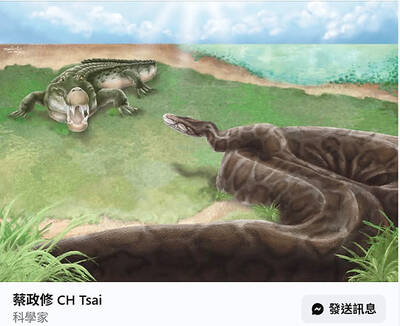
Taiwanese paleontologists have discovered fossil evidence that pythons up to 4m long inhabited Taiwan during the Pleistocene epoch, reporting their findings in the international scientific journal Historical Biology. National Taiwan University (NTU) Institute of Ecology and Evolutionary Biology associate professor Tsai Cheng-hsiu (蔡政修) led the team that discovered the largest snake fossil ever found in Taiwan. The single trunk vertebra was discovered in Tainan at the Chiting Formation, dated to between 400,000 and 800,000 years ago in the Middle Pleistocene, the paper said. The area also produced Taiwan’s first avian fossil, as well as crocodile, mammoth, saber-toothed cat and rhinoceros fossils, it said. Discoveries

Taiwanese paleontologists have discovered fossil evidence that pythons up to 4m long inhabited Taiwan during the Pleistocene epoch, reporting their findings in the international scientific journal Historical Biology. National Taiwan University (NTU) Institute of Ecology and Evolutionary Biology associate professor Tsai Cheng-hsiu (蔡政修) led the team that discovered the largest snake fossil ever found in Taiwan. A single trunk vertebra was discovered in Tainan at the Chiting Formation, dated to between 800,000 to 400,000 years ago in the Middle Pleistocene, the paper said. The area also produced Taiwan’s first avian fossil, as well as crocodile, mammoth, sabre-toothed cat and rhinoceros fossils, it said. Discoveries
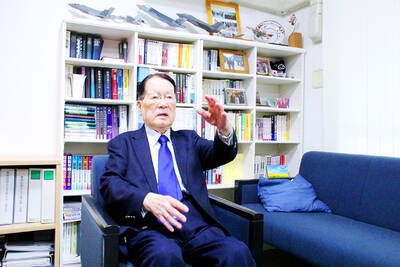
Whether Japan would help defend Taiwan in case of a cross-strait conflict would depend on the US and the extent to which Japan would be allowed to act under the US-Japan Security Treaty, former Japanese minister of defense Satoshi Morimoto said. As China has not given up on the idea of invading Taiwan by force, to what extent Japan could support US military action would hinge on Washington’s intention and its negotiation with Tokyo, Morimoto said in an interview with the Liberty Times (sister paper of the Taipei Times) yesterday. There has to be sufficient mutual recognition of how Japan could provide


 RSS
RSS