


Taipei’s eastern shopping districts are suffering because rent is kept high and the city government is looking for solutions to the issue, Taipei Mayor Ko Wen-je (柯文哲) said on Friday.
Ko made the remarks during a radio interview with Huang Kuang-chin (黃光芹).
Huang asked Ko to comment on a remark by actress Eva Lo (羅霈穎), who said on Facebook on Feb. 13: “Mayor Ko, please revive Taipei and let the eastern shopping district return to life. We want it to be bustling like Kaohsiung. Please care about Taipei residents rather than [thinking about] running for president.”
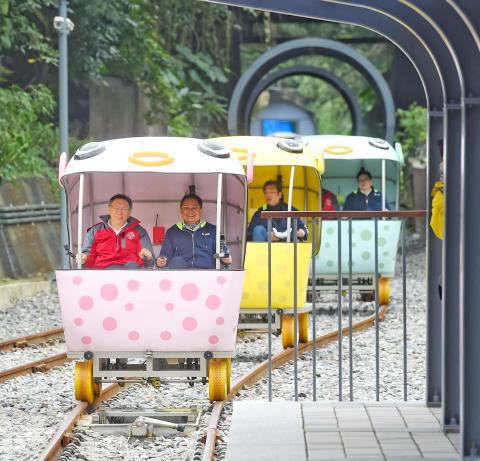
Photo: Fang Pin-chao, Taipei Times
Cash flow in Taipei has remained steady over the past four years, Ko said, adding that he worked hard to revive the city’s western areas in his first term, so the eastern areas might have fallen behind.
One solution would be to increase cash flow, he said, adding that property owners in shopping districts are unwilling to lower rent, even if they do not have tenants.
“We are thinking about increasing property taxes for empty storefront properties,” Ko said. “I think we should lower taxes on self-occupied properties that are the only one the owner has ... but the current cost of holding onto an empty storefront property without renting it is too low.”
“Frankly, high rent increases already high property prices,” he said, adding that people live in suburban areas because of high prices in downtown areas.
“However, it is difficult to operate a store in a suburban area and start-ups commonly spend all their profit on high rent,” he said.
Ko yesterday said that lowering taxes on single self-occupied properties would his administration’s top priority, because a home is a basic necessity, but using a storefront site to collect high rent and even leaving it empty instead of lowering the rent is a different situation.
Tax policy is a serious issue, so decisions would not be rushed, he said.

Taiwan's Vice President Hsiao Bi-khim (蕭美琴) said Saturday that she would not be intimidated by the Chinese Communist Party (CCP), following reports that Chinese agents planned to ram her car during a visit to the Czech Republic last year. "I had a great visit to Prague & thank the Czech authorities for their hospitality & ensuring my safety," Hsiao said on social media platform X. "The CCP's unlawful activities will NOT intimidate me from voicing Taiwan's interests in the international community," she wrote. Hsiao visited the Czech Republic on March 18 last year as vice president-elect and met with Czech Senate leadership, including

There have been clear signs of Chinese Communist Party (CCP) attempts to interfere in the nationwide recall vote on July 26 in support of Chinese Nationalist Party (KMT) legislators facing recall, an unnamed government official said, warning about possible further actions. The CCP is actively involved in Taiwanese politics, and interference in the recall vote is to be expected, with multiple Chinese state media and TAO attempts to discredit the Democratic Progressive Party (DPP) and undermine public support of their recall movement, the official said. This interference includes a smear campaign initiated this month by a pro-Beijing Hong Kong news outlet against

A week-long exhibition on modern Tibetan history and the Dalai Lama’s global advocacy opened yesterday in Taipei, featuring quotes and artworks highlighting human rights and China’s ongoing repression of Tibetans, Hong Kongers and Uighurs. The exhibition, the first organized by the Human Rights Network for Tibet and Taiwan (HRNTT), is titled “From the Snowy Ridges to the Ocean of Wisdom.” “It would be impossible for Tibetans inside Tibet to hold an exhibition like this — we can do it. because we live in a free and democratic country,” HRNTT secretary-general Tashi Tsering said. Tashi Tsering, a Taiwan-based Tibetan who has never
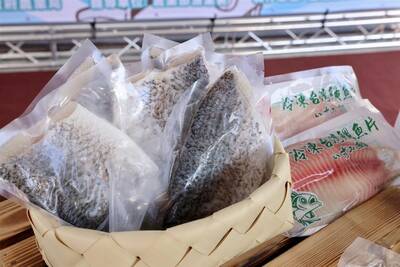
A first shipment of five tons of Taiwan tilapia was sent from Tainan to Singapore on Wednesday, following an order valued at NT$600,000 (US$20,500) placed with a company in the city. The products, including frozen whole fish and pre- cooked fish belly, were dispatched from Jiangjun Fishing Harbor, where a new aquatic processing and logistics center is under construction. At the launch, Tainan Mayor Huang Wei-che (黃偉哲) called the move a “breakthrough,” marking Taiwan’s expansion into the Singaporean tilapia market. Taiwan’s tilapia exports have traditionally focused on the United States, Canada, and the Middle East, Huang said, adding that the new foothold in


 RSS
RSS