


Chinese Nationalist Party (KMT) Legislator Wang Jin-pyng (王金平) on Saturday said that his intent to run for president was motivated by the poor state of cross-strait relations.
Wang made the remarks during a speech to supporters at a reunion at National Tainan First Senior High School, where he said that he “would not run in an election at my age if Taiwan did not need help.”
After beating around the bush for months, Wang, 77, on Wednesday last week said that he would launch a presidential bid next month.
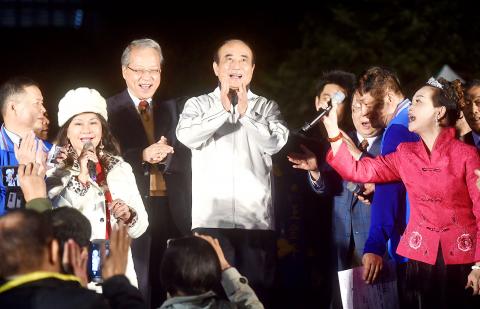
Photo: Chien Jung-fong, Taipei Times
On Saturday, Wang, who was the legislative speaker from 1999 to 2016, staunchly rejected criticism that he is secretly a pan-green supporter.
Wang said he is “for the KMT and for Taiwan,” and even though he is Taiwanese, he could not reject his ethnic-Chinese “soul.”
“The current state of cross-strait relations is not peaceful. It is nothing like during [former president] Ma Ying-jeou’s (馬英九) administration, when we had cooperative exchanges and room for discourse,” he said.
Pressure from China to unify is mounting, but neither unification nor official independence can easily be achieved, Wang said, adding that peace could not be maintained without President Tsai Ing-wen (蔡英文) acknowledging the “1992 consensus.”
The “1992 consensus” — a term former Mainland Affairs Council chairman Su Chi (蘇起) admitted making up in 2000 — refers to a tacit understanding between the KMT and the Chinese Communist Party that both sides acknowledge there is “one China,” with each side having its own interpretation of what “China” means.
The lack of exchanges between Taiwan and China has harmed the public, Wang said, adding that it is his urgent public duty to mend and rebuild the cross-strait relationship.
The “1992 consensus” is just a phrase, but it gives China “face” and gives Taiwan “ambiguous space” to maneuver, he said.
The Democratic Progressive Party’s policies are making Taiwan’s path ever narrower and the US is only acting for its own benefit with regard to Taiwan, he said.
If cross-strait relations were good, the US would not be “so demanding” and Taiwan would have more space to assert its own position, he added.
“Taiwan would not need to do as the US wishes,” he said.
He said he aims to present five demands regarding Taiwan to China “if the two sides agree,” but he would not present the demands in front of the media until there is an agreement “to avoid lots of people giving their views.”
Wang said he had not decided whether he would visit the US to discuss his view.
Such a trip is not a must, as the US regularly sends people to Taiwan to exchange views with him, he said.

ANOTHER EMERGES: The CWA yesterday said this year’s fourth storm of the typhoon season had formed in the South China Sea, but was not expected to affect Taiwan Tropical Storm Gaemi has intensified slightly as it heads toward Taiwan, where it is expected to affect the country in the coming days, the Central Weather Administration (CWA) said yesterday. As of 8am yesterday, the 120km-radius storm was 800km southeast of Oluanpi (鵝鑾鼻), Taiwan’s southernmost tip, moving at 9kph northwest, the agency said. A sea warning for Gaemi could be issued tonight at the earliest, it said, adding that the storm is projected to be closest to Taiwan on Wednesday or Thursday. Gaemi’s potential effect on Taiwan remains unclear, as that would depend on its direction, radius and intensity, forecasters said. Former Weather Forecast

As COVID-19 cases in Japan have been increasing for 10 consecutive weeks, people should get vaccinated before visiting the nation, the Centers for Disease Control (CDC) said. The centers reported 773 hospitalizations and 124 deaths related to COVID-19 in Taiwan last week. CDC Epidemic Intelligence Center Director Guo Hung-wei (郭宏偉) on Tuesday said the number of weekly COVID-19 cases reported in Japan has been increasing since mid-May and surpassed 55,000 cases from July 8 to July 14. The average number of COVID-19 patients at Japan’s healthcare facilities that week was also 1.39 times that of the week before and KP.3 is the dominant

The Chinese Communist Party’s (CCP) working group for Taiwan-related policies is likely to be upgraded to a committee-level body, a report commissioned by the Mainland Affairs Council (MAC) said. As Chinese President Xi Jinping (習近平) is increasingly likely to upgrade the CCP’s Central Leading Group for Taiwan Affairs, Taiwanese authorities should prepare by researching Xi and the CCP, the report said. At the third plenary session of the 20th Central Committee of the CCP, which ended on Thursday last week, the party set a target of 2029 for the completion of some tasks, meaning that Xi is likely preparing to

US-CHINA TRADE DISPUTE: Despite Beijing’s offer of preferential treatment, the lure of China has dimmed as Taiwanese and international investors move out Japan and the US have become the favored destinations for Taiwanese graduates as China’s attraction has waned over the years, the Ministry of Labor said. According to the ministry’s latest income and employment advisory published this month, 3,215 Taiwanese university graduates from the class of 2020 went to Japan, surpassing for the first time the 2,881 graduates who went to China. A total of 2,300 graduates from the class of 2021 went to the US, compared with the 2,262 who went to China, the document showed. The trend continued for the class of 2023, of whom 1,460 went to Japan, 1,334 went to


 RSS
RSS