


President Tsai Ing-wen (蔡英文) is slated to visit NASA’s Johnson Space Center in Houston, Texas, today — a visit of political significance, as it would be the first time a president from Taiwan has entered a US federal building in their official capacity after US President Donald Trump signed the Taiwan Travel Act in March.
The Taiwan Travel Act allows high-level US officials to visit Taiwan and vice versa, breaking from previous US policy that did not permit bilateral visits by Cabinet-level ministers, but allowed Taiwanese presidents to transit through US cities en route to other countries.
Tsai arrived in Los Angeles on Sunday last week en route to Paraguay and Belize, two of Taiwan’s 18 diplomatic allies. On her return trip, she arrived in Houston yesterday for a 27-hour transit.
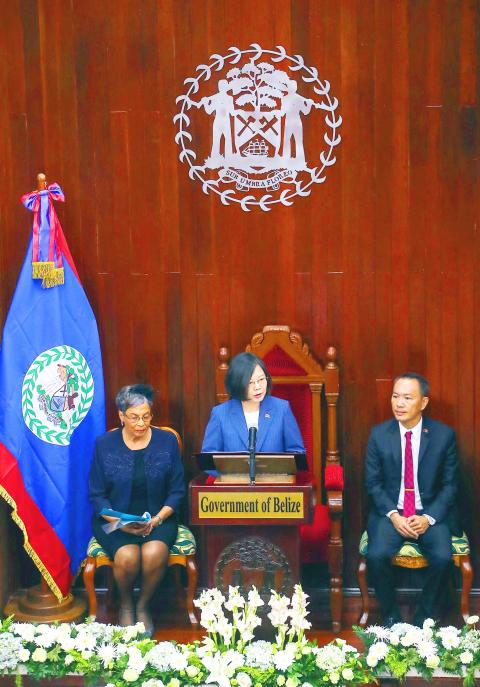
Photo: CNA
The president is to return to Taiwan late tomorrow.
Speaking to reporters accompanying her on the trip, Tsai on Friday said that Washington followed its four principles of providing travelers “safety, comfort, convenience and dignity,” as it has done in the past.
“I am grateful to the US for arranging the stopovers,” Tsai said.
When Tsai was in Los Angeles, she visited the Taipei Economic and Cultural Office’s Culture Center, making her the first Taiwanese president to visit one of the country’s representative offices in the US.
She also gave a speech at the Ronald Reagan Presidential Library, her first public address in the US since she became president.
Earlier on Friday when speaking at the Belizean National Assembly, Tsai promised to strengthen cooperation with the Central American country in various fields, including education, economy, agriculture and infrastructure.
In her address, Tsai said that Taiwan would increase its number of scholarship students from Belize and would invite young Belizeans to join short-term vocational training programs in Taiwan.
The country would also work with Belize’s Institute for Technical, Vocational and Educational Training to improve the quality of vocational education in Belize to better prepare young people for the job market, Tsai said.
In terms of the economy, she said she would continue to encourage delegations from Taiwan’s business sector to visit Belize and develop further trade relationships with the cocoa and coffee industries there.
Bilateral ties between Taiwan and Belize would also be enhanced via Taiwan’s Official Development Assistance program, which would assist Belize in improving its infrastructure, including the construction of new roads and hospitals, Tsai said.
Taiwan’s longstanding friendship with Belize is also manifested by its dedication to helping its ally provide medical care and restore its cultural heritage, Tsai said.
“The friendship between Taiwan and Belize is not built on empty promises or the political whims of our leadership. This is a friendship that, for the past 29 years, has led to results; results that have benefited people from both countries,” Tsai said.
Additional reporting by Su Yung-yao

ANOTHER EMERGES: The CWA yesterday said this year’s fourth storm of the typhoon season had formed in the South China Sea, but was not expected to affect Taiwan Tropical Storm Gaemi has intensified slightly as it heads toward Taiwan, where it is expected to affect the country in the coming days, the Central Weather Administration (CWA) said yesterday. As of 8am yesterday, the 120km-radius storm was 800km southeast of Oluanpi (鵝鑾鼻), Taiwan’s southernmost tip, moving at 9kph northwest, the agency said. A sea warning for Gaemi could be issued tonight at the earliest, it said, adding that the storm is projected to be closest to Taiwan on Wednesday or Thursday. Gaemi’s potential effect on Taiwan remains unclear, as that would depend on its direction, radius and intensity, forecasters said. Former Weather Forecast

As COVID-19 cases in Japan have been increasing for 10 consecutive weeks, people should get vaccinated before visiting the nation, the Centers for Disease Control (CDC) said. The centers reported 773 hospitalizations and 124 deaths related to COVID-19 in Taiwan last week. CDC Epidemic Intelligence Center Director Guo Hung-wei (郭宏偉) on Tuesday said the number of weekly COVID-19 cases reported in Japan has been increasing since mid-May and surpassed 55,000 cases from July 8 to July 14. The average number of COVID-19 patients at Japan’s healthcare facilities that week was also 1.39 times that of the week before and KP.3 is the dominant

The Chinese Communist Party’s (CCP) working group for Taiwan-related policies is likely to be upgraded to a committee-level body, a report commissioned by the Mainland Affairs Council (MAC) said. As Chinese President Xi Jinping (習近平) is increasingly likely to upgrade the CCP’s Central Leading Group for Taiwan Affairs, Taiwanese authorities should prepare by researching Xi and the CCP, the report said. At the third plenary session of the 20th Central Committee of the CCP, which ended on Thursday last week, the party set a target of 2029 for the completion of some tasks, meaning that Xi is likely preparing to

US-CHINA TRADE DISPUTE: Despite Beijing’s offer of preferential treatment, the lure of China has dimmed as Taiwanese and international investors move out Japan and the US have become the favored destinations for Taiwanese graduates as China’s attraction has waned over the years, the Ministry of Labor said. According to the ministry’s latest income and employment advisory published this month, 3,215 Taiwanese university graduates from the class of 2020 went to Japan, surpassing for the first time the 2,881 graduates who went to China. A total of 2,300 graduates from the class of 2021 went to the US, compared with the 2,262 who went to China, the document showed. The trend continued for the class of 2023, of whom 1,460 went to Japan, 1,334 went to


 RSS
RSS