


Groups yesterday criticized the Taipei Department of Cultural Affairs’ decision to alter the design of city mascot Bravo the Bear and called for the version used at last year’s Summer Universiade to be brought back.
One should not seek to make changes, even the most minute, to the original creation, Humanistic Education Foundation president Shih Ying (史英) said.
Such changes to the Mona Lisa would not be accepted, Shih said.
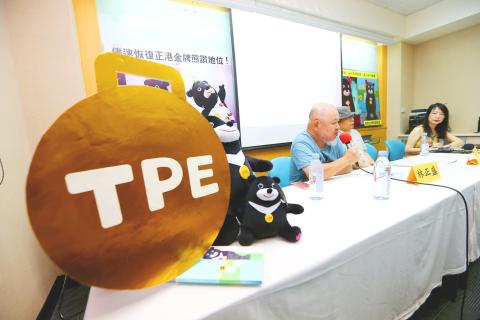
Photo: CNA
Taipei Mayor Ko Wen-je (柯文哲) and his team are blinded by the arrogance of those in power and cannot see that people have become attached to the original, Shih said.
Ko did not have a satisfactory explanation for the change, director Lin Cheng-sheng (林正盛) said, adding that no culture has ever been created using a standard operating procedure.
The previous version of the mascot is a physical symbol representing the past, and such collective memories should be preserved, Lin said.
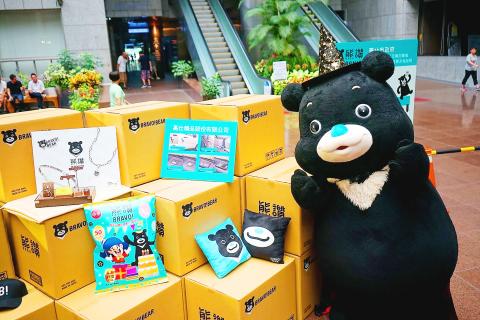
Photo provided by the Taipei Department of Information and Tourism
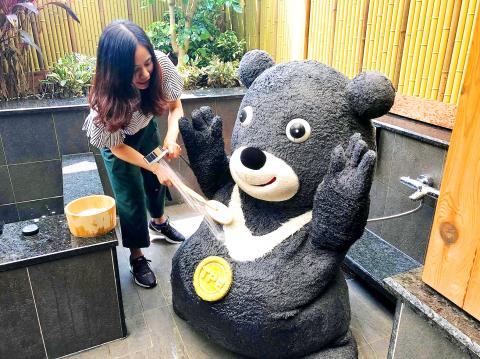
There have been three versions of the mascot: A Formosan black bear was used first, before a gold-medal version was designed after Ko conferred a medal to the mascot at a post-Universiade event. An “ocean” version, named for the color of its nose, was announced as the city’s mascot in April.
A petition — launched by the Save the Universiade Version of Bravo the Bear Alliance — has garnered signatures from athletes, including table tennis player Lee Chia-sheng (李佳陞) and billiards champion Hsu Jui-an (許睿安).
The gold-medal version is what the public remembers and, as such, it represents Taipei well, alliance spokesperson Chiang Wen-yu (江文瑜) said.
Screengrab from Bravo’s fan page
Changing it because getting past trademark issues was an issue and claiming that the mascot was not well-known is absurd, Chiang said.
Chiang said that Trino Creative had avoided an open bid for the project as stipulated by the Government Procurement Act (政府採購法) for all government contracts worth more than NT$1 million (US$32,567) by submitting a proposal at NT$980,000.
Chiang said the Taipei Department of Information and Tourism, having authorized the ocean Bravo on Aug. 2, had failed to obtain trademark approval for the version.
The ocean Bravo was designed because trademark rights for the gold-medal version could not be obtained.
Department of Information and Tourism Director Chen Ssu-yu (陳思宇) could not be reached for comment.
Department worker Hung Yi-chun (洪怡君) said that information on the latest design has been published online.
It is possible that both versions will make an appearance at events marking the first anniversary of the Universiade, Hung said, adding that the Intellectual Property Office was still reviewing a trademark application for ocean Bravo and would have an answer by the end of this month.
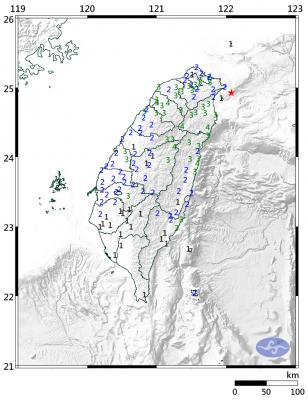
A magnitude 6.1 earthquake struck off the coast of Yilan County at 8:39pm tonight, the Central Weather Administration (CWA) said, with no immediate reports of damage or injuries. The epicenter was 38.7km east-northeast of Yilan County Hall at a focal depth of 98.3km, the CWA’s Seismological Center said. The quake’s maximum intensity, which gauges the actual physical effect of a seismic event, was a level 4 on Taiwan’s 7-tier intensity scale, the center said. That intensity level was recorded in Yilan County’s Nanao Township (南澳), Hsinchu County’s Guansi Township (關西), Nantou County’s Hehuanshan (合歡山) and Hualien County’s Yanliao (鹽寮). An intensity of 3 was
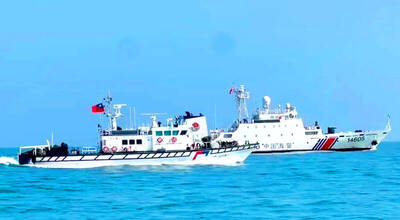
Instead of focusing solely on the threat of a full-scale military invasion, the US and its allies must prepare for a potential Chinese “quarantine” of Taiwan enforced through customs inspections, Stanford University Hoover fellow Eyck Freymann said in a Foreign Affairs article published on Wednesday. China could use various “gray zone” tactics in “reconfiguring the regional and ultimately the global economic order without a war,” said Freymann, who is also a nonresident research fellow at the US Naval War College. China might seize control of Taiwan’s links to the outside world by requiring all flights and ships entering or leaving Taiwan
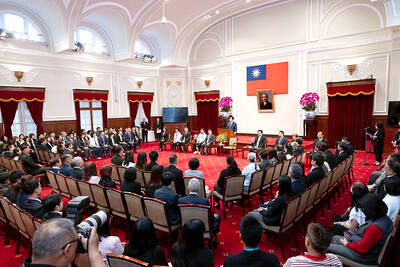
The next minimum wage hike is expected to exceed NT$30,000, President William Lai (賴清德) said yesterday during an award ceremony honoring “model workers,” including migrant workers, at the Presidential Office ahead of Workers’ Day today. Lai said he wished to thank the awardees on behalf of the nation and extend his most sincere respect for their hard work, on which Taiwan’s prosperity has been built. Lai specifically thanked 10 migrant workers selected for the award, saying that although they left their home countries to further their own goals, their efforts have benefited Taiwan as well. The nation’s industrial sector and small businesses lay
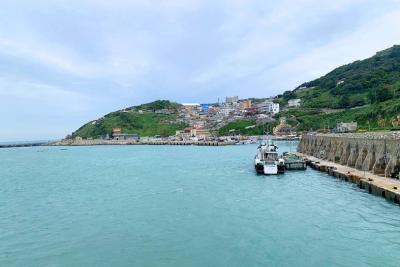
Taiwan has activated backup communications for its northernmost territory, the remote and strategically located island of Dongyin (東引), after poor weather conditions apparently shifted the wreckage of a ship onto an undersea cable causing it to break. The vulnerability of undersea communication cables linking Taiwan with its outlying islands has been a persistent cause of concern for Taipei, whose government has on several occasions blamed Chinese ships for intentionally causing damage. Dongyin, home to about 1,500 people, sits in a strategic position at the top of the Taiwan Strait and the island has a heavy military presence. It does not have an


 RSS
RSS