


Chinese President Xi Jinping (習近平) is making unification a more important component of his “China Dream,” despite Taipei’s pledges to maintain peace in the Taiwan Strait and to preserve the “status quo” in cross-strait relations, a US-based foreign and defense policy commentator said.
“Tensions are rising between Beijing and Taipei,” American Enterprise Institute foreign and defense policy studies research fellow Michael Mazza said in an article titled “Is a Storm Brewing in the Taiwan Strait?” published by the Council on Foreign Relations on Friday.
Mazza linked Beijing’s increasing pressure on Taiwan with Xi’s vision for the future of China, or “China Dream,” of which Xi has made unification an important component.
Xi “began talking about the ‘great renewal of the Chinese nation’ — which, for him, requires formal unification with Taiwan — during a speech he gave in 2012 as general secretary of the Chinese Communist Party [CCP],” Mazza said.
Xi last year at the CCP’s 19th National Congress said that by mid-century, the party would “develop China into a great modern socialist country that is prosperous, strong, democratic, culturally advanced, harmonious and beautiful,” Mazza said.
“If Xi turns out to be unable to deliver on his promises of economic prosperity for all Chinese people, as may well be the case, the other components of the China Dream will become more important,” Mazza said, referring to the unification of China and Taiwan.
Taiwan has proven itself a responsible actor in East Asia and would seek to avert a potentially cataclysmic collision “as long as doing so does not require submitting to Beijing,” Mazza said.
However, whether Beijing will accept anything less than submission is not at all clear, he said.
“The Taiwan Strait is already known for its strong winds and choppy waters — but rougher seas lie ahead,” Mazza said.

FUKUOKA SITUATION: Japanese media reported that the pathogen is expected to be identified by the summer, while the CDC downplayed the idea that it was hMPV A “mysterious cold-like illness” reported in Japan’s Fukuoka Prefecture does not seem to be a new disease, but Japanese authorities have been asked about the situation, the Centers for Disease Control (CDC) said yesterday. The Fukuoka Prefectural Medical Association on Wednesday told a news conference that a “mystery cold” that has become a hot topic on social media is “highly likely to be caused by some kind of viral infection,” Japan’s KBC News reported. “Many people are experiencing symptoms starting with a sore throat, followed by a runny nose, phlegm and a severe cough,” KBC News reported, citing association officials. Health authorities are

Nvidia Corp CEO Jensen Huang (黃仁勳) arrived in Taiwan yesterday ahead of upcoming AI and technology events, saying he plans to meet with clients and Taiwan Semiconductor Manufacturing Co Chairman C.C. Wei (魏哲家) during his visit. After landing at Taipei Songshan Airport, Huang posed for photos with fans and handed out Yakult drinks to reporters and supporters waiting at the scene, saying he has “a lot to do” during the trip. Asked about reports that Nvidia’s planned headquarters site in Taipei’s Beitou Shilin Technology Park could break ground on May 27, Huang said that if the company holds an event, he would

The Ministry of Finance this afternoon announced the winning numbers for the March-April uniform invoice lottery. The winning number for the NT$10 million (US$318,060) special prize is 19531471, and the winning number for the NT$2 million grand prize is 85941329. Three numbers were drawn for the NT$200,000 first prize: 07225810, 20231230 and 83518781. Those with receipts matching the last seven digits of any of the first-prize numbers will win the NT$40,000 second prize, while those matching the last six digits will win the NT$10,000 third prize. Those whose receipts match the last five digits of the first-prize numbers can claim the NT$4,000 fourth prize,
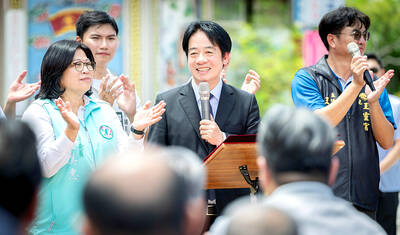
SIX SUBSIDIES: The monthly allowance for older farmers is to increase to NT$10,000, and NT$5,000 is to be given to homemakers under the national pension system, Lai said The government is to implement major welfare policies for disadvantaged groups, including raising the monthly allowance for older farmers to NT$10,000 and providing homemakers with NT$5,000 per month, President William Lai (賴清德) said yesterday. Lai made the remarks during a visit to Wangling Temple in Chiayi County, saying that the planned increases were being introduced amid economic growth and an increase in tax revenue. Touting a policy, in which the government plans to provide a monthly allowance of NT$5,000 for every child under the age of 18 in a bid to address Taiwan’s low birthrate, Lai said that if received for the


 RSS
RSS