


“Lots of exercise and being social — that’s the secret to being happy every day,” said 81-year-old Lee Hung-sen (李紅森), a long-term volunteer at Taoyuan hospitals.
Employees of the Ten-Chen Medical Group branch in Jhongli District (中壢), Ten-Chen General Hospital and Yeezen Hospital in Yangmei District (楊梅), and Landseed Hospital in Pingjhen District (平鎮) are very familiar with Lee’s hospital visits.
He can often be seen in the hospital wards, going from patient to patient with his signature knapsacks, greeting them loudly and chatting with them, employees said.
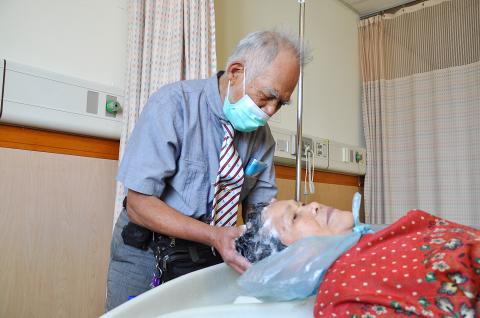
Photo: Chou Min-hung, Taipei Times
On one such visit, Lee arrived in a dress shirt and a tie, and waved familiarly to those at the nursing station as he walked to a patient surnamed Chen’s room and began taking out a washtub, and various other tools needed to wash hair.
Filling the tub with warm water, he took out another basin, placing it on the bed so that Chen could lean on it and be more comfortable as he washed her hair.
Throughout the procedure, which only took 20 minutes, Lee was very gentle, and though his gestures were sure and firm, they were inevitably slower due to Lee’s advanced age and his attention to detail.
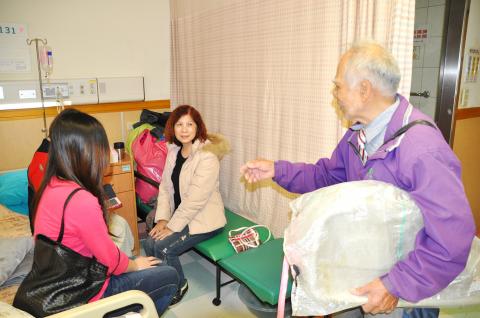
Photo: Chou Min-hung, Taipei Times
Helping to blow dry Chen’s hair afterward, Lee chatted with her and her family members as he cleaned and packed up the tools of his trade, which took another 20 minutes.
“You’re the same age as I am,” Lee told Chen jokingly, adding: “You need to keep exercising to stay healthy.”
“I wash people’s hair every day to exercise and make new friends,” Lee said.
Learning his trade at a barbershop when he was 17 years old helped Lee to start his own barbershop in then-Longtan Township (龍潭) after finishing his military service, he said.
He plied his trade for 26 years and it was only due to a declining number of customers that he started spending the mornings working at a local factory, and his evenings cutting and perming hair for clients by appointment.
Lee discovered the need for barbers at the hospital when his customers began making appointments with him for hospital patients, he said, adding that when he retired from the factory after a 30-year career, he focused on the hospital runs.
“I really like to help wash and cut patients’ hair at the hospital,” Lee said, adding that sickness often made people more in touch with their feelings and less reserved about sharing stories with him.
Each patient has a story and they are all different, Lee said, adding that he eventually looked forward to his hospital appointments, wondering: “What different stories will I hear today?”
There have been patients who thought he continued to work at his age because he needed the money and would give him NT$100 or NT$200 as a tip.
“I told them that I hadn’t come for the money,” Lee said. “I just wanted to take care of them, make new friends and keep exercising.”
Even though his customer count is declining, he does not mind, Lee added.
“My son and his three daughters visit every Sunday,” he said.
“I hop on my scooter and get there as soon as possible whenever someone calls to make an appointment,” Lee said, adding that he genuinely enjoys helping patients wash their hair.
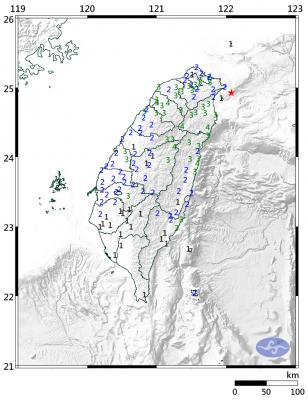
A magnitude 6.1 earthquake struck off the coast of Yilan County at 8:39pm tonight, the Central Weather Administration (CWA) said, with no immediate reports of damage or injuries. The epicenter was 38.7km east-northeast of Yilan County Hall at a focal depth of 98.3km, the CWA’s Seismological Center said. The quake’s maximum intensity, which gauges the actual physical effect of a seismic event, was a level 4 on Taiwan’s 7-tier intensity scale, the center said. That intensity level was recorded in Yilan County’s Nanao Township (南澳), Hsinchu County’s Guansi Township (關西), Nantou County’s Hehuanshan (合歡山) and Hualien County’s Yanliao (鹽寮). An intensity of 3 was

Instead of focusing solely on the threat of a full-scale military invasion, the US and its allies must prepare for a potential Chinese “quarantine” of Taiwan enforced through customs inspections, Stanford University Hoover fellow Eyck Freymann said in a Foreign Affairs article published on Wednesday. China could use various “gray zone” tactics in “reconfiguring the regional and ultimately the global economic order without a war,” said Freymann, who is also a nonresident research fellow at the US Naval War College. China might seize control of Taiwan’s links to the outside world by requiring all flights and ships entering or leaving Taiwan
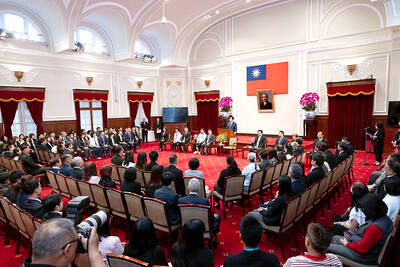
The next minimum wage hike is expected to exceed NT$30,000, President William Lai (賴清德) said yesterday during an award ceremony honoring “model workers,” including migrant workers, at the Presidential Office ahead of Workers’ Day today. Lai said he wished to thank the awardees on behalf of the nation and extend his most sincere respect for their hard work, on which Taiwan’s prosperity has been built. Lai specifically thanked 10 migrant workers selected for the award, saying that although they left their home countries to further their own goals, their efforts have benefited Taiwan as well. The nation’s industrial sector and small businesses lay
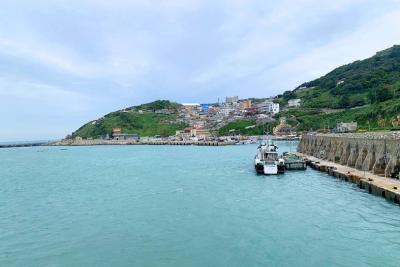
Taiwan has activated backup communications for its northernmost territory, the remote and strategically located island of Dongyin (東引), after poor weather conditions apparently shifted the wreckage of a ship onto an undersea cable causing it to break. The vulnerability of undersea communication cables linking Taiwan with its outlying islands has been a persistent cause of concern for Taipei, whose government has on several occasions blamed Chinese ships for intentionally causing damage. Dongyin, home to about 1,500 people, sits in a strategic position at the top of the Taiwan Strait and the island has a heavy military presence. It does not have an


 RSS
RSS