


Chinese Nationalist Party (KMT) Vice Chairman Hau Lung-bin (郝龍斌) yesterday turned over 18,750 signatures for a referendum drive to the Central Election Commission to back a call for a referendum on boycotting food imports from Fukushima Prefecture and four surrounding Japanese prefectures that were affected by the Fukushima Dai-ichi nuclear power plant disaster in 2011.
“The number of signatures is tenfold the legal requirement. It symbolizes the public outrage directed at the Democratic Progressive Party [DPP] administration,” Hau told a news conference at the commission’s office after presenting boxes containing the signed pages to commission official Chuang Kuo-hsiang (莊國祥).
Hau said that he was not against trade with Japan, but that he is against importing radiation-contaminated food products.
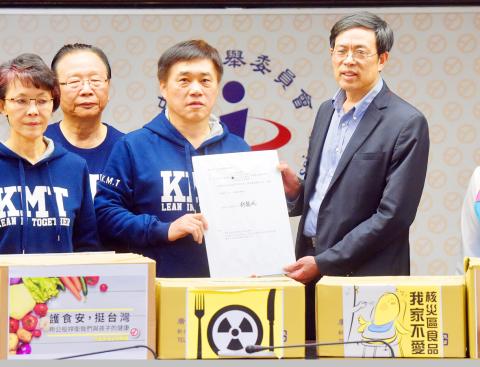
Photo: Huang Yao-cheng, Taipei Times
Hopefully, a referendum would help ban such products from entering Taiwan and safeguard public health, he said.
Several KMT lawmakers attended the news conference to express their support for the referendum drive.
Whether such imports should be allowed is an issue best decided by the voting public exercising their civil rights, making it an ideal referendum question, KMT caucus whip Lin Te-fu (林德福) said.
Quoting Minister of Health and Welfare Chen Shih-chung (陳時中), KMT Legislator Lai Shyh-bao (賴士葆) said that the Ministry of Health and Welfare might adjust its control mechanisms for Japanese food imports from location-based to product-based, indicating that it could be paving the way for lifting the ban on food imports from the five prefectures.
The commission should not intervene in the KMT’s referendum drive though the use of red tape, such as delaying it with a prolonged review, Lai said.
Amendments to the Referendum Act (公民投票法) last year lowered the threshold for referendum initiation from 0.005 percent of the electorate in the most recent presidential election, or about 90,000 people, to 0.0001 percent or about 1,800 people.
The proposal needs 280,000 signatures to be seconded.
During a question-and-answer session with KMT Legislator Wang Hui-mei (王惠美) yesterday, Council of Agriculture (COA) Minister Lin Tsung-hsien (林聰賢) said that he was against importing potentially radiation-contaminated food or lifting the import ban in exchange for Taiwan’s membership in the Comprehensive and Progressive Agreement for Trans-Pacific Partnership (CPTPP).
Negotiations with CPTPP member states should be based on the condition that the terms would be mutually beneficial, equal and reasonable, Lin said.
However, Taiwan would likely have to comply with “international norms” if it wants to secure membership in the trade agreement, so that it is on equal footing with the 11-member states, he said.
“If [the import of Japanese food-products from the five prefectures] is the international norm, can we resist that?” he said.
Saying that the public is concerned about the possibility of the ban being lifted, Wang urged the council to safeguard public health in any trade talks with Japan.
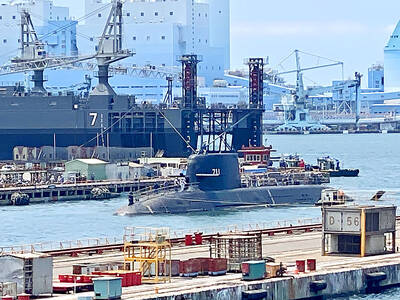
AGING: While Japan has 22 submarines, Taiwan only operates four, two of which were commissioned by the US in 1945 and 1946, and transferred to Taiwan in 1973 Taiwan would need at least 12 submarines to reach modern fleet capabilities, CSBC Corp, Taiwan chairman Chen Cheng-hung (陳政宏) said in an interview broadcast on Friday, citing a US assessment. CSBC is testing the nation’s first indigenous defense submarine, the Hai Kun (海鯤, Narwhal), which is scheduled to be delivered to the navy next month or in July. The Hai Kun has completed torpedo-firing tests and is scheduled to undergo overnight sea trials, Chen said on an SET TV military affairs program. Taiwan would require at least 12 submarines to establish a modern submarine force after assessing the nation’s operational environment and defense
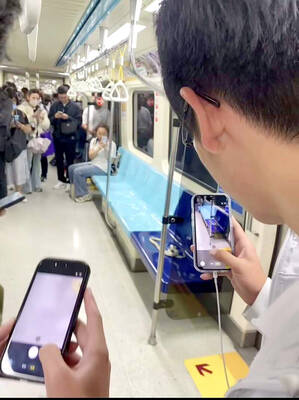
A white king snake that frightened passengers and caused a stir on a Taipei MRT train on Friday evening has been claimed by its owner, who would be fined, Taipei Rapid Transit Corp (TRTC) said yesterday. A person on Threads posted that he thought he was lucky to find an empty row of seats on Friday after boarding a train on the Bannan (Blue) Line, only to spot a white snake with black stripes after sitting down. Startled, he jumped up, he wrote, describing the encounter as “terrifying.” “Taipei’s rat control plan: Release snakes on the metro,” one person wrote in reply, referring
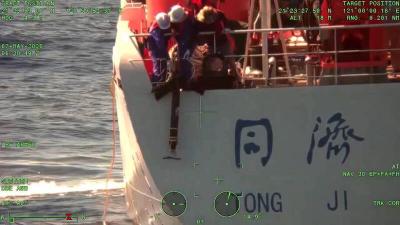
The coast guard today said that it had disrupted "illegal" operations by a Chinese research ship in waters close to the nation and driven it away, part of what Taipei sees a provocative pattern of China's stepped up maritime activities. The coast guard said that it on Thursday last week detected the Chinese ship Tongji (同濟號), which was commissioned only last year, 29 nautical miles (54km) southeast of the southern tip of Taiwan, although just outside restricted waters. The ship was observed lowering ropes into the water, suspected to be the deployment of scientific instruments for "illegal" survey operations, and the coast
Taiwan’s two cases of hantavirus so far this year are on par with previous years’ case numbers, and the government is coordinating rat extermination work, so there should not be any outbreaks, Centers for Disease Control (CDC) Director-General Philip Lo (羅一鈞) said today in an interview with the Liberty Times (the Taipei Times’ sister newspaper). An increase in rat sightings in Taipei and New Taipei City has raised concerns about the spread of hantavirus, as rats can carry the disease. In January, a man in his 70s who lived in Taipei’s Daan District (大安) tested positive posthumously for hantavirus, Taiwan’s


 RSS
RSS