


One of only six known maps remaining in the world that demarcate zones of residence of the Han from those of the Aborigines on Taiwan during the Qing Dynasty is being exhibited at the National Museum of Taiwan History in Tainan.
The Demarcation Map (界址圖), was created by Qing cartographers to detail the separation of residential zones, and each map would have required three to five years of research and drawing to complete, Museum assistant researchers Chen Ming-hsiang (陳明祥) and Chen Yu-chen (陳玉珍) said.
The six known maps of the kind are kept at museums or research facilities in Taiwan, China, the UK and Russia, the researchers said, adding that the map on display at the Tainan museum is part of the private collection of Sinologist and painter Hou Chin-lang (侯錦郎), who resides in France.
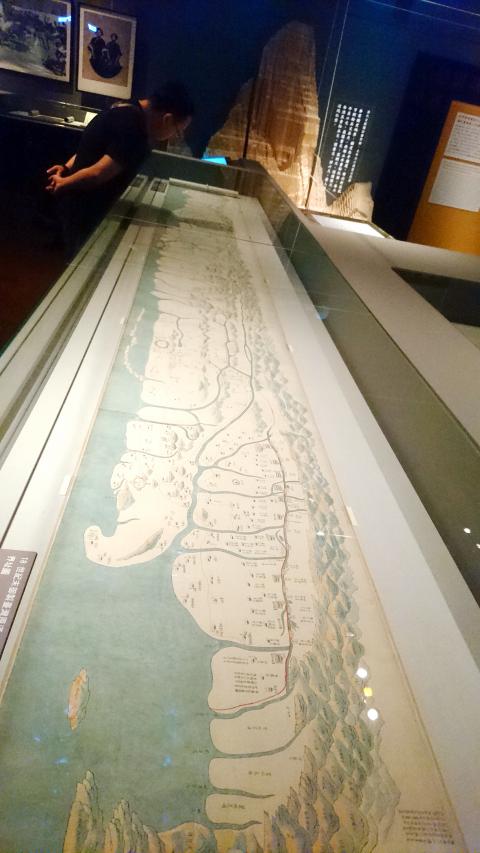
Photo: Liu Wan-chun, Taipei Times
Academia Sinica is in possession of another demarcation map, the researchers added.
The map details the demarcation of zones at the end of the 18th century, around the time when the Qing Empire implemented a policy to separate the zones, building borders and digging ditches to create physical boundary lines, the researchers said.
The policy was enacted in response to problems with Han ethnic rebels and increasing clashes between Han and Aboriginal people, the researchers said.
The Han arrived in Taiwan in the 17th century and by the 18th century their colonization efforts were encroaching on the foothills of the eastern mountain range, further compressing the living space of Aborigines, the researchers said.
Following the Zhu Yigui (朱一貴) rebellion in 1721, the Qing Empire declared further measures to demarcate areas and restrict access to mountainous areas, the researchers said.
However, as Han colonization progressed on the island, demarcation lines were changed at least four times under Emperor Qianlong (乾隆) of the Qing Dynasty, they said.
It was during this stage that the formerly nominal lines on paper were actually enforced by digging ditches as deep as 1.8m and establishing guard posts on the borders, the researchers said.
The exhibit, which started on Friday and is to run until Aug. 12, also features more than 70 other ancient maps, including a map of Taiwan drawn under Emperor Daoguang (道光帝), who reigned from 1820 to 1850, and maps marking areas managed by Presbyterian missionaries in the final years of the Qing Empire, the museum said.
It also features a scaled-down version of the ditches that separated the Han and Aboriginal populace, it added.

Former president Tsai Ing-wen (蔡英文) on Monday called for greater cooperation between Taiwan, Lithuania and the EU to counter threats to information security, including attacks on undersea cables and other critical infrastructure. In a speech at Vilnius University in the Lithuanian capital, Tsai highlighted recent incidents in which vital undersea cables — essential for cross-border data transmission — were severed in the Taiwan Strait and the Baltic Sea over the past year. Taiwanese authorities suspect Chinese sabotage in the incidents near Taiwan’s waters, while EU leaders have said Russia is the likely culprit behind similar breaches in the Baltic. “Taiwan and our European

The Taipei District Court sentenced babysitters Liu Tsai-hsuan (劉彩萱) and Liu Jou-lin (劉若琳) to life and 18 years in prison respectively today for causing the death of a one-year-old boy in December 2023. The Taipei District Prosecutors’ Office said that Liu Tsai-hsuan was entrusted with the care of a one-year-old boy, nicknamed Kai Kai (剴剴), in August 2023 by the Child Welfare League Foundation. From Sept. 1 to Dec. 23 that year, she and her sister Liu Jou-lin allegedly committed acts of abuse against the boy, who was rushed to the hospital with severe injuries on Dec. 24, 2023, but did not
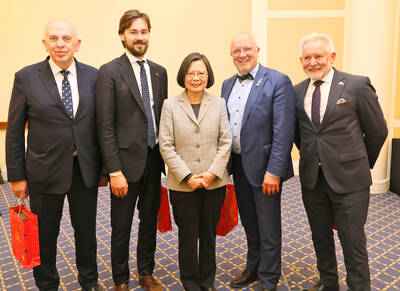
LIKE-MINDED COUNTRIES: Despite the threats from outside, Taiwan and Lithuania thrived and developed their economies, former president Tsai Ing-wen said Former president Tsai Ing-wen (蔡英文) on Saturday thanked Lithuania for its support of Taiwan, saying that both countries are united as partners in defending democracy. Speaking at a reception organized by the Lithuania-Taiwan Parliamentary Friendship Group welcoming her on her first visit to the Baltic state, Tsai said that while she was president from 2016 to last year, many Lithuanian “friends” visited Taiwan. “And I told myself I have to be here. I am very happy that I am here, a wonderful country and wonderful people,” Tsai said. Taiwan and Lithuania are in similar situations as both are neighbors to authoritarian countries, she

Former president Tsai Ing-wen (蔡英文) is to visit the UK during her ongoing European trip, which originally included only Lithuania and Denmark, her office said today. Tsai departed Taiwan for Europe on Friday night, with planned stops in Lithuania and Denmark, marking her second visit to the continent since her two-term presidency ended in May last year. Her office issued a statement today saying that Tsai would also visit the UK "for a few days," during which she is to meet with UK politicians and Taiwanese professionals, and visit academic and research institutions. Following Tsai's stop in Denmark, she is to visit the


 RSS
RSS