


President Tsai Ing-wen’s (蔡英文) “lavish” trip to visit the nation’s diplomatic allies in the South Pacific ignored the dire financial situation faced by the nation, Chinese Nationalist Party (KMT) legislators said yesterday, demanding that the Ministry of Foreign Affairs account for Tsai’s “excessive” spending.
Tsai spent NT$76.8 million (US$2.54 million) on chartered flights, which is more than double the amount former presidents Ma Ying-jeou (馬英九) and Chen Shui-bian (陳水扁) spent, the KMT caucus said, comparing Tsai to an extravagant “empress” inspecting her realm.
Ma in 2010 used two planes to visit six diplomatic allies in the South Pacific.
The trip cost about NT$30 million, the caucus said.
Chen in 2005 used two planes and visited three allies in the region, spending a total of NT$31.51 million, it said.
Tsai between Oct. 28 and Saturday last week visited the Marshall Islands, Tuvalu and the Solomon Islands using four planes, including two Bombardier Global 6000 business jets for her flight to Tuvalu, burning through at least NT$76.8 million, the caucus said.
KMT Legislator Lu Yu-ling (呂玉玲) asked why Tsai chose to take a detour, traveling to Hawaii before turning around to visit the Marshall Islands, adding an additional 3,900km to the trip.
“It is like setting out from Taipei to visit Taichung via Kaohsiung. It makes no sense,” Lu said.
KMT Legislator Johnny Chiang (江啟臣) questioned whether the US allowed Tsai to make a transit stop in Hawaii on condition that she agreed to increase the nation’s procurement of US weapons, since Tsai made the announcement to boost the military budget in Hawaii.
If true, Tsai’s stop in Hawaii had been “disappointing and regrettable,” Chiang said.
KMT Legislator Alicia Wang (王育敏) said Tsai made a transit stop in Hawaii “for the sake of stopping in the US.”
Meanwhile, the ministry refuted allegations of extravagant travel expenses, saying the expenditure conformed to past practices.
At a meeting of the legislature’s Foreign Affairs and National Defense Committee, Minister of Foreign Affairs David Lee (李大維) was questioned by Lu about the cost of Tsai’s eight-day visit.
Comparing Tsai’s flight expenses with Ma’s, Lu asked why Tsai needed to choose the more expensive Bombardier Global 6000 jets over ATR-72 aircraft — which was used in Ma’s 2011 visit — alleging that it costs US$500,000 an hour to rent a Global 6000 jet.
She also questioned the need to change to the larger Airbus A350 to fly from Guam to Taipei, rather than taking the Boeing 737-800 that took Tsai from Hawaii to Marshall Islands, accusing the president of unnecessary, extravagant spending.
The cost of the two visits cannot be compared since Ma’s trip was made several years ago, Lee said.
“Due to the natural conditions and limitations of the three Pacific nations, we had to rent three different types of aircraft,” Lee said, adding that the arrangement was to ensure Tsai’s safety and dignity.
Department of East Asian and Pacific Affairs Director-General Winston Chen (陳文儀) said as Ma traveled to more Pacific nations, the flight distance between them was shorter and within a safe travel range for the ATR-72 aircraft.
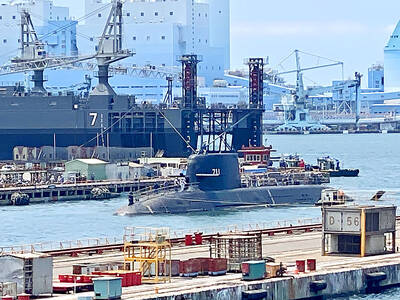
AGING: While Japan has 22 submarines, Taiwan only operates four, two of which were commissioned by the US in 1945 and 1946, and transferred to Taiwan in 1973 Taiwan would need at least 12 submarines to reach modern fleet capabilities, CSBC Corp, Taiwan chairman Chen Cheng-hung (陳政宏) said in an interview broadcast on Friday, citing a US assessment. CSBC is testing the nation’s first indigenous defense submarine, the Hai Kun (海鯤, Narwhal), which is scheduled to be delivered to the navy next month or in July. The Hai Kun has completed torpedo-firing tests and is scheduled to undergo overnight sea trials, Chen said on an SET TV military affairs program. Taiwan would require at least 12 submarines to establish a modern submarine force after assessing the nation’s operational environment and defense

A white king snake that frightened passengers and caused a stir on a Taipei MRT train on Friday evening has been claimed by its owner, who would be fined, Taipei Rapid Transit Corp (TRTC) said yesterday. A person on Threads posted that he thought he was lucky to find an empty row of seats on Friday after boarding a train on the Bannan (Blue) Line, only to spot a white snake with black stripes after sitting down. Startled, he jumped up, he wrote, describing the encounter as “terrifying.” “Taipei’s rat control plan: Release snakes on the metro,” one person wrote in reply, referring
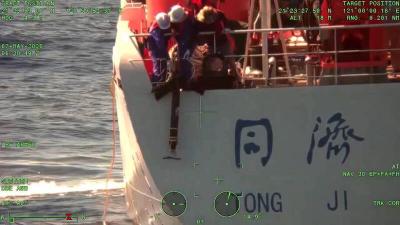
The coast guard today said that it had disrupted "illegal" operations by a Chinese research ship in waters close to the nation and driven it away, part of what Taipei sees a provocative pattern of China's stepped up maritime activities. The coast guard said that it on Thursday last week detected the Chinese ship Tongji (同濟號), which was commissioned only last year, 29 nautical miles (54km) southeast of the southern tip of Taiwan, although just outside restricted waters. The ship was observed lowering ropes into the water, suspected to be the deployment of scientific instruments for "illegal" survey operations, and the coast

Yangmingshan National Park authorities yesterday urged visitors to respect public spaces and obey the law after a couple was caught on a camera livestream having sex at the park’s Qingtiangang (擎天崗) earlier in the day. The Shilin Police Precinct in Taipei said it has identified a suspect and his vehicle registration number, and would summon him for questioning. The case would be handled in accordance with public indecency charges, it added. The couple entered the park at about 11pm on Thursday and began fooling around by 1am yesterday, the police said, adding that the two were unaware of the park’s all-day live


 RSS
RSS