


Chinese President Xi Jinping (習近平) aims to turn the Chinese Communist Party (CCP) into a “state party,” which, as it builds a Chinese model of development, requires meritocracy, a Chinese politics expert said in Taipei on Saturday.
Xi is set to begin his second five-year term as CCP general secretary with so-called “Xi Jinping thought” expected to be incorporated into the party’s constitution at the CCP’s ongoing 19th National Congress this week.
In a lecture for the Lung Ying-tai Cultural Foundation’s “Taipei Salon” series, John Burns, a former chair professor of politics and public administration at the University of Hong Kong, offered his reading of the vision for China laid out by Xi in his work report presented at the congress on Wednesday.
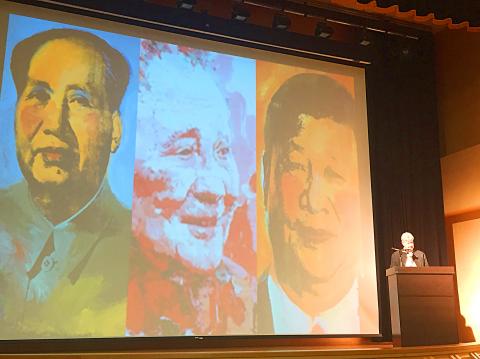
Photo: CNA
Burns said there are several significant differences between Xi’s work report and earlier ones.
One point that has attracted little, if any, attention is an indication that the CCP and the Chinese government will be merged at provincial, prefectural and county levels where they perform the same functions, Burns said.
“This is a step toward creating a ‘state party.’ This is the clue. This is exactly where the [Chinese] Communist Party is going,” he said. “This is not a small paragraph. It’s a major departure from the policies [former Chinese leader] Deng Xiaoping (鄧小平) has championed since the 1980s.”
Instead of using the term “party state,” which is often used to refer to China, Burns said: “We should be talking about the Communist Party as a ‘state party.’”
Burns said he believes turning the CCP into a “state party” is Xi’s ultimate goal.
Xi’s vision for China as a global leader in terms of national strength and international influence was a “dramatic declaration,” he added.
When Xi came to power in 2012, the CCP was riddled with systematic syndicated corruption and its leadership was fractured into many factions, each led by a strongman competing for power, but the massive anti-corruption campaign waged by Xi has enabled him to build a “coherent, unified” party, Burns said.
Burns said he considers Xi’s rooting out corruption in the Chinese People’s Liberation Army (PLA) to be his “No. 1 achievement,” because the problem was so severe that Xi saw it as a military that “cannot fight.”
The progress Xi has made at home in fighting corruption has allowed him to punish political enemies, identify loyal supporters and, most significantly, regain central control of the PLA, Burns said.
Those achievements, together with China’s increasing global presence partly to do with the global leadership vacuum created by US President Donald Trump, have made Xi “the world’s most powerful man,” Burns said.
Burns said that the concentration of such vast power in the hands of one person is by no means without risks.
“There are dangers ahead,” he said. “And we see nothing [in Xi’s work report] to reform the economy that is new.”
“But please remember, China’s model of development requires meritocracy,” he said.
Answering a question from German Institute Taipei Director-General Martin Eberts on China’s economy, Burns said that he saw “contradictions between party control and the market” and that he doubts Xi’s ideas in this area will work in the long term.
Xi believes that the Soviet Communist Party’s downfall came about after it gave up control of the economy, and that is why he insists on tighter control of Chinese state-owned enterprises, directing private investments from large numbers of billionaires in state-owned enterprises and encouraging the state to invest in private businesses, Burns said.
On the question of democracy, Burns said that Xi’s understanding of democracy bears no relation to the democracy in Taiwan, which he described as “the headquarters of competitive democracy.”
“Look around you. This is democracy,” he said.
Burns said what Xi talks about is a “different kind of democracy” that is “in the interests of its people.”
On Xi’s pledge to advance law-based governance, Burns said that Xi’s goal is to have the Chinese government “ruled by law,” not to establish “rule of law.”
Under the rule of law, the state is be treated like any other legal entity before the courts, but “I don’t think this was [Xi’s] intention,” Burns said.
What Xi envisions is that the CCP will “tightly control the content of laws” and the laws will be applied to corrupt businesses and officials, Burns said.
Although this will affect the legal professions and human rights, Xi considers it necessary for China’s development, he added.

ANOTHER EMERGES: The CWA yesterday said this year’s fourth storm of the typhoon season had formed in the South China Sea, but was not expected to affect Taiwan Tropical Storm Gaemi has intensified slightly as it heads toward Taiwan, where it is expected to affect the country in the coming days, the Central Weather Administration (CWA) said yesterday. As of 8am yesterday, the 120km-radius storm was 800km southeast of Oluanpi (鵝鑾鼻), Taiwan’s southernmost tip, moving at 9kph northwest, the agency said. A sea warning for Gaemi could be issued tonight at the earliest, it said, adding that the storm is projected to be closest to Taiwan on Wednesday or Thursday. Gaemi’s potential effect on Taiwan remains unclear, as that would depend on its direction, radius and intensity, forecasters said. Former Weather Forecast

As COVID-19 cases in Japan have been increasing for 10 consecutive weeks, people should get vaccinated before visiting the nation, the Centers for Disease Control (CDC) said. The centers reported 773 hospitalizations and 124 deaths related to COVID-19 in Taiwan last week. CDC Epidemic Intelligence Center Director Guo Hung-wei (郭宏偉) on Tuesday said the number of weekly COVID-19 cases reported in Japan has been increasing since mid-May and surpassed 55,000 cases from July 8 to July 14. The average number of COVID-19 patients at Japan’s healthcare facilities that week was also 1.39 times that of the week before and KP.3 is the dominant

The Chinese Communist Party’s (CCP) working group for Taiwan-related policies is likely to be upgraded to a committee-level body, a report commissioned by the Mainland Affairs Council (MAC) said. As Chinese President Xi Jinping (習近平) is increasingly likely to upgrade the CCP’s Central Leading Group for Taiwan Affairs, Taiwanese authorities should prepare by researching Xi and the CCP, the report said. At the third plenary session of the 20th Central Committee of the CCP, which ended on Thursday last week, the party set a target of 2029 for the completion of some tasks, meaning that Xi is likely preparing to

US-CHINA TRADE DISPUTE: Despite Beijing’s offer of preferential treatment, the lure of China has dimmed as Taiwanese and international investors move out Japan and the US have become the favored destinations for Taiwanese graduates as China’s attraction has waned over the years, the Ministry of Labor said. According to the ministry’s latest income and employment advisory published this month, 3,215 Taiwanese university graduates from the class of 2020 went to Japan, surpassing for the first time the 2,881 graduates who went to China. A total of 2,300 graduates from the class of 2021 went to the US, compared with the 2,262 who went to China, the document showed. The trend continued for the class of 2023, of whom 1,460 went to Japan, 1,334 went to


 RSS
RSS