


Women comprise 13.6 percent of the volunteer military, with 19,000 members, a number that is expected to rise to more than 20,000 next year, a Ministry of National Defense report said.
A report on the recruitment and promotion of women in the military mandated by the Legislative Yuan’s Foreign and National Defense Committee has been completed, an unnamed ministry official said.
The number of women serving has steadily increased to 19,000 this year from 6,900 in 2006, when the armed forces began integrating women on a large scale, the official cited the report as saying.
Regarding officers, there are 3,000 women who comprise 11.2 percent of all volunteer officers, it said.
The two highest-ranking women in the military are major generals, with one serving in the ministry and the other in the National Security Bureau, the report said.
There are more than 9,000 female non-commissioned officers, comprising 14.5 percent, while 6,000 enlisted female soldiers comprise 14.2 percent of all volunteer enlisted troops, it said.
Although comparatively few women choose to serve in the combat arms, gender integration in those branches has accelerated, the official said.
Last year, women comprised 15 percent of all soldiers with a combat military occupational specialty, up from 9.7 percent in 2014, the official said.
Combat divisions open to women include the infantry, artillery, military police, marines, aviation, missile specialists and most positions in the navy, the official said.
The military is implementing a pilot program for recruiting and training female soldiers for the armor branch, including the tank and self-propelled artillery crew, they added.
The occupational positions under evaluation are commander, gunner and driver for tanks and self-propelled guns with a non-commissioned officer ranking, the official said.
The Army Command is to evaluate the performance of female armored troops before making further decisions, the official said.
The Republic of China military began recruiting women in 1932 to meet a need for intelligence officers, while the recruitment of female military nurses and political warfare officers followed in 1947 and 1951 respectively, the official said.
Careers in other technical fields were opened to women in 1991, while the army, navy and air force academies began enrolling women in 1994, the official said.
By 2006, women could volunteer for most enlisted and non-commissioned ranks, and the quota is increased annually, the official said, adding the program was modeled after the gender integration efforts of Western militaries.
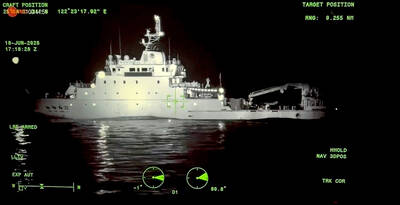
EXCUSES: Beijing is using government and research vessels as a pretext to harass the nation and enter its EEZ, and engage in ‘hegemonic expansion,’ the coast guard said The Coast Guard Administration yesterday said it drove away Chinese oceanographic research vessel Xiang Yang Hong 22 (向陽紅33) from restricted waters after warning it that it was in Taiwan’s exclusive economic zone (EEZ). The Chinese vessel entered restricted waters off the coast of Yilan County’s Suao (蘇澳) at 11:35pm on Thursday, the coast guard said, adding that it dispatched the Lanyu patrol vessel and the boat PP-10077 to shadow the Chinese ship and issue radio warnings ordering it to leave. China has no sovereignty over waters off Taiwan’s east coast, Lanyu’s crew told Xiang Yang Hong 22 over the radio, and demanded
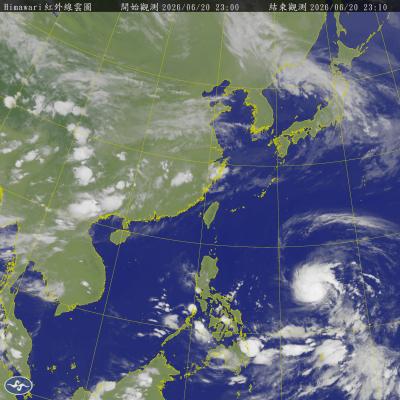
Tropical Storm Mekkhala is forecast to strengthen into a typhoon tomorrow and could come close enough to Taiwan later in the week to prompt a sea warning, the Central Weather Administration (CWA) said yesterday. As of 2 pm, the storm was located 1,870 kilometers southeast of Taiwan's southern tip and moving west- northwest at 23 km per hour. CWA forecaster Cheng Chieh-jen (鄭傑仁) said Mekkhala is expected to continue moving west-northwest through Tuesday under the influence of the Pacific high- pressure system before gradually turning north toward waters east of Taiwan or south of the Ryukyu Islands. The timing and angle of the
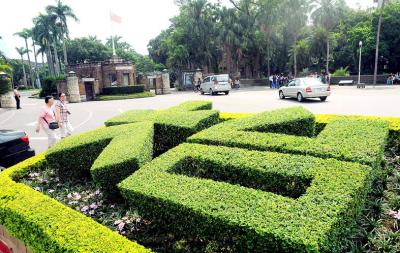
Four Taiwanese universities have been ranked among the world's top 200 institutions in the Quacquarelli Symonds (QS) World University Rankings for next year, the highest Taiwan has ever placed in the category, with National Taiwan University (NTU) achieving its best performance at 54th globally and 17th in Asia. The four Taiwanese institutions in the global top 200 are NTU (54th), National Tsing Hua University (142nd), National Yang Ming Chiao Tung University (177th) and National Cheng Kung University (191st), the rankings showed. All four universities achieved their highest-ever global rankings this year, QS data showed. National Cheng Kung University entered the top 200 for

RISING POPULARITY: Enhanced flight connectivity and a visa waiver trial program are among the motivations that have boosted travel to Taiwan by Filipinos, the agency said The Tourism Administration said yesterday that it is stepping up efforts to attract tourists from the Philippines following strong growth during the first quarter. The agency’s data showed the nation welcomed 210,000 Filipino visitors from January to March, marking a 43 percent increase compared with the same period last year. The Philippines is Taiwan’s top source of inbound tourists among the Southeast Asian nations, data showed. With a population of 116 million and national median age of 26, the Philippines boasts a young demographic with strong travel potential, the Tourism Administration said. Outbound travel demand in the Philippines continues to rise amid robust


 RSS
RSS