


Non-Partisan Solidarity Union Legislator May Chin (高金素梅) pressured National Taiwan University (NTU) to loan its athletic field for use by the “Sing! China: Shanghai-Taipei Music Festival,” according to school documents obtained by reporters.
The festival on Sept. 24 was called off just two hours after students protested over what they said was the school’s failure to prioritize students’ right to use campus facilities.
After the event was called off, three university students were assaulted, allegedly by members of the pro-unification Chinese Unity Promotion Party (CUPP).
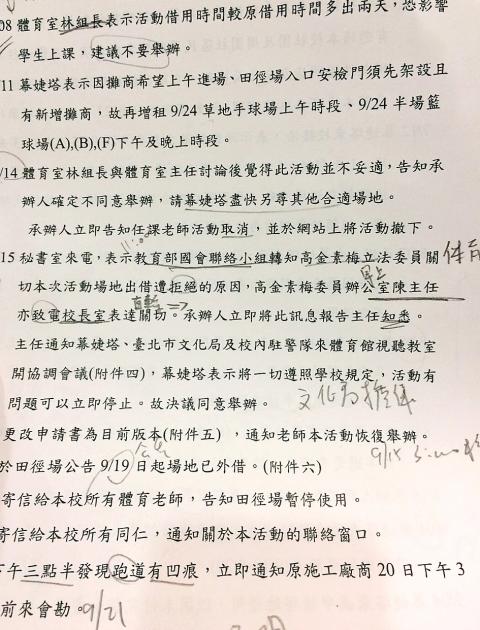
Photo: Rachel Lin, Taipei Times
The university launched a review into its decision to host the event, which was one of series of events initiated as part of the Taipei-Shanghai Forum, and its investigative committee met for the first time on Saturday to discuss the issue.
A copy of the athletics department’s written report to the committee was obtained by the Chinese-language Liberty Times (the sister newspaper of the Taipei Times), which showed that festival organizer Mu Chieh Ta Co (幕婕塔) on Aug. 8 filed a request to rent the field for the event and it was approved the following day.
The athletics department said in the report that it had been worried that hosting the festival, which would require cordoning off the athletic field for six days, might disrupt classes and excess noise might draw protests from area residents.
Due to those concerns, the department said it decided on Sept. 14 not host the festival and told Mu Chieh Ta to look elsewhere for a venue.
However, the university president’s office and the department on Sept. 15 received telephone calls from Chin’s legislative office chief Chen Chih-huang (陳智篁) and the Ministry of Education’s Legislative Liaison Section respectively to voice Chin’s concern over the reversal and wanting to know why the school no longer wanted to host the event, the report said.
The university reversed its decision again that day and agreed to host the event after a meeting with Mu Chieh Ta and Taipei Department of Cultural Affairs Deputy Commissioner Shen Hsi-hsing (沈希行), the report said.
The second reversal was attributable to pressure from Chin’s office and Mu Chieh Ta’s promises that it would manage noise levels at the concert, the report said.
Athletics department staff involved said they felt pressured by the phone calls from Chin’s office, the report said.
Deputy Minister of Education Tsai Ching-hwa (蔡清華) said the liaison section did receive a call from Chen Chih-huang on Sept. 15 asking it “to find out” why NTU had backed out of its contract with Mu Chieh Ta.
A liaison section employee then called the university in accordance with standard operating procedures and protocols, Tsai said.
During the phone call, the employee did not ask the school to host the festival, Tsai said, adding that neither he nor Minister of Education Pan Wen-chung (潘文忠) were aware of the issue.
Chin yesterday posted on Facebook that allegations that she exerted pressure were an “exaggeration,” but that she supported cross-strait exchanges and Taipei Mayor Ko Wen-je’s (柯文哲) “rational attitude” to China.
Taiwan should not “continue to carry out purges, partisanship, political struggles against others and indulge in self-intoxication,” Chin wrote.
Chen Chih-huang said he “was unclear” the report’s allegations.
Additional reporting by Chen Fu-yu

ANOTHER EMERGES: The CWA yesterday said this year’s fourth storm of the typhoon season had formed in the South China Sea, but was not expected to affect Taiwan Tropical Storm Gaemi has intensified slightly as it heads toward Taiwan, where it is expected to affect the country in the coming days, the Central Weather Administration (CWA) said yesterday. As of 8am yesterday, the 120km-radius storm was 800km southeast of Oluanpi (鵝鑾鼻), Taiwan’s southernmost tip, moving at 9kph northwest, the agency said. A sea warning for Gaemi could be issued tonight at the earliest, it said, adding that the storm is projected to be closest to Taiwan on Wednesday or Thursday. Gaemi’s potential effect on Taiwan remains unclear, as that would depend on its direction, radius and intensity, forecasters said. Former Weather Forecast

As COVID-19 cases in Japan have been increasing for 10 consecutive weeks, people should get vaccinated before visiting the nation, the Centers for Disease Control (CDC) said. The centers reported 773 hospitalizations and 124 deaths related to COVID-19 in Taiwan last week. CDC Epidemic Intelligence Center Director Guo Hung-wei (郭宏偉) on Tuesday said the number of weekly COVID-19 cases reported in Japan has been increasing since mid-May and surpassed 55,000 cases from July 8 to July 14. The average number of COVID-19 patients at Japan’s healthcare facilities that week was also 1.39 times that of the week before and KP.3 is the dominant

The Chinese Communist Party’s (CCP) working group for Taiwan-related policies is likely to be upgraded to a committee-level body, a report commissioned by the Mainland Affairs Council (MAC) said. As Chinese President Xi Jinping (習近平) is increasingly likely to upgrade the CCP’s Central Leading Group for Taiwan Affairs, Taiwanese authorities should prepare by researching Xi and the CCP, the report said. At the third plenary session of the 20th Central Committee of the CCP, which ended on Thursday last week, the party set a target of 2029 for the completion of some tasks, meaning that Xi is likely preparing to

US-CHINA TRADE DISPUTE: Despite Beijing’s offer of preferential treatment, the lure of China has dimmed as Taiwanese and international investors move out Japan and the US have become the favored destinations for Taiwanese graduates as China’s attraction has waned over the years, the Ministry of Labor said. According to the ministry’s latest income and employment advisory published this month, 3,215 Taiwanese university graduates from the class of 2020 went to Japan, surpassing for the first time the 2,881 graduates who went to China. A total of 2,300 graduates from the class of 2021 went to the US, compared with the 2,262 who went to China, the document showed. The trend continued for the class of 2023, of whom 1,460 went to Japan, 1,334 went to


 RSS
RSS