


Premier Lin Chuan (林全) is being “juvenile” in asking all government agencies to turn off their air conditioners in the early afternoon as part of his energy-saving policies, the Chinese Nationalist Party (KMT) said yesterday, adding that the Democratic Progressive Party’s (DPP) opposition to nuclear energy would put the nation’s power supply at risk.
The “nuclear-free home” policy championed by the DPP government has proven unattainable, as power rationing is expected to be imposed soon given Taiwan Power Co’s (Taipower) low power reserves, KMT caucus whip Lin Te-fu (林德福) said.
KMT caucus vice secretary-general Wang Hui-mei (王惠美) said that Lin’s order that agencies turn off air conditioning from 1pm to 3pm during the summer has drawn mounting criticism from civil servants, which they said felt like “food in a steamer.”
“Like juveniles, Lin and his Cabinet appear to be proud of their ineffective energy-saving policy,” Wang said.
When the DPP was in opposition, it used to accuse Taipower of making false statements about the nation facing a potential power shortage, but now even DPP supporters, such as Representative to Japan Frank Hsieh (謝長廷), has expressed concern over a possible shortfall in the nation’s electricity supply, Wang said.
The DPP’s conflicting remarks over the nation’s energy supply has left the public with no choice but to “grudgingly” take measures to conserve electricity, she said.
“President Tsai Ing-wen’s (蔡英文) administration excels at using grand, but hollow language like hipsters do, and the Executive Yuan order that agencies turn off air conditioners in the afternoon is no different,” KMT Legislator John Wu (吳志揚) said.
KMT caucus vice secretary-general William Tseng (曾銘宗) said he believed power would be rationed in some regions as soon as next week, with the Tsai administration likely breaking its promise that there would be no power rationing this year.
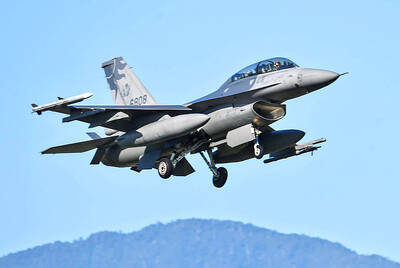
The first two F-16V Bock 70 jets purchased from the US are expected to arrive in Taiwan around Double Ten National Day, which is on Oct. 10, a military source said yesterday. Of the 66 F-16V Block 70 jets purchased from the US, the first completed production in March, the source said, adding that since then three jets have been produced per month. Although there were reports of engine defects, the issue has been resolved, they said. After the jets arrive in Taiwan, they must first pass testing by the air force before they would officially become Taiwan’s property, they said. The air force
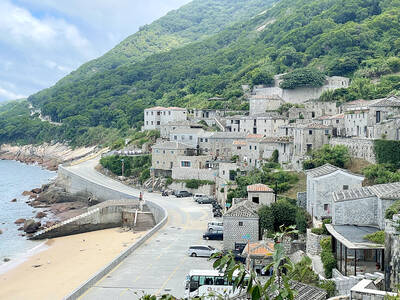
GLOBAL: Although Matsu has limited capacity for large numbers of domestic tourists, it would be a great high-end destination for international travelers, an official said Lienchiang County’s (Matsu) unique landscape and Cold War history give it great potential to be marketed as a destination for international travelers, Tourism Administration Director General Chen Yu-hsiu (陳玉秀) said at the weekend. Tourism officials traveled to the outlying island for the Matsu Biennial, an art festival that started on Friday to celebrate Matsu’s culture, history and landscape. Travelers to Matsu, which lies about 190km northwest of Taipei, must fly or take the state-run New Taima passenger ship. However, flights are often canceled during fog season from April to June. Chen spoke about her vision to promote Matsu as a tourist attraction in

PAWSITIVE IMPACT: A shop owner said that while he adopted cats to take care of rodents, they have also attracted younger visitors who also buy his dried goods In Taipei’s Dadaocheng (大稻埕), cats lounging in shops along Dihua Street do more than nap amid the scent of dried seafood. Many have become beloved fixtures who double as photography models, attracting visitors and helping boost sales in one of the capital’s most historic quarters. A recent photo contest featuring more than a dozen shop cats drew more than 2,200 submissions, turning everyday cat-spotting into a friendly competition that attracted amateur and professional photographers. “It’s rare to see cats standing, so when it suddenly did, it felt like a lucky cat,” said Sabrina Hsu (徐淳蔚), who won the NT$10,000 top prize in

STRIKE: Some travel agencies in Taiwan said that they were aware of the situation in South Korea, and that group tours to the country were proceeding as planned A planned strike by airport personnel in South Korea has not affected group tours to the country from Taiwan, travel agencies said yesterday. They added that they were closely monitoring the situation. Personnel at 15 airports, including Seoul’s Incheon and Gimpo airports, are to go on strike. They announced at a news conference on Tuesday that the strike would begin on Friday next week and continue until the Mid-Autumn Festival next month. Some travel agencies in Taiwan, including Cola Tour, Lion Travel, SET Tour and ezTravel, said that they were aware of the situation in South Korea, and that group


 RSS
RSS