


The Ministry of National Defense is considering producing self-propelled howitzers by converting CM-32 “Clouded Leopard” wheeled armored personnel carriers, ministry spokesman Major General Chen Chung-chi (陳中吉) said yesterday.
A self-propelled gun could be produced by mating the chassis of the 25-tonne, eight-wheeled CM-32 with an M114 155mm howitzer, Chen said.
The new vehicle is only a concept and army units have yet to submit an operational need for it, which would be required for the ministry to move forward with setting manufacturing volume, unit cost and project goals, he said.
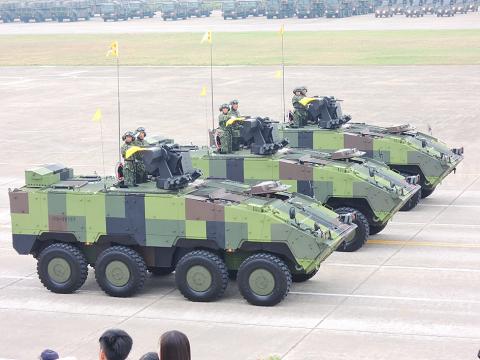
Photo: Lo Tien-pin, Taipei Times
The army is studying how the hypothetical artillery piece should be deployed for maximum operational effectiveness, he added.
First unveiled in 2005, the domestically produced CM-32 has been plagued by design flaws and budgetary irregularities during development.
Chung-Hsin Electric and Machinery Manufacturing (中興電工), the main contractor for the CM-32 program, has been accused of falsifying accounting records and buying substandard components from China.
Last year, 12 Chung-Hsin employees were convicted of violating the Business Entity Accounting Act (商業會計法), while legal proceedings against the firm’s CEO and military personnel involved in procurement are ongoing.
The ministry is to stringently adhere to all relevant laws and regulations in future arms purchases, Chen said, adding that it respects the oversight provided by the Legislative Yuan and the media.
The ministry said it plans to expand the CM-32 program from an armored personnel carrier to a family of vehicles with additional roles, including those of mortar carrier, a cannon-equipped infantry fighting vehicle, a mobile gun platform and self-propelled artillery.
In previous reports to the legislature, the ministry said the self-propelled artillery based on the CM-32 would provide fire support for the army’s mechanized infantry brigades and would have high mobility and digital communications.
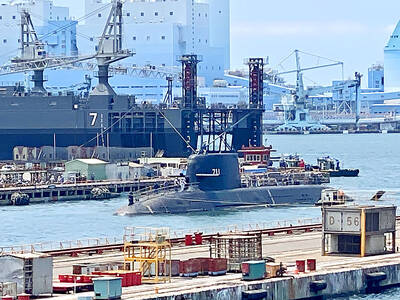
AGING: While Japan has 22 submarines, Taiwan only operates four, two of which were commissioned by the US in 1945 and 1946, and transferred to Taiwan in 1973 Taiwan would need at least 12 submarines to reach modern fleet capabilities, CSBC Corp, Taiwan chairman Chen Cheng-hung (陳政宏) said in an interview broadcast on Friday, citing a US assessment. CSBC is testing the nation’s first indigenous defense submarine, the Hai Kun (海鯤, Narwhal), which is scheduled to be delivered to the navy next month or in July. The Hai Kun has completed torpedo-firing tests and is scheduled to undergo overnight sea trials, Chen said on an SET TV military affairs program. Taiwan would require at least 12 submarines to establish a modern submarine force after assessing the nation’s operational environment and defense
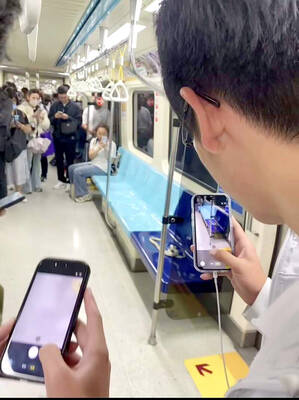
A white king snake that frightened passengers and caused a stir on a Taipei MRT train on Friday evening has been claimed by its owner, who would be fined, Taipei Rapid Transit Corp (TRTC) said yesterday. A person on Threads posted that he thought he was lucky to find an empty row of seats on Friday after boarding a train on the Bannan (Blue) Line, only to spot a white snake with black stripes after sitting down. Startled, he jumped up, he wrote, describing the encounter as “terrifying.” “Taipei’s rat control plan: Release snakes on the metro,” one person wrote in reply, referring
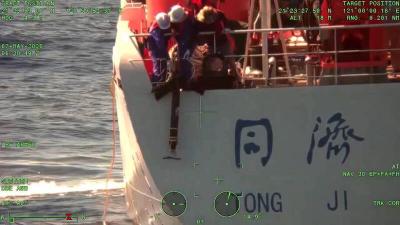
The coast guard today said that it had disrupted "illegal" operations by a Chinese research ship in waters close to the nation and driven it away, part of what Taipei sees a provocative pattern of China's stepped up maritime activities. The coast guard said that it on Thursday last week detected the Chinese ship Tongji (同濟號), which was commissioned only last year, 29 nautical miles (54km) southeast of the southern tip of Taiwan, although just outside restricted waters. The ship was observed lowering ropes into the water, suspected to be the deployment of scientific instruments for "illegal" survey operations, and the coast
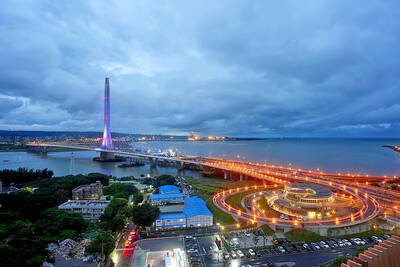
An inauguration ceremony was held yesterday for the Danjiang Bridge, the world’s longest single-mast asymmetric cable-stayed bridge, ahead of its official opening to traffic on Tuesday, marking a major milestone after nearly three decades of planning and construction. At the ceremony in New Taipei City attended by President William Lai (賴清德), Premier Cho Jung-tai (卓榮泰), Minister of Transportation and Communications Chen Shih-kai (陳世凱) and New Taipei City Mayor Hou Yu-ih (侯友宜), the bridge was hailed as both an engineering landmark and a long-awaited regional transport link connecting Tamsui (淡水) and Bali (八里)


 RSS
RSS