


The Food and Drug Administration (FDA) yesterday said that another batch of AstraZeneca’s lipid-lowering drug Crestor was found to have been adulterated with counterfeit drugs, so the company has agreed to initiate a recall for all batches on the market.
The administration last weekend confirmed that batch number MV503 of Crestor 10mg film-coated tablets contained counterfeit drugs in similar packaging, and all the medication from that batch was recalled from hospitals and pharmacies.
“The agency received the report about the counterfeit drugs on Thursday last week and immediately launched an investigation; examinations confirmed that there were counterfeit drugs being sold,” administration Director-General Shou-Mei Wu (吳秀梅) said yesterday.
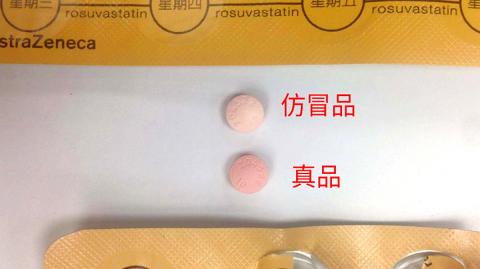
Photo: courtesy of the Taichung Health Bureau
The New Taipei District Prosecutors’ Office took two suspects into custody over the weekend, and they may face up to 10 years in prison or a fine up to NT$100 million (US$3.24 million) for producing counterfeit drugs under the Pharmaceutical Affairs Act (藥事法).
Another consignment of Crestor 10mg film-coated tablets, batch number MK479, was also found to contain counterfeit drugs, so the FDA said it asked AstraZeneca to recall all batches of the product in the interests of public safety.
“The main ingredient that has been added to the counterfeit drugs is actually another type of lipid-lowering drug, atorvastatin, that used to be commonly prescribed, so people who have taken the counterfeit drugs need not worry too much,” Wu said, adding that people should consult doctors or pharmacists if they have any questions.
According to National Health Insurance (NHI) Administration statistics, more than 200,000 boxes of Crestor are prescribed each month in Taiwan by NHI physicians, administration official Chih Lan-hui (遲蘭慧) said.
AstraZeneca told the administration that it has a sufficient quantity of the medication in stock to replace the recalled products, so patients would not be forced to take other types of drugs, she said.
Asked to respond to media reports that two other types of oral lipid-lowering drugs and one type of oral hypoglycemic drugs had been adulterated with counterfeit drugs and marketed under other brand names, the administration said it did not have any information on the issue, but that prosecutors and the administration would investigate.
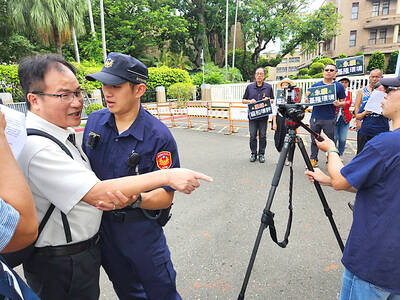
Environmental groups yesterday filed an appeal with the Executive Yuan, seeking to revoke the environmental impact assessment (EIA) conditionally approved in February for the Hsieh-ho Power Plant’s planned fourth liquefied natural gas (LNG) receiving station off the coast of Keelung. The appeal was filed jointly by the Protect Waimushan Seashore Action Group, the Wild at Heart Legal Defense Association and the Keelung City Taiwan Head Cultural Association, which together held a news conference outside the Executive Yuan in Taipei. Explaining the reasons for the appeal, Wang Hsing-chih (王醒之) of the Protect Waimushan Seashore Action Group said that the EIA failed to address
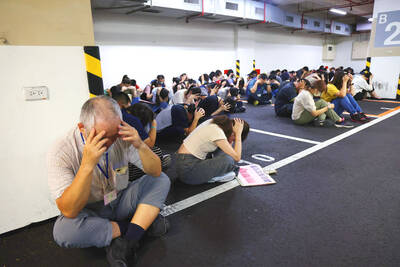
Taipei on Thursday held urban resilience air raid drills, with residents in one of the exercises’ three “key verification zones” reporting little to no difference compared with previous years, despite government pledges of stricter enforcement. Formerly known as the Wanan exercise, the air raid drills, which concluded yesterday, are now part of the “Urban Resilience Exercise,” which also incorporates the Minan disaster prevention and rescue exercise. In Taipei, the designated key verification zones — where the government said more stringent measures would be enforced — were Songshan (松山), Zhongshan (中山) and Zhongzheng (中正) districts. Air raid sirens sounded at 1:30pm, signaling the

The number of people who reported a same-sex spouse on their income tax increased 1.5-fold from 2020 to 2023, while the overall proportion of taxpayers reporting a spouse decreased by 4.4 percent from 2014 to 2023, Ministry of Finance data showed yesterday. The number of people reporting a spouse on their income tax trended upward from 2014 to 2019, the Department of Statistics said. However, the number decreased in 2020 and 2021, likely due to a drop in marriages during the COVID-19 pandemic and the income of some households falling below the taxable threshold, it said. The number of spousal tax filings rebounded

A saleswoman, surnamed Chen (陳), earlier this month was handed an 18-month prison term for embezzling more than 2,000 pairs of shoes while working at a department store in Tainan. The Tainan District Court convicted Chen of embezzlement in a ruling on July 7, sentencing her to prison for illegally profiting NT$7.32 million (US$248,929) at the expense of her employer. Chen was also given the opportunity to reach a financial settlement, but she declined. Chen was responsible for the sales counter of Nike shoes at Tainan’s Shinkong Mitsukoshi Zhongshan branch, where she had been employed since October 2019. She had previously worked


 RSS
RSS