


A chance introduction to organic farming that brought Kao Yi-hsin (高一鑫) face to face with draft water buffaloes — used to pull heavy loads — impressed him so much that the 34-year-old is now promoting the practice of plowing fields using the animals instead of machines.
Kao said he moved to Changhua County’s Sijhou Township (溪州) last year to attend the Water Buffalo School, founded by Lee Chun-hsin (李春信), and was given a water buffalo by a local farmer named Hsu Jung (許榮), which he named Lala (拉拉).
Kao began working at the Sijhou Shangshui Eco-friendly Farming organization as a warehouse manager and used his spare time to take Lala to plow fields.
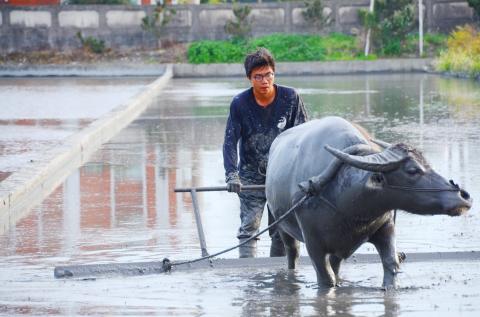
Photo: Yen Hung-chun, Taipei Times
The price to hire a tractor-pulled plow is NT$2,500 (US$81) per fen (about 977m2) of land, but he charged from NT$250 to NT$500 for plowing the same area, Kao said.
Using a water buffalo to plow fields means putting up with the weather and negotiating the animal’s temperament, Kao said, adding that sometimes he earned less than NT$250 per hour.
However, he took on the work not to make money, but to train Lala, he said.
A water buffalo is a partner, not a tool to make money, Kao said, adding that if an animal is treated well and talked to regularly then it reciprocates by offering its loyalty.
There is a lot to learn about water buffalo, as the animals can come down with colds or suffer from heatstroke, and there are certain types of herbal remedies that only the older generation know about, he said.
If the use of the animals died out in Taiwan, the nation would be losing a cultural asset, Kao said.
Kao said he is saving money to tour Taiwan and promote such practices, once Lala is more accustomed to plowing fields.
Kao said he was very lucky to find Sijhou, where local farmers were willing to give him a chance, adding that they not only asked him to help, but also taught him how to better control a water buffalo.
Sijhou Township Office Secretary-General Wu Yin-ning (吳音寧) said Kao’s willingness to promote the culture of plowing farmland with water buffalo should be welcomed by the public.
In a 2015 report in the Chinese-language United Daily News, Tainan official Chou Chih-hsun (周志勳) was quoted as saying that Tainan had 273 draft water buffaloes in 2009, but the number had dropped to 99 in 2015.
There were 19 water buffaloes in Yunlin County, the majority of which were at least 15 years old, Chou said, adding that while Pingtung County still had 236 of the animals, most of them were not used for plowing.

Considering that most countries issue more than five denominations of banknotes, the central bank has decided to redesign all five denominations, the bank said as it prepares for the first major overhaul of the banknotes in more than 24 years. Central bank Governor Yang Chin-lung (楊金龍) is expected to report to the Legislative Yuan today on the bank’s operations and the redesign’s progress. The bank in a report sent to the legislature ahead of today’s meeting said it had commissioned a survey on the public’s preferences. Survey results showed that NT$100 and NT$1,000 banknotes are the most commonly used, while NT$200 and NT$2,000

The Centers for Disease Control (CDC) yesterday reported the first case of a new COVID-19 subvariant — BA.3.2 — in a 10-year-old Singaporean girl who had a fever upon arrival in Taiwan and tested positive for the disease. The girl left Taiwan on March 20 and the case did not have a direct impact on the local community, it said. The WHO added the BA.3.2 strain to its list of Variants Under Monitoring in December last year, but this was the first imported case of the COVID-19 variant in Taiwan, CDC Deputy Director-General Lin Ming-cheng (林明誠) said. The girl arrived in Taiwan on

South Korea is planning to revise its controversial electronic arrival card, a step Taiwanese officials said prompted them to hold off on planned retaliatory measures, a South Korean media report said yesterday. A Yonhap News Agency report said that the South Korean Ministry of Foreign Affairs is planning to remove the “previous departure place” and “next destination” fields from its e-arrival card system. The plan, reached after interagency consultations, is under review and aims to simplify entry procedures and align the electronic form with the paper version, a South Korean ministry official said. The fields — which appeared only on the electronic form

The Ministry of Foreign Affairs (MOFA) is suspending retaliation measures against South Korea that were set to take effect tomorrow, after Seoul said it is updating its e-arrival system, MOFA said today. The measures were to be a new round of retaliation after Taiwan on March 1 changed South Korea's designation on government-issued alien resident certificates held by South Korean nationals to "South Korea” from the "Republic of Korea," the country’s official name. The move came after months of protests to Seoul over its listing of Taiwan as "China (Taiwan)" in dropdown menus on its new online immigration entry system. MOFA last week


 RSS
RSS