


New regulations announced by the Council of Indigenous Peoples that exclude privately held land from being recognized as traditional Aboriginal territory perpetuate the injustices done to Aborigines for more than a century, Aboriginal rights advocates said yesterday in Taipei.
A group of protesters, who have been staging a “sleepout” on Ketagalan Boulevard down the street from the Presidential Office Building since Thursday last week, offered lilies to commemorate the 70th anniversary of the 228 Incident and called for the restoration of traditional Aboriginal territories and transitional justice for all Taiwanese, regardless of ethnicity.
Several of the protesters had planned to attend a commemoration ceremony at the 228 Peace Memorial Park to offer condolences to families of the victims of the 228 Massacre, but were prevented from entering the venue.
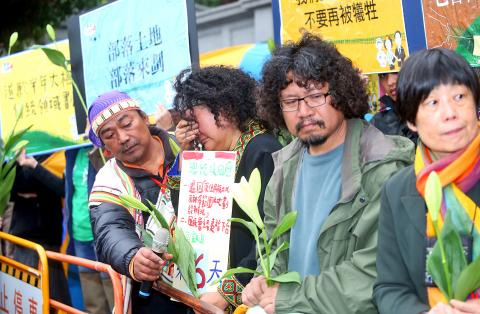
Photo: CNA
The council on Feb. 14 announced guidelines on the delineation of traditional Aboriginal territories that would restrict the application of the “traditional area” label to government-owned land, explicitly excluding private land.
The exclusion has sparked heated debate. A large amount of Aboriginal territory has been privatized and the exclusion would deprive Aborigines of the rights to participate in the development of traditional territories that were seized and privatized by the Japanese colonial and the Republic of China (ROC) governments, campaigners have said.
Much of the land owned by state-run Taiwan Sugar Corp and private hotel chains in eastern Taiwan was the hunting grounds of Amis communities for hundreds of years, and the new guidelines would only serve to legalize and entrench the misappropriation of Aboriginal land, said documentary filmmaker Mayaw Biho, an Amis and a former director of the state-run Taiwan Indigenous Television.
President Tsai Ing-wen’s (蔡英文) apology for the historical oppression of Aborigines in August last year gave them hope, but the government has once again rejected Aborigines’ rights to their traditional territories, Mayaw said.
“Half a year has passed since the apology, but the ROC government has continued to ignore the plight of the Aborigines,” he said.
“The ROC government takes advantage of Aborigines when it wants to promote the image of Taiwan, but it never relents when it comes to sacrificing their interests,” said singer Nabu Husungan Istanda, who is a Bunun.
“Although it is absolutely correct that the government has sought to address the 228 Incident and the issue of transitional justice, the nation has yet to make an equal effort to redress the injustices done to Aborigines,” said singer-activist Panai Kusui, who is an Amis.
The guidelines are a political expedient agreed between Minister Without Portfolio Chang Ching-sen (張景森) and Council of Indigenous Peoples Minister Icyang Parod, which override Aboriginal rights by using the Han Chinese concept of private ownership, said Lin Fei-fan (林飛帆), one of the leaders of the Sunflower movement in 2014.
“Many Aborigines are willing to negotiate with the government about the conflict between private ownership [and the delineation of traditional areas], but I want to ask if the government is willing to offer such an opportunity,” Lin said.

Considering that most countries issue more than five denominations of banknotes, the central bank has decided to redesign all five denominations, the bank said as it prepares for the first major overhaul of the banknotes in more than 24 years. Central bank Governor Yang Chin-lung (楊金龍) is expected to report to the Legislative Yuan today on the bank’s operations and the redesign’s progress. The bank in a report sent to the legislature ahead of today’s meeting said it had commissioned a survey on the public’s preferences. Survey results showed that NT$100 and NT$1,000 banknotes are the most commonly used, while NT$200 and NT$2,000

The Centers for Disease Control (CDC) yesterday reported the first case of a new COVID-19 subvariant — BA.3.2 — in a 10-year-old Singaporean girl who had a fever upon arrival in Taiwan and tested positive for the disease. The girl left Taiwan on March 20 and the case did not have a direct impact on the local community, it said. The WHO added the BA.3.2 strain to its list of Variants Under Monitoring in December last year, but this was the first imported case of the COVID-19 variant in Taiwan, CDC Deputy Director-General Lin Ming-cheng (林明誠) said. The girl arrived in Taiwan on

South Korea is planning to revise its controversial electronic arrival card, a step Taiwanese officials said prompted them to hold off on planned retaliatory measures, a South Korean media report said yesterday. A Yonhap News Agency report said that the South Korean Ministry of Foreign Affairs is planning to remove the “previous departure place” and “next destination” fields from its e-arrival card system. The plan, reached after interagency consultations, is under review and aims to simplify entry procedures and align the electronic form with the paper version, a South Korean ministry official said. The fields — which appeared only on the electronic form

The Ministry of Foreign Affairs (MOFA) is suspending retaliation measures against South Korea that were set to take effect tomorrow, after Seoul said it is updating its e-arrival system, MOFA said today. The measures were to be a new round of retaliation after Taiwan on March 1 changed South Korea's designation on government-issued alien resident certificates held by South Korean nationals to "South Korea” from the "Republic of Korea," the country’s official name. The move came after months of protests to Seoul over its listing of Taiwan as "China (Taiwan)" in dropdown menus on its new online immigration entry system. MOFA last week


 RSS
RSS