


Chinese Nationalist Party (KMT) Vice Chairman Hau Lung-bin (郝龍斌) yesterday said his bid for KMT chairperson would gain support from local and waishengren (外省人) factions, allowing him to unite the party, as he is less inclined to take part in politicking.
Waishengren refers to people who fled to Taiwan with the KMT in 1949 after its defeat in the Chinese Civil War.
He had intended to step down as vice party chairman to run in the May 20 race, but was convinced by fellow KMT Vice Chairman Jason Hu (胡志強) not to, Hau said in a radio interview, adding that part of his bid is to show that candidates could run for party chairperson and maintain cordial relations with other KMT members.
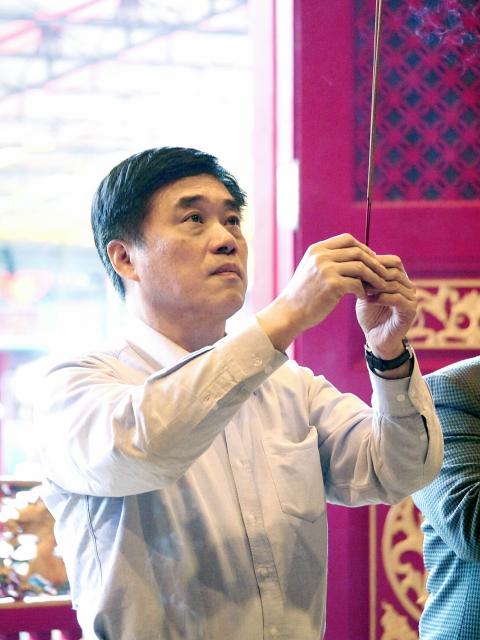
Photo: Chien Hui-ju, Taipei Times
The campaign has just started and everything is up in the air, Hau said, adding that should he find his bid failing, he would resign as vice chairman.
Hau said his campaign would be better than his rivals’.
KMT Chairwoman Hung Hsiu-chu (洪秀柱) “should fare worse than I” in the campaign, Hau said, adding that Hung could improve her party administration capabilities.
He said that former vice president Wu Den-yih (吳敦義) had party administration experience, as well as governmental administrative experience, but the 68-year-old’s age was not in his favor and he lacked support from the Huang Fu-hsing (黃復興) military veterans’ branch.
The Huang Fu-hsing is the party’s only special branch. Established in 1956 according to an initiative by then-president Chiang Ching-kuo (蔣經國) to protect the interests of veterans and to ensure that retired military personnel supported KMT policies, the branch holds considerable influence within the KMT.
Hau, the son of former premier Hau Pei-tsun (郝柏村), said that he has a deep connection with the Huang Fu-hsing branch and its members accepted him.
Hau said he had the support of KMT members from central and southern Taiwan after interacting with them over a referendum to maintain an import ban on food from five Japanese prefectures.
He would not run for president in 2020 if his chairperson bid is successful, Hau said, adding that he would ask Hon Hai Precision Industry Co chairman Terry Gou (郭台銘) to be the party’s presidential candidate in such a scenario.
A party chairperson should help presidential candidates, so staking a claim to represent the party in the 2020 race would not be conducive to party solidarity and would interfere with the chairperson’s role, Hau said.
Hau said that Gou had the best chance of being elected president in 2020.
At an event in Yilan County later yesterday, Hau said his assessment was based on pan-blue support for Gou over other party members.
The most important job for a party chairperson is to be impartial and to nominate the best candidate to run for president, Hau said.
The party will focus on winning local government elections next year and from there select the best candidate for the presidential race, he said.

ANOTHER EMERGES: The CWA yesterday said this year’s fourth storm of the typhoon season had formed in the South China Sea, but was not expected to affect Taiwan Tropical Storm Gaemi has intensified slightly as it heads toward Taiwan, where it is expected to affect the country in the coming days, the Central Weather Administration (CWA) said yesterday. As of 8am yesterday, the 120km-radius storm was 800km southeast of Oluanpi (鵝鑾鼻), Taiwan’s southernmost tip, moving at 9kph northwest, the agency said. A sea warning for Gaemi could be issued tonight at the earliest, it said, adding that the storm is projected to be closest to Taiwan on Wednesday or Thursday. Gaemi’s potential effect on Taiwan remains unclear, as that would depend on its direction, radius and intensity, forecasters said. Former Weather Forecast

As COVID-19 cases in Japan have been increasing for 10 consecutive weeks, people should get vaccinated before visiting the nation, the Centers for Disease Control (CDC) said. The centers reported 773 hospitalizations and 124 deaths related to COVID-19 in Taiwan last week. CDC Epidemic Intelligence Center Director Guo Hung-wei (郭宏偉) on Tuesday said the number of weekly COVID-19 cases reported in Japan has been increasing since mid-May and surpassed 55,000 cases from July 8 to July 14. The average number of COVID-19 patients at Japan’s healthcare facilities that week was also 1.39 times that of the week before and KP.3 is the dominant

The Chinese Communist Party’s (CCP) working group for Taiwan-related policies is likely to be upgraded to a committee-level body, a report commissioned by the Mainland Affairs Council (MAC) said. As Chinese President Xi Jinping (習近平) is increasingly likely to upgrade the CCP’s Central Leading Group for Taiwan Affairs, Taiwanese authorities should prepare by researching Xi and the CCP, the report said. At the third plenary session of the 20th Central Committee of the CCP, which ended on Thursday last week, the party set a target of 2029 for the completion of some tasks, meaning that Xi is likely preparing to

US-CHINA TRADE DISPUTE: Despite Beijing’s offer of preferential treatment, the lure of China has dimmed as Taiwanese and international investors move out Japan and the US have become the favored destinations for Taiwanese graduates as China’s attraction has waned over the years, the Ministry of Labor said. According to the ministry’s latest income and employment advisory published this month, 3,215 Taiwanese university graduates from the class of 2020 went to Japan, surpassing for the first time the 2,881 graduates who went to China. A total of 2,300 graduates from the class of 2021 went to the US, compared with the 2,262 who went to China, the document showed. The trend continued for the class of 2023, of whom 1,460 went to Japan, 1,334 went to


 RSS
RSS