


The death of an Indonesian fisherman last year who was allegedly beaten while aboard his Taiwanese employer’s vessel has sparked demands for improved working conditions for migrant fishermen, who are not protected by labor laws.
The Taiwan International Worker’s Association and a Hsinchu Catholic Church group yesterday organized a protest involving fishermen and members of the public outside the Council of Agriculture to voice four demands for foreign fishermen’s rights.
The protesters, who said they were responding to abuses of foreign fishermen aboard Taiwanese fishing vessels, said they are now in talks with the council.
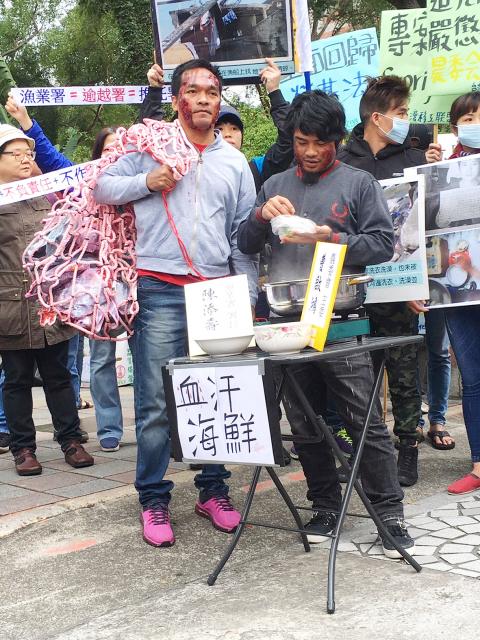
Photo: Lin Yen-tung, Taipei Times
A Taiwanese online media source brought the issue to public attention again last week with an in-depth report on the death of an Indonesian migrant fisherman named Supriyanto, who was allegedly the victim of physical abuse that led to his death at sea last year.
The report said a court investigation was been hampered by an inability to translate video footage of Supriyanto taken before his death, as no translator proficient in his central Javanese dialect was available.
Taiwan has the greatest number of distant-sea fishing vessels of any nation, the association said, adding that revenue from the industry reaches NT$43.8 billion (US$1.357 billion) annually.
Despite the amount of money involved, the industry employs only about 20,000 full-time workers, 90 percent of whom are hired from abroad, the association said.
Interviews with migrant fishermen conducted by Greenpeace last year brought accusations of exploitative working conditions aboard fishing vessels, with many fishermen working more than 18 hours per day to earn about NT$10,000 per month, some of which they said they had to pay to employment brokers.
Foreign workers are subject to the Fisheries Act (漁業法) rather than being covered by the same laws that protect Taiwanese fishermen, the association said.
The Fisheries Agency in May proposed an amendment to Article 84, Section 1 of the Labor Standards Act (勞動基準法) that would include migrant fishermen in regulations governing special work hour agreements reached between employers and employees.
The proposed changes would still be inadequate to address the pressures migrant fishermen face due to being overworked, underpaid and subject to high job broker fees, association member Hsu Wei-tung (許惟棟) said, adding that these problems are in addition to the physical and verbal abuse migrant fishermen regularly face.
Hsu said the association has demanded that the council put migrant fishermen fully under the protection of the Labor Standards Act and asked that it ban overseas recruitment of fishermen, cancel proposed amendments to Article 84 of the act, fully investigate alleged executive failures last year in investigations of the fishing vessel Supriyanto worked on, the Fu Tzu Chun, and have the boat’s owners compensate Supriyanto’s family for his death according to the labor act.
Fisheries Agency Deputy Director-General Huang Hung-yan (黃鴻燕) said that 10,000 migrant fishermen aboard vessels plying waters near Taiwan were hired after arriving in the nation and are covered by the labor act.
The remaining 18,000 migrant fishermen aboard Taiwanese vessels in distant waters were hired overseas out of necessity, as the ships were already in the vicinity of those countries when the workers were needed, Huang said, citing examples of vessels near Cape Town that hired foreign fishermen after their arrival there.
Nearly 1,200 Taiwanese fishing vessels operate in distant waters, he said, adding that putting all of the migrant fishermen on those vessels under the labor act would be difficult and would require consultation with the Ministry of Labor.
Citing Japan, he said that most nations had fisheries rules similar to Taiwan’s, using different standards for migrant fishermen.
Other Taiwanese industries also have similar regulations, such as factories that operate overseas that do not include local workers they employ according to the labor act.

ANOTHER EMERGES: The CWA yesterday said this year’s fourth storm of the typhoon season had formed in the South China Sea, but was not expected to affect Taiwan Tropical Storm Gaemi has intensified slightly as it heads toward Taiwan, where it is expected to affect the country in the coming days, the Central Weather Administration (CWA) said yesterday. As of 8am yesterday, the 120km-radius storm was 800km southeast of Oluanpi (鵝鑾鼻), Taiwan’s southernmost tip, moving at 9kph northwest, the agency said. A sea warning for Gaemi could be issued tonight at the earliest, it said, adding that the storm is projected to be closest to Taiwan on Wednesday or Thursday. Gaemi’s potential effect on Taiwan remains unclear, as that would depend on its direction, radius and intensity, forecasters said. Former Weather Forecast

As COVID-19 cases in Japan have been increasing for 10 consecutive weeks, people should get vaccinated before visiting the nation, the Centers for Disease Control (CDC) said. The centers reported 773 hospitalizations and 124 deaths related to COVID-19 in Taiwan last week. CDC Epidemic Intelligence Center Director Guo Hung-wei (郭宏偉) on Tuesday said the number of weekly COVID-19 cases reported in Japan has been increasing since mid-May and surpassed 55,000 cases from July 8 to July 14. The average number of COVID-19 patients at Japan’s healthcare facilities that week was also 1.39 times that of the week before and KP.3 is the dominant

The Chinese Communist Party’s (CCP) working group for Taiwan-related policies is likely to be upgraded to a committee-level body, a report commissioned by the Mainland Affairs Council (MAC) said. As Chinese President Xi Jinping (習近平) is increasingly likely to upgrade the CCP’s Central Leading Group for Taiwan Affairs, Taiwanese authorities should prepare by researching Xi and the CCP, the report said. At the third plenary session of the 20th Central Committee of the CCP, which ended on Thursday last week, the party set a target of 2029 for the completion of some tasks, meaning that Xi is likely preparing to

US-CHINA TRADE DISPUTE: Despite Beijing’s offer of preferential treatment, the lure of China has dimmed as Taiwanese and international investors move out Japan and the US have become the favored destinations for Taiwanese graduates as China’s attraction has waned over the years, the Ministry of Labor said. According to the ministry’s latest income and employment advisory published this month, 3,215 Taiwanese university graduates from the class of 2020 went to Japan, surpassing for the first time the 2,881 graduates who went to China. A total of 2,300 graduates from the class of 2021 went to the US, compared with the 2,262 who went to China, the document showed. The trend continued for the class of 2023, of whom 1,460 went to Japan, 1,334 went to


 RSS
RSS