


The appeal of a Bunun Aborigine against convictions for poaching and illegal possession of firearms began at the Supreme Court in Taipei yesterday, with supporters and advocacy groups holding a rally outside the building to demand respect for the culture and customs of the nation’s Aboriginal communities.
Despite suffering from pneumonia, the defendant, Tama Talum, also known by his Chinese name Wang Guang-lu (王光祿), attended the hearing, traveling from his home village in a mountainous region of Taitung County.
Prosecutor-General Yen Ta-ho (顏大和) filed an extraordinary appeal on Talum’s behalf in December last year after the Taiwan High Court’s Hualien branch upheld the guilty verdict of a lower court, which sentenced the 57-year-old to three-and-a-half years in prison.
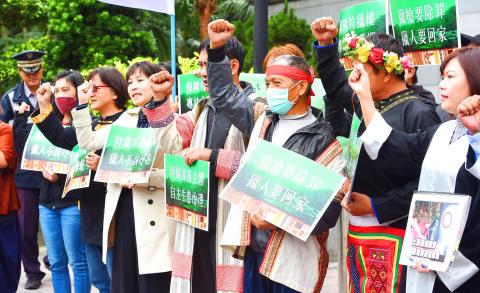
Photo: Peter Lo, Taipei Times
Talum was found to have violated the Act Controlling Guns, Knives and Ammunition (槍砲彈藥刀械管制條例) and the Wildlife Conservation Act (野生動物保育法).
Talum and his lawyers had argued that he was entitled to hunt and practice traditional Bunun culture under the Indigenous Peoples Basic Act (原住民基本法).
The case has fueled heated debate over the rights of Aborigines, and preservation of their culture.
However, some environmentalists and wildlife conservation groups have demanded a clampdown on poaching and illegal firearms to stop the killing of protected animals.
“This case must be appealed because it is not just about me, it concerns the traditional culture of my people. Hunting is a customary practice for Aboriginal communities. When the Supreme Court makes its judgement, I hope they take this into account,” Talum said before the hearing, standing alongside supporters and Aboriginal rights advocates. “As a man from a Bunun village, if I did not own a hunting rifle, I would be laughed at by my people. I hope the authorities can return our Aboriginal traditions and culture to us.”
Talum was arrested in August 2013 in possession of two dead animals, a Formosan serow and a Reeves’ muntjac, and a modified rifle.
At his trial, Talum said that he had killed the animals to provide meat for his 94-year-old mother, who was ill at home and wanted to eat the meat as a treat.
His lawyers had requested that the court transfer the trial to Talum’s village, so that the judges and judicial officials could better understand the living conditions and cultural practices of his community, adding that the Bunun people would like to better understand, and participate in, the judicial process.
At yesterday’s hearing, presiding judge Hsu Chin-yin (許錦印) requested that Yen be present at the next session, saying it is within the prosecutor-general’s authority to file an extraordinary appeal.
However, later in the afternoon Yen said it was unnecessary for him to attend, as there was no precedent, and he could be represented by the prosecutor of the case.

Taipei has once again made it to the top 100 in Oxford Economics’ Global Cities Index 2025 report, moving up five places from last year to 60. The annual index, which was published last month, evaluated 1,000 of the most populated metropolises based on five indices — economics, human capital, quality of life, environment and governance. New York maintained its top spot this year, placing first in the economics index thanks to the strength of its vibrant financial industry and economic stability. Taipei ranked 263rd in economics, 44th in human capital, 15th in quality of life, 284th for environment and 75th in governance,

The Sports Administration yesterday demanded an apology from the national table tennis association for barring 17-year-old Yeh Yi-tian (葉伊恬) from competing in the upcoming World Table Tennis (WTT) United States Smash tournament in Las Vegas this July. The sports agency said in a statement that the Chinese Taipei Table Tennis Association (CTTTA) must explain to the public why it withdrew Yeh from the WTT tournament in Las Vegas. The sports agency said it contacted the association to express its disapproval of the decision-making process after receiving a complaint from Yeh’s coach, Chuang
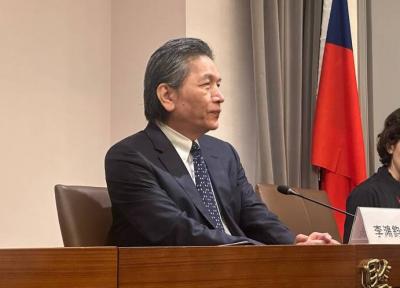
Control Yuan Secretary-General Lee Chun-yi (李俊俋) tendered his resignation last night, admitting that he had misused a government vehicle, as reported by media. His resignation was immediately accepted by the Control Yuan. In a statement explaining why he had resigned, Lee apologized for using a Control Yuan vehicle to transport his dog to a pet grooming salon on May 20. The issue first came to light late last month, when TVBS News reported that Lee had instructed his driver to take the dog to the salon. The news channel broadcast photos that it said were taken by an unnamed whistle-blower, which purportedly showed the
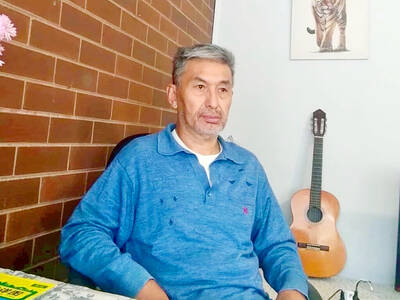
A former officer in China’s People’s Liberation Army (PLA) who witnessed the aftermath of the 1989 Tiananmen Square massacre has warned that Taiwan could face a similar fate if China attempts to unify the country by force. Li Xiaoming (李曉明), who was deployed to Beijing as a junior officer during the crackdown, said Taiwanese people should study the massacre carefully, because it offers a glimpse of what Beijing is willing to do to suppress dissent. “What happened in Tiananmen Square could happen in Taiwan too,” Li told CNA in a May 22 interview, ahead of the massacre’s 36th anniversary. “If Taiwanese students or


 RSS
RSS