


Taiwanese sports officials and fans were dismayed by the news that the Japan Table Tennis Association allegedly issued an order to prohibit Olympic bronze medalist Ai Fukuhara from marrying her Taiwanese boyfriend, Chiang Hung-chieh (江宏傑), who is also an Olympic table tennis player.
Fukuhara and Chiang, both 27, have been in a relationship for more than a year, and it was reported that they planned to get married.
However, Josei Jishin magazine reported that Japanese table tennis officials ordered Fukuhara to put off the plans, because they wanted her to concentrate on her training and lead the Japanese women’s table tennis team at the 2020 Tokyo Olympics.
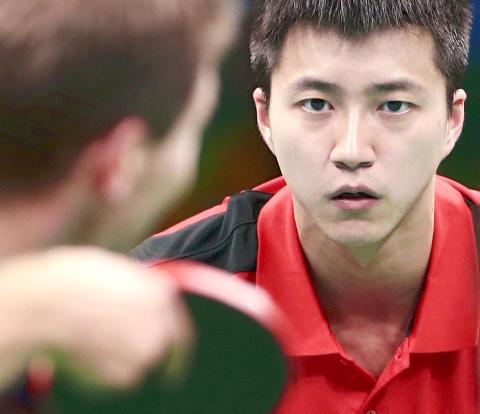
Photo: Reuters
The report said Japanese officials also had objections over Fukuhara marrying Chiang, because it would be a “status-gap marriage,” a Japanese term referring to a couple having significant disparity between their incomes, social status and personal values.
Other Japanese media outlets said that Fukuhara is the nation’s top female table tennis player, who was once the world’s No. 4 player, with an annual income estimated at ¥100 million (US$982,318), while Chiang is on a much lower level with a world ranking of 49, and was eliminated in the first round at the Rio de Janeiro Olympics, and only has an estimated annual income of ¥4 million.
Many Taiwanese sports fans were angered at the perceived slight against Chiang. Some fans posted messages condemning Japanese sports officials, saying they have no right to interfere in people’s affairs, adding that it is appalling to dictate a young woman’s choice of a marriage partner.
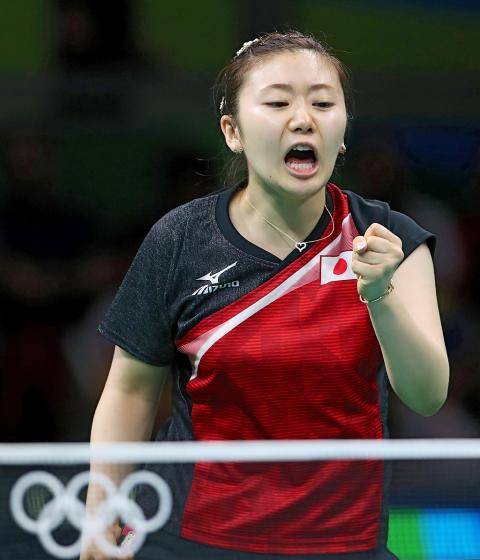
Photo: AP
In response to queries from Taiwanese media on Friday, Chiang said: “I cannot say anything about this matter. Whatever I say would not be right at this time.”
Fukuhara tried to dispel the speculation by posting a photograph on Facebook showing two cantaloupes filled with ice cream, tagged with Chiang’s name, whereby he responded with: “I will take you there after finishing my competition.”
Taiwanese sports officials were also alarmed, as they want to see the marriage go ahead, saying that Fukuhara could be granted Taiwanese citizenship to enable her to compete in table tennis matches for Taiwan at the Olympics, an idea which does not sit well with Japanese authorities.
The relationship between Fukuhara and Chiang was also covered by Chinese media outlets, since Fukuhara can write and speak Mandarin due to her training in China by top coaches from an early age and she is viewed as a celebrity there.
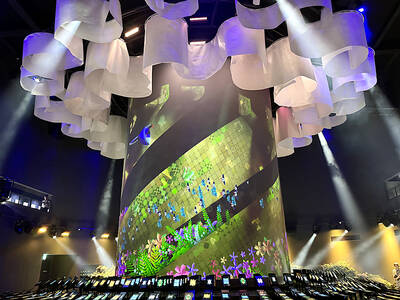
PRAISE: Japanese visitor Takashi Kubota said the Taiwanese temple architecture images showcased in the AI Art Gallery were the most impressive displays he saw Taiwan does not have an official pavilion at the World Expo in Osaka, Japan, because of its diplomatic predicament, but the government-backed Tech World pavilion is drawing interest with its unique recreations of works by Taiwanese artists. The pavilion features an artificial intelligence (AI)-based art gallery showcasing works of famous Taiwanese artists from the Japanese colonial period using innovative technologies. Among its main simulated displays are Eastern gouache paintings by Chen Chin (陳進), Lin Yu-shan (林玉山) and Kuo Hsueh-hu (郭雪湖), who were the three young Taiwanese painters selected for the East Asian Painting exhibition in 1927. Gouache is a water-based
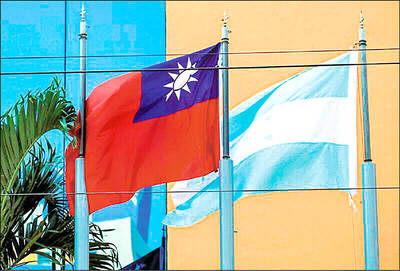
Taiwan would welcome the return of Honduras as a diplomatic ally if its next president decides to make such a move, Minister of Foreign Affairs Lin Chia-lung (林佳龍) said yesterday. “Of course, we would welcome Honduras if they want to restore diplomatic ties with Taiwan after their elections,” Lin said at a meeting of the legislature’s Foreign Affairs and National Defense Committee, when asked to comment on statements made by two of the three Honduran presidential candidates during the presidential campaign in the Central American country. Taiwan is paying close attention to the region as a whole in the wake of a
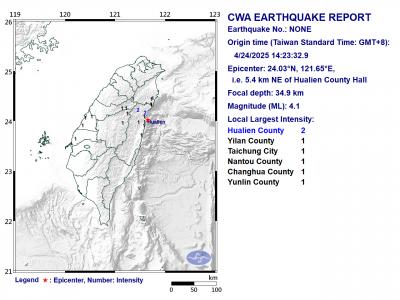
A magnitude 4.1 earthquake struck eastern Taiwan's Hualien County at 2:23pm today, according to the Central Weather Administration (CWA). The epicenter of the temblor was 5.4 kilometers northeast of Hualien County Hall, at a depth of 34.9 km, according to the CWA. The earthquake's intensity, which gauges the actual effect of a temblor, was the highest in Hualien County, where it measured 2 on Taiwan's 7-tier intensity scale. The quake also measured an intensity of 1 in Yilan county, Taichung, Nantou County, Changhua County and Yunlin County, the CWA said. There were no immediate reports of damage or injuries.

OFF-TARGET: More than 30,000 participants were expected to take part in the Games next month, but only 6,550 foreign and 19,400 Taiwanese athletes have registered Taipei city councilors yesterday blasted the organizers of next month’s World Masters Games over sudden timetable and venue changes, which they said have caused thousands of participants to back out of the international sporting event, among other organizational issues. They also cited visa delays and political interference by China as reasons many foreign athletes are requesting refunds for the event, to be held from May 17 to 30. Jointly organized by the Taipei and New Taipei City governments, the games have been rocked by numerous controversies since preparations began in 2020. Taipei City Councilor Lin Yen-feng (林延鳳) said yesterday that new measures by


 RSS
RSS