


With the Lovers’ Day (七夕情人節) — which falls on Aug. 9 this year — approaching, a group in Tainan is planning to help the lesbian, gay, bisexual and transgender (LGBT) community celebrate the day with popsicles that promote inclusiveness.
The popsicles the group sells have packages that have half heart shapes and cartoon depictions of men and women, encouraging people to make full hearts in any combination they like: with two men, two women, or a man and a woman.
“People in Taiwan might still not be very open-minded in their views of the LGBT community, so we are working with the Tainan City North District Office to sell popsicles to support LGBT families,” Chimei Foods marketing director Lin Wan-ting (林婉婷) said.
The company has produced 20,000 of the popsicles that come in lychee, pineapple, lemon and mango flavors and are made without additives, Lin said.
Lin said the additive-free popsicles reflect the “pure love” she hopes will abound, whether between two people of the same sex or the opposite sex.
She also said that the popsicles melt quickly, just as “love is fleeting.”
Chimei borrowed an ice cream bike from its museum for the event and started displaying it at various locations around Tainan on July 22.
The company said the bike will not stay in any spot for too long and encouraged people to “run in the pursuit of love” when they see it.
“Tainan Mayor William Lai (賴清德) believes that people in love have the right to be together, and since February, same-sex household registrations are possible in Tainan,” North District Administrator Hsieh Chen-i (謝振益) said.
“In this same spirit, the Tainan City North District Office is proud to work with Chimei Foods in their popsicle event, which we think demonstrates the benevolence of the people of Tainan,” Hsieh added.
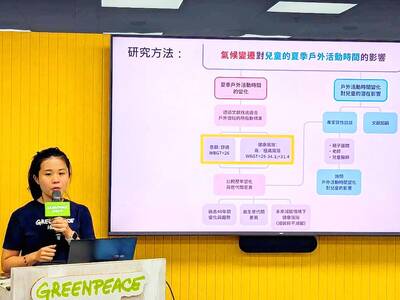
The government should improve children’s outdoor spaces and accelerate carbon reduction programs, as the risk of heat-related injury due to high summer temperatures rises each year, Greenpeace told a news conference yesterday. Greenpeace examined summer temperatures in Taipei, New Taipei City, Taoyuan, Hsinchu City, Taichung, Tainan and Kaohsiung to determine the effects of high temperatures and climate change on children’s outdoor activities, citing data garnered by China Medical University, which defines a wet-bulb globe temperature (WBGT) of 29°C or higher as posing the risk of heat-related injury. According to the Central Weather Administration, WBGT, commonly referred to as the heat index, estimates
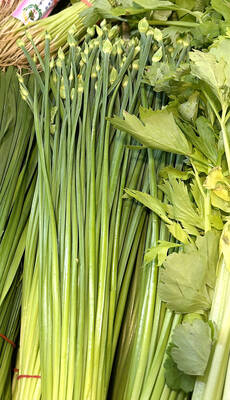
The Taipei Department of Health’s latest inspection of fresh fruit and vegetables sold in local markets revealed a 25 percent failure rate, with most contraventions involving excessive pesticide residues, while two durians were also found to contain heavy metal cadmium at levels exceeding safety limits. Health Food and Drug Division Director Lin Kuan-chen (林冠蓁) yesterday said the agency routinely conducts inspections of fresh produce sold at traditional markets, supermarkets, hypermarkets, retail outlets and restaurants, testing for pesticide residues and other harmful substances. In its most recent inspection, conducted in May, the department randomly collected 52 samples from various locations, with testing showing
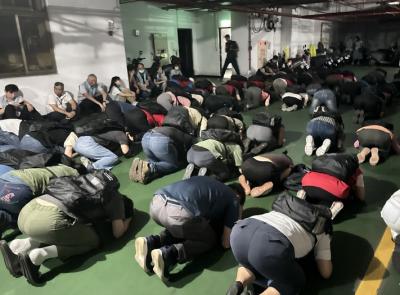
Taipei and other northern cities are to host air-raid drills from 1:30pm to 2pm tomorrow as part of urban resilience drills held alongside the Han Kuang exercises, Taiwan’s largest annual military exercises. Taipei, New Taipei City, Keelung, Taoyuan, Yilan County, Hsinchu City and Hsinchu County are to hold the annual Wanan air defense exercise tomorrow, following similar drills held in central and southern Taiwan yesterday and today respectively. The Taipei Mass Rapid Transit (MRT) and Maokong Gondola are to run as usual, although stations and passenger parking lots would have an “entry only, no exit” policy once air raid sirens sound, Taipei
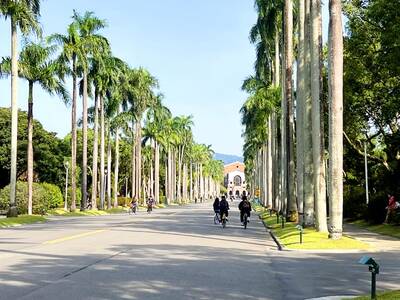
Taipei placed 14th in the Quacquarelli Symonds (QS) Best Student Cities 2026 list, its highest ever, according to results released yesterday. With an overall score of 89.1, the city climbed 12 places from the previous year, surpassing its previous best ranking of 17th in 2019. Taipei is “one of Asia’s leading higher-education hubs,” with strong employer activity scores and students “enjoying their experience of the city and often keen to stay after graduation,” a QS staff writer said. In addition to Taipei, Hsinchu (71st), Tainan (92nd), Taichung (113th) and Taoyuan (130th) also made QS’ list of the top 150 student cities. Hsinchu showed the


 RSS
RSS