


Democratic Progressive Party Legislator Su Chih-feng (蘇治芬) yesterday said that the Vietnamese government did not give any explanation for a series of difficulties she encountered on a trip this week.
Su and her entourage returned from Vietnam yesterday after a five-day trip to learn more about a pollution incident involving a Formosa Plastics Group steel mill in Ha Tinh Province, visit a Catholic orphanage in Vinh and purchase Vietnamese children’s books to promote mother-tongue education in Yunlin County.
Su said her passport was temporarily held at Noi Bai International Airport in Hanoi, the group was prohibited from visiting the orphanage and they were followed on a trip to the steel mill.
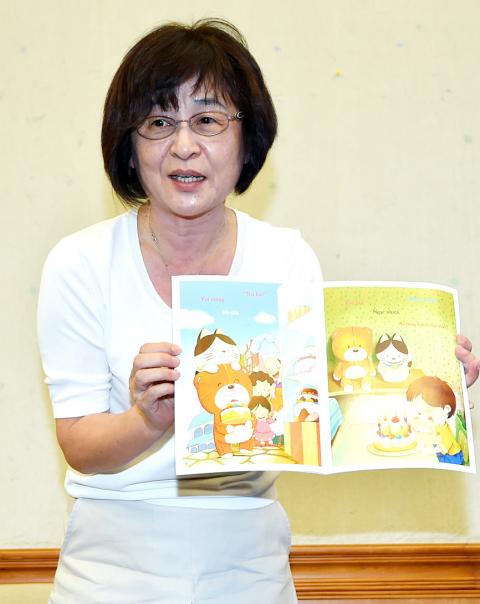
Photo: Liao Chen-huei, Taipei Times
“The Vietnamese government did not make any direct or indirect contact with us,” she said. “I still do not understand why my passport was held by airline clerks.”
Su’s passport was held for unknown reasons when the group was to fly to Vinh.
After Representative to Vietnam Richard Shih (石瑞琦) negotiated with Vietnamese officials, the group was told that they were not allowed to visit the orphanage, so they canceled that event and went to Ha Tinh by bus, Su said.
While media reports said that Su was blocked because the church is an “anti-[Vietnamese] government” organization, Su said she was totally unaware of the church’s political nature and they simply wanted to visit the orphanage for charity purposes.
“I do not know any so-called anti-government people or dissidents,” she said.
“I still do not know whether the church leadership are anti-government,” she added.
Brushing aside speculation that her passport was held because the group planned to visit places not listed on her visa application, Su said they went to Vietnam on tourist visas and they were never asked to provide an itinerary, so there was no conflict between the planned trip and where they actually went.
They were never asked to explain the purpose of their travel, but they were not given any explanation for the situation, Su said, adding that the group never met any Vietnamese officials, while negotiations were conducted by Shih.
In Ha Tinh, the group was followed by plainclothes police officers and they had to ask permission to visit places, Su said. The police arranged a visit to a head massage parlor and watched during the time there.
“It is impossible to feel comfortable while being followed,” she said.
Su quoted chemist Ding Guo-tsuen (丁國村), who was with the group, as saying that the Formosa Ha Tinh Steel Corp plant is a world-class facility, but that could not prevent human error.
She said that even after the visit, the group did not understand anything about the pollution incident other than what was reported by the media, but she questioned the transparency of the Vietnamese government’s investigation.
Hanoi said the plant was responsible for causing a mass fish die-off in the province and downstream areas in April.
“We cannot reach a definite conclusion on the pollution incident,” Su said. “The Vietnamese government is obliged to make its investigation report public.”
Su reaffirmed her endorsement of the government’s “new southbound policy” amid concerns that the issues she faced on the trip might spell its failure.
The presence of Taiwanese companies is strong in Vietnam and Vietnamese are energetic and friendly toward Taiwanese, she said.

ANOTHER EMERGES: The CWA yesterday said this year’s fourth storm of the typhoon season had formed in the South China Sea, but was not expected to affect Taiwan Tropical Storm Gaemi has intensified slightly as it heads toward Taiwan, where it is expected to affect the country in the coming days, the Central Weather Administration (CWA) said yesterday. As of 8am yesterday, the 120km-radius storm was 800km southeast of Oluanpi (鵝鑾鼻), Taiwan’s southernmost tip, moving at 9kph northwest, the agency said. A sea warning for Gaemi could be issued tonight at the earliest, it said, adding that the storm is projected to be closest to Taiwan on Wednesday or Thursday. Gaemi’s potential effect on Taiwan remains unclear, as that would depend on its direction, radius and intensity, forecasters said. Former Weather Forecast

As COVID-19 cases in Japan have been increasing for 10 consecutive weeks, people should get vaccinated before visiting the nation, the Centers for Disease Control (CDC) said. The centers reported 773 hospitalizations and 124 deaths related to COVID-19 in Taiwan last week. CDC Epidemic Intelligence Center Director Guo Hung-wei (郭宏偉) on Tuesday said the number of weekly COVID-19 cases reported in Japan has been increasing since mid-May and surpassed 55,000 cases from July 8 to July 14. The average number of COVID-19 patients at Japan’s healthcare facilities that week was also 1.39 times that of the week before and KP.3 is the dominant

The Chinese Communist Party’s (CCP) working group for Taiwan-related policies is likely to be upgraded to a committee-level body, a report commissioned by the Mainland Affairs Council (MAC) said. As Chinese President Xi Jinping (習近平) is increasingly likely to upgrade the CCP’s Central Leading Group for Taiwan Affairs, Taiwanese authorities should prepare by researching Xi and the CCP, the report said. At the third plenary session of the 20th Central Committee of the CCP, which ended on Thursday last week, the party set a target of 2029 for the completion of some tasks, meaning that Xi is likely preparing to

US-CHINA TRADE DISPUTE: Despite Beijing’s offer of preferential treatment, the lure of China has dimmed as Taiwanese and international investors move out Japan and the US have become the favored destinations for Taiwanese graduates as China’s attraction has waned over the years, the Ministry of Labor said. According to the ministry’s latest income and employment advisory published this month, 3,215 Taiwanese university graduates from the class of 2020 went to Japan, surpassing for the first time the 2,881 graduates who went to China. A total of 2,300 graduates from the class of 2021 went to the US, compared with the 2,262 who went to China, the document showed. The trend continued for the class of 2023, of whom 1,460 went to Japan, 1,334 went to


 RSS
RSS