


The Ministry of Culture said it regretted that Taiwanese actor Leon Dai (戴立忍) had been replaced in a Chinese film and urged for artists’ freedom of expression to be respected.
The lead actor in the film No Other Love (沒有別的愛), directed by Chinese actress Zhao Wei (趙薇), Dai was removed from the production by its investors over vague positions on whether “Taiwan is part of China” and whether he believes he is Chinese.
“Freedom of artistic expression and creativity should not be censored for political reasons,” the ministry said in a statement, adding that cultural interaction between China and Taiwan should set aside controversies and respect artists and workers in the entertainment industry.
The movie’s production team on Friday said on Sina Weibo why Dai was removed from the movie.
“Following Dai’s initial statement, the director and investors both expressed hope that he could provide a fuller explanation to the public and state his stance more clearly on important issues, but because Dai remained vague on his stance, the director and investors decided to replace Dai as the lead actor,” the team said.
Chinese entertainment companies have taken a hard-line on Taiwanese performers with political leanings they or their customers do not approve of before, especially performers who have supported Taiwanese independence.
Dai said on his Weibo account on Friday that he had “never joined any political party nor any political organization” and he had “never supported Taiwanese independence.”
However, he said he supported the decision to replace him in the movie and he apologized to investors and the crew for the controversies created by his past.
Online campaigns in China to boycott the movie based on the political stances of some actors also in the movie emerged after the production team announced the cast in late April.
The campaigns gathered steam after Zhao posted a photograph on Weibo of her and the cast, including Dai, when filming wrapped up late last month.
On June 30, Dai, 49, posted on Weibo that he had expressed his concerns on many issues in Taiwan, such as the forced demolition of private homes, gay rights and nuclear power, but he had not joined any political party.
On the same day, the film’s production team said on Weibo that it supported Dai in protecting his reputation and would have its lawyers protect Zhao from online censure and defamation.
However, after the Chinese Communist Youth League of China Central and the Zhonguo Guofangbao (the Chinese People’s Liberation Army newspaper) started to exaggerate the controversy, online campaigns opposing Dai went viral.
On Monday last week, Zhao said on Weibo that Dai had worked in the film industry for many years and cooperated with many professionals in Taiwan, Hong Kong and China adding that he was not a supporter of Taiwanese independence.
However, Zhao changed her position on Friday, saying that “whether on people or issues, attitudes can not be vague.”
Dai is also an acclaimed director, whose 2009 film No Puedo Vivir Sin Ti (不能沒有你, “Cannot Live Without You”) adopted from a true story of a father’s fight for the custody of his child, won him the best director award at both the Golden Horse Awards and the Asia-Pacific Film Festival that year.


UPGRADE: The Kang Ding-class frigate is replacing its Chaparall missiles with Tien Chien II and Hua Yang VLS, which would provide it with long-range, 360° air defense Taiwan plans to produce 1,200 to 1,376 Hai Chien II missiles (海劍二, Sea Sword II) — also known as TC-2N — to serve as the standard air defense system of the navy’s surface combatant fleet, a source said yesterday. Last week, the Hai Chien II, the naval version of the Tien Kung II missile (天劍二, Sky Sword II), completed a live-fire test in waters off the National Chungshan Institute of Science and Technology’s Jiupeng facility (九鵬) in Pingtung County’s Manjhou Township (滿州). The MIM72 Chaparral and other dated air defense missiles that currently arm Taiwanese ships have inadequate range to combat Chinese

REASONS FOR TRAVEL: An assistant professor said that proposed amendments to penalize drivers if they used drugs overseas would not deter people from traveling People who operate a motor vehicle under the influence of marijuana would have their driver’s license revoked, even if they used the substance while overseas, the Ministry of Transportation and Communications said yesterday, citing proposed amendments to the Road Traffic Management and Penalty Act (道路交通管理處罰條例). The amendments would also authorize the government to revoke the licenses of people determined to have used Category 1 or Category 2 narcotics, even if they were not operating a vehicle while under the influence of drugs, as well as ban them from taking the license test for three years, the ministry said. People aged 18 or
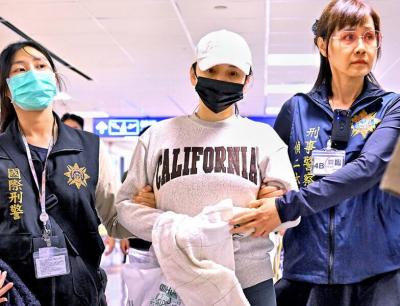
Johanne Liou (劉喬安), a Taiwanese woman who shot to unwanted fame during the Sunflower movement protests in 2014, returned to Taiwan last night after being deported from the US. She is to stand trial in Taiwan for charges involving embezzlement, fraud and drug crimes. The Criminal Investigation Bureau (CIB) said it took her into custody at Taiwan Taoyuan International Airport and would first question her before transferring her to the New Taipei District Prosecutors’ Office. She was arrested upon disembarking a flight from San Francisco that landed shortly before 7pm. Liou absconded to the US in 2019 after jumping bail
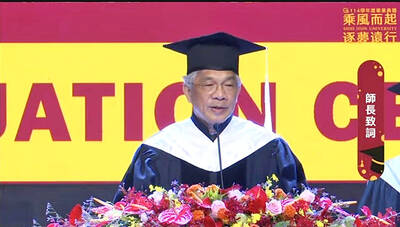
Shih Hsin University President Chen Ching-he (陳清河) yesterday issued a public apology for comments made in his commencement speech last week, stating that he has asked the school to suspend his duties and halt his wages for two months as a show of contrition. At the commencement ceremony on May 30, Chen said, “If you don’t manage your time well, or your own emotions, or your health, then I am telling every one of you — put a quick end to ‘you,’ because the world has no need for ‘you.’” The comments have sparked significant controversy online, and Chen through an open


 RSS
RSS