


Military officials have been busy apologizing for the past two weeks — for the killing of a dog by soldiers at a military base last week and the accidental firing of a missile by the navy that killed a fishing boat captain on Friday — but a Chinese Nationalist Party (KMT) official said the repeated expressions of remorse are sapping military morale.
KMT Vice Chairman Hau Lung-bin (郝龍斌) on Friday wrote in a Facebook post that it was wrong for soldiers to abuse and kill dogs and that the military needed to take action to handle such misconduct.
However, he added that when all ranks of the military and the Minister of National Defense have to bow in apology because of the abusers’ behavior, “I believe this hurts the morale and image of the military.”
Hau was responding to an army general’s Facebook post in which the general said he was quitting the army because of the ongoing pressure put on the military over the incident.
Hau is the son of Hau Pei-tsun (郝柏村), a former premier and retired army general who served as chief of the General Staff of the Republic of China Armed Forces.
“As one general has said, there is no country in the world that would crush an entire military’s morale and image because of individual soldiers’ behavior,” Hau Lung-bin said.
Although he said he agreed that discipline and morality in the military must be improved, he said that if people in the military are not respected by society and the government or do not have a sense of identity or honor in their job, it would be hard to improve the quality of the nation’s armed forces.
Army Training Center commander Major General Chang Chun-ta (張俊達) on Thursday night wrote on Facebook that he felt sad, helpless and powerless over the dog abuse incident, which sparked Hau Lung-bin’s response.
Chang wrote that he enrolled in the military academy at the age of 15 because it was the only opportunity he had to make a living aside from learning a profession.
When he first entered the military, he did not have a patriotic fervor to die for his country, Chang said.
However, he still wanted to serve in the military because it offered him a chance to learn and provided an income that supported a wife and children, and he could buy a house and a car, even if military life is dull with a lot of pressure and little freedom.
Over three decades in the military, he has withstood high pressure and many risks as a commander, Chang said, and he now felt people piling criticism on the military were being extreme.
“When I see society blast the soldiers, blood leaks from my heart without end,” he wrote.
“If the energy I have put into the military has earned me nothing but criticism, I can only say I am in the wrong cycle of reincarnation. I wasted my life,” he said.
Chang wrote that he had expected to die for Taiwan, but now with populism riding high, “I wake up, I feel sad and I feel regret. Why would I want to die for a government, politicians, pundits and self-centered netizens who do not support and defend the military?” he said.
“A dog was able to undermine the military. You can all wait for even more serious consequences, but I quit,” he said.
Army Command Headquarters said it had not received Chang’s application for retirement, but added that if Chang did apply, it would ask him to stay.
The military apologies came after Kaohsiung City Councilor Chen Hsin-yu (陳信瑜) posted a YouTube video on June 26 showing puppy being tortured on what turned out to be a military base.
The dog died after a struggle in which it tried, but failed, to climb up an embankment where it was hanged from a metal chain.
Minister of National Defense Feng Shih-kuan (馮世寬), Navy Commander Admiral Huang Shu-kuang (黃曙光) and other military officers apologized over the incident, and nine military personnel were disciplined.
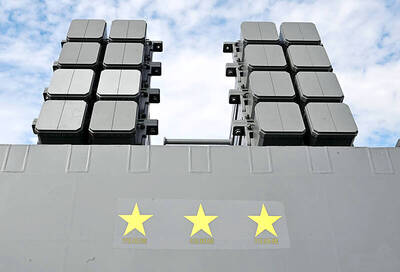
UPGRADE: The Kang Ding-class frigate is replacing its Chaparall missiles with Tien Chien II and Hua Yang VLS, which would provide it with long-range, 360° air defense Taiwan plans to produce 1,200 to 1,376 Hai Chien II missiles (海劍二, Sea Sword II) — also known as TC-2N — to serve as the standard air defense system of the navy’s surface combatant fleet, a source said yesterday. Last week, the Hai Chien II, the naval version of the Tien Kung II missile (天劍二, Sky Sword II), completed a live-fire test in waters off the National Chungshan Institute of Science and Technology’s Jiupeng facility (九鵬) in Pingtung County’s Manjhou Township (滿州). The MIM72 Chaparral and other dated air defense missiles that currently arm Taiwanese ships have inadequate range to combat Chinese

REASONS FOR TRAVEL: An assistant professor said that proposed amendments to penalize drivers if they used drugs overseas would not deter people from traveling People who operate a motor vehicle under the influence of marijuana would have their driver’s license revoked, even if they used the substance while overseas, the Ministry of Transportation and Communications said yesterday, citing proposed amendments to the Road Traffic Management and Penalty Act (道路交通管理處罰條例). The amendments would also authorize the government to revoke the licenses of people determined to have used Category 1 or Category 2 narcotics, even if they were not operating a vehicle while under the influence of drugs, as well as ban them from taking the license test for three years, the ministry said. People aged 18 or

HEAVY WEATHER: Typhoon Jangmi is due to crash straight into the Ryukyus as airlines look to shift flights to larger aircraft or cancel flights to Okinawa entirely Taiwan’s international air carriers announced flight adjustments over the weekend as Typhoon Jangmi is forecast to hit the Ryukyu Islands today and tomorrow. The Central Weather Administration (CWA) upgraded Jangmi from a tropical storm to a typhoon at 8am yesterday, with the eye located 580km south of Naha city. It was moving north at 19kph. Today, China Airlines’ CI-120, CI-121, CI-122 and CI-123 flights between Taoyuan and Naha, Okinawa, have been canceled as well as CI-132 and CI-133 between Kaohsiung and Naha. EVA Air’s BR-112, BR-113, BR-186 and BR-185 flights between Taoyuan and Naha are also canceled. Low-cost carrier Tigerair Taiwan canceled IT-230,
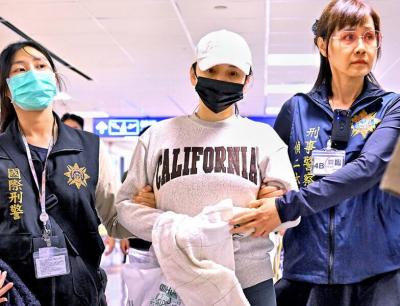
Johanne Liou (劉喬安), a Taiwanese woman who shot to unwanted fame during the Sunflower movement protests in 2014, returned to Taiwan last night after being deported from the US. She is to stand trial in Taiwan for charges involving embezzlement, fraud and drug crimes. The Criminal Investigation Bureau (CIB) said it took her into custody at Taiwan Taoyuan International Airport and would first question her before transferring her to the New Taipei District Prosecutors’ Office. She was arrested upon disembarking a flight from San Francisco that landed shortly before 7pm. Liou absconded to the US in 2019 after jumping bail


 RSS
RSS