


President-elect Tsai Ing-wen (蔡英文) yesterday promised that she would resolve all conflict of interest issues before her inauguration on May 20, after an article published by an online media source questioned the connection between her brother, Tsai Ying-yang (蔡瀛陽), and OBI Pharma Inc (台灣浩鼎).
A letter to the editor published by the online news outlet Storm Media said that it is curious that Tsai Ing-wen seems to have close ties with OBI Pharma, adding that she visited the company’s chairman in person after it failed a test on a new drug.
The article went on to say that a search through the Ministry of Economic Affairs’ database would reveal that Fu-tai Investment Co (富鈦投資), for which Tsai Ying-yang is a board member, is a major stockholder in OBI Pharma.
Fu-tai was previously named Chieh-sheng Investment Co (潔生投資), after Tsai Ing-wen’s father, Tsai Chieh-sheng (蔡潔生), the author said, questioning the connection between the Tsai family and OBI Pharma, suggesting that Tsai Ing-wen should follow President Ma Ying-jeou’s (馬英九) example and ask her relatives to step down from positions to avoid any conflicts of interest.
Through Democratic Progressive Party spokesperson Wang Min-sheng (王閔生), the president-elect said that she has not participated in and knows nothing about the investment activities of her brother and sister-in-law.
“It is natural for a national leader to be concerned about industrial developments, including the biotech industry, which would be considered an important industry by any government regardless of party affiliation,” Wang said. “The visit [to OBI Pharma] on Wednesday was arranged by the institute for biotechnology and medicine industry, and it was aimed at engaging in a dialogue with the entire industry.”
Since Tsai Ing-wen’s election last month, she has prioritized addressing conflict of interest issues before her inauguration, Wang added.
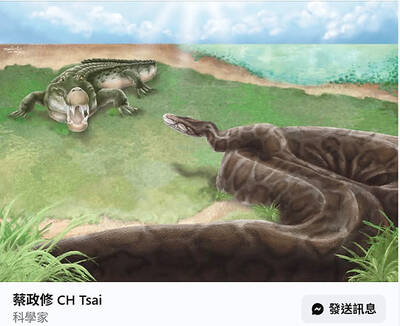
Taiwanese paleontologists have discovered fossil evidence that pythons up to 4m long inhabited Taiwan during the Pleistocene epoch, reporting their findings in the international scientific journal Historical Biology. National Taiwan University (NTU) Institute of Ecology and Evolutionary Biology associate professor Tsai Cheng-hsiu (蔡政修) led the team that discovered the largest snake fossil ever found in Taiwan. The single trunk vertebra was discovered in Tainan at the Chiting Formation, dated to between 400,000 and 800,000 years ago in the Middle Pleistocene, the paper said. The area also produced Taiwan’s first avian fossil, as well as crocodile, mammoth, saber-toothed cat and rhinoceros fossils, it said. Discoveries

WATCH FOR HITCHHIKERS: The CDC warned those returning home from Japan to be alert for any contagious diseases that might have come back with them People who have returned from Japan following the World Baseball Classic (WBC) games during the weekend are recommended to watch for symptoms of infectious gastroenteritis, flu and measles for two weeks, the Centers for Disease Control (CDC) said. Flu viruses remain the most common respiratory pathogen in Taiwan in the past four weeks and the influenza B virus accounted for 55.7 percent of the tested cases, exceeding the percentage of influenza A (H3N2) infections and becoming the local dominant strain, CDC Epidemic Intelligence Center Deputy Director Lee Chia-lin (李佳琳) said at a news conference on Tuesday. There were 82,187 hospital visits for

Alumni from Japan’s Kyoto Tachibana Senior High School marching band, widely known as the “Orange Devils,” staged a flash mob performance at the Grand Hotel in Taipei yesterday to thank Taiwan for its support after the Great East Japan Earthquake. The show, performed on the earthquake’s 15th anniversary, drew more than 100 spectators, some of whom arrived two hours before the show to secure a good viewing spot. The 26-member group played selections from “High School Musical,” “Beauty and the Beast,” and their signature piece “Sing Sing Sing” and shouted “I love

Taiwan’s three major international carriers are increasing booking fees, with EVA Airways having already increased the charge to US$28 per flight segment from US$25, while China Airlines (CAL) and Starlux Airlines are set to follow suit. Booking fees are charged by airlines through a global distribution system (GDS) and passed on to passengers. Carriers that apply the fees include CAL, EVA, Starlux and Tigerair Taiwan. A GDS is a computerized network operated by a company that connects airlines with travel agents and ticketing platforms, allowing reservations to be made and processed in real time. Major players include Amadeus, Sabre and Travelport. EVA Air began


 RSS
RSS