


Nine Audi A8L armored vehicles are to begin their service to president-elect Tsai Ing-wen (蔡英文) and her entourage starting on her inauguration on May 20, people with knowledge of the matter said.
Volkswagen (VW) Taiwan outbid BMW’s Taiwan franchise in a National Security Bureau (NSB) procurement tender to replace the BMW 740Li — the current presidential vehicle — with the Audi A8L, they said.
The NSB procurement aimed to purchase nine five-seater armored security vehicles for the five-car presidential motorcade and the four-vehicle vice presidential motorcade, with nine Audi A8L cars to be used as presidential sedans offered at NT$31.09 million (US$923,923), according to an NSB budget plan.
The cars are scheduled to be delivered by mid-April after the NSB awarded the bid to VW Taiwan, the people said.
The BMW 740Li has served as presidential vehicles for the past 12 years, since 2004 during the second term of then-president Chen Shui-bian (陳水扁).
All models that VW Taiwan and BMW’s Taiwan franchise offered for the bid met NSB security requirements, while the tender was done publicly and the contract was awarded to the lowest bidder, with VW Taiwan securing the bid with a “fairly favorable price,” they said.
The presidential motorcade, comprising the presidential vehicle, a backup car and security vehicles, would be made of the same models with identical looks, sources said, adding that to ensure the safety of president, the vehicle to be customized as the presidential car would undergo special modifications, such as bulletproofing and having armor plates.
The government commissioned Cadillac vehicles for presidential use during the tenure of former presidents Chiang Kai-shek (蔣介石) and Chiang Ching-kuo (蔣經國), whereas Cadillac and Mercedes cars were used as presidential vehicles during terms of former president Lee Teng-hui (李登輝), said a retired official, who asked not to be named.
An elongated Lincoln limousine was used as the presidential sedan in Chen’s first term, and the BMW 740Li and the Ford E350 armored van were used alternatively in his second term, while the BMW 740Li served as the official state car throughout Ma’s two terms, the retired official said.
A sport utility vehicle from Land Rover’s Discovery series was commissioned to ferry presidential candidates during campaigning for the presidential and legislative elections earlier this month.
Besides ensuring the safety of the president, presidential cars are often considered a symbol of a nation’s automobile industry, so nations often adopt domestically manufactured cars as state vehicles, such as the Citroen DS5 used by French President Francois Hollande, the Toyota Camry hybrid used by Japanese Prime Minister Shinzo Abe and the Hongqi L5 used by Chinese President Xi Jinping (習近平).
German Chancellor Angela Merkel has been known for her penchant for Audi vehicles and she doubled as an Audi product endorser to unveil the company’s new models to promote the German automobile industry, while an Audi A8L armored model is used as Germany’s official state car.

The military has spotted two Chinese warships operating in waters near Penghu County in the Taiwan Strait and sent its own naval and air forces to monitor the vessels, the Ministry of National Defense (MND) said. Beijing sends warships and warplanes into the waters and skies around Taiwan on an almost daily basis, drawing condemnation from Taipei. While the ministry offers daily updates on the locations of Chinese military aircraft, it only rarely gives details of where Chinese warships are operating, generally only when it detects aircraft carriers, as happened last week. A Chinese destroyer and a frigate entered waters to the southwest
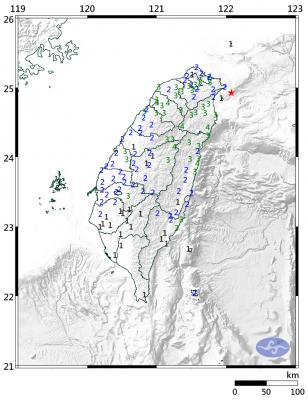
A magnitude 6.1 earthquake struck off the coast of Yilan County at 8:39pm tonight, the Central Weather Administration (CWA) said, with no immediate reports of damage or injuries. The epicenter was 38.7km east-northeast of Yilan County Hall at a focal depth of 98.3km, the CWA’s Seismological Center said. The quake’s maximum intensity, which gauges the actual physical effect of a seismic event, was a level 4 on Taiwan’s 7-tier intensity scale, the center said. That intensity level was recorded in Yilan County’s Nanao Township (南澳), Hsinchu County’s Guansi Township (關西), Nantou County’s Hehuanshan (合歡山) and Hualien County’s Yanliao (鹽寮). An intensity of 3 was
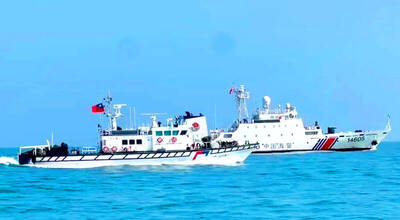
Instead of focusing solely on the threat of a full-scale military invasion, the US and its allies must prepare for a potential Chinese “quarantine” of Taiwan enforced through customs inspections, Stanford University Hoover fellow Eyck Freymann said in a Foreign Affairs article published on Wednesday. China could use various “gray zone” tactics in “reconfiguring the regional and ultimately the global economic order without a war,” said Freymann, who is also a nonresident research fellow at the US Naval War College. China might seize control of Taiwan’s links to the outside world by requiring all flights and ships entering or leaving Taiwan
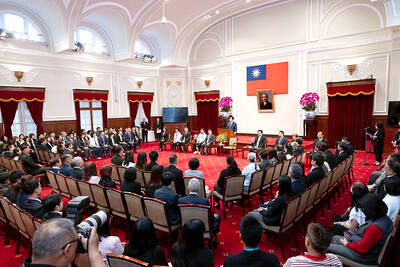
The next minimum wage hike is expected to exceed NT$30,000, President William Lai (賴清德) said yesterday during an award ceremony honoring “model workers,” including migrant workers, at the Presidential Office ahead of Workers’ Day today. Lai said he wished to thank the awardees on behalf of the nation and extend his most sincere respect for their hard work, on which Taiwan’s prosperity has been built. Lai specifically thanked 10 migrant workers selected for the award, saying that although they left their home countries to further their own goals, their efforts have benefited Taiwan as well. The nation’s industrial sector and small businesses lay


 RSS
RSS