


Birdwatchers can find a treat along Taipei’s riverside cycling paths, where wild birds of the Anatidae family, red-tailed shrikes, kestrels and white egrets have been arriving since late September, a spokesman for the city’s Hydraulic Engineering Office said on Thursday.
Taipei has a 112km network of bikeways and parks along the Keelung (基隆河), Tamsui (淡水河), Xindian (新店河) and Jingmei (景美溪) rivers, according to the office, which is responsible for the maintenance and management of river-related construction projects.
Until the end of March, cyclists along these paths can watch the arrival of migratory birds from the north that overwinter in Taiwan, the office’s spokesman said.
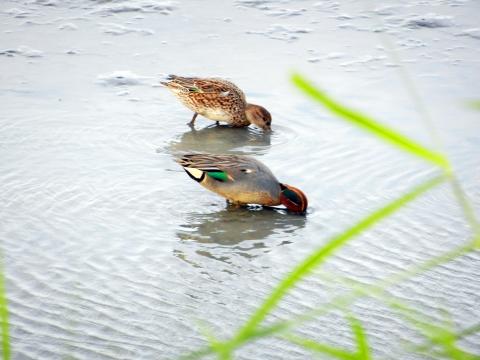
Photo: Ho Shih-chang, Taipei Times
He said red-tailed shrikes usually arrive early at the riverside parks, around late September or early October, adding that herons, sandpipers and little ringed plovers can be seen at the intertidal zone of the low-lying Shezidao (社子島) peninsula at the confluence of the Keelung and Tamsui rivers in Taipei’s Shilin District (士林).
For those interested in birds of prey, the spokesman recommended visiting the riverside parks along the Xindian and Jingmei rivers, where kestrels and black kites can be spotted gliding along as they hunt for food.
Wild birds from the Anatidae family, including geese and ducks, have also started flying into Taipei’s wetlands, the spokesman said, adding that large flocks can be seen on the riverbank near Huajiang Bridge (華江橋) during winter.

ANOTHER EMERGES: The CWA yesterday said this year’s fourth storm of the typhoon season had formed in the South China Sea, but was not expected to affect Taiwan Tropical Storm Gaemi has intensified slightly as it heads toward Taiwan, where it is expected to affect the country in the coming days, the Central Weather Administration (CWA) said yesterday. As of 8am yesterday, the 120km-radius storm was 800km southeast of Oluanpi (鵝鑾鼻), Taiwan’s southernmost tip, moving at 9kph northwest, the agency said. A sea warning for Gaemi could be issued tonight at the earliest, it said, adding that the storm is projected to be closest to Taiwan on Wednesday or Thursday. Gaemi’s potential effect on Taiwan remains unclear, as that would depend on its direction, radius and intensity, forecasters said. Former Weather Forecast

As COVID-19 cases in Japan have been increasing for 10 consecutive weeks, people should get vaccinated before visiting the nation, the Centers for Disease Control (CDC) said. The centers reported 773 hospitalizations and 124 deaths related to COVID-19 in Taiwan last week. CDC Epidemic Intelligence Center Director Guo Hung-wei (郭宏偉) on Tuesday said the number of weekly COVID-19 cases reported in Japan has been increasing since mid-May and surpassed 55,000 cases from July 8 to July 14. The average number of COVID-19 patients at Japan’s healthcare facilities that week was also 1.39 times that of the week before and KP.3 is the dominant

The Chinese Communist Party’s (CCP) working group for Taiwan-related policies is likely to be upgraded to a committee-level body, a report commissioned by the Mainland Affairs Council (MAC) said. As Chinese President Xi Jinping (習近平) is increasingly likely to upgrade the CCP’s Central Leading Group for Taiwan Affairs, Taiwanese authorities should prepare by researching Xi and the CCP, the report said. At the third plenary session of the 20th Central Committee of the CCP, which ended on Thursday last week, the party set a target of 2029 for the completion of some tasks, meaning that Xi is likely preparing to

US-CHINA TRADE DISPUTE: Despite Beijing’s offer of preferential treatment, the lure of China has dimmed as Taiwanese and international investors move out Japan and the US have become the favored destinations for Taiwanese graduates as China’s attraction has waned over the years, the Ministry of Labor said. According to the ministry’s latest income and employment advisory published this month, 3,215 Taiwanese university graduates from the class of 2020 went to Japan, surpassing for the first time the 2,881 graduates who went to China. A total of 2,300 graduates from the class of 2021 went to the US, compared with the 2,262 who went to China, the document showed. The trend continued for the class of 2023, of whom 1,460 went to Japan, 1,334 went to


 RSS
RSS