


Minister of Culture Hung Meng-chi (洪孟啟) on Monday promised the Taitung County Government that the ministry would assist in efforts to have the Basiandong Historical Site (caves of eight deities, 八仙洞遺址) listed as a potential world heritage site.
Basiandong, on cliffs facing the Pacific Ocean in Changbin Township (長濱), is made up of dozens of natural sea caves that are the result of erosion carving out softer rock.
They are scattered among 150m-tall cliffs that were pushed up due to the upward motion of the Earth’s crust in the area.
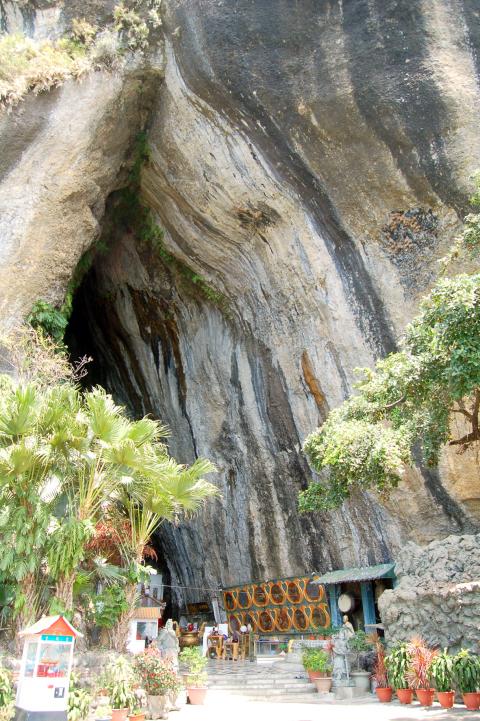
Photo: Huang Ming-tang, Taipei Times
In 1968, geologists and archeologists discovered in the caves evidence of a Paleolithic pottery culture — which was later named the Changbin Culture — the Taitung Bureau of Cultural Heritage said.
Basiandong is the oldest prehistoric site to have been found in Taiwan, with researchers saying it dates back to 30,000 years ago, and it has been designated a national heritage site.
Democratic Progressive Party Legislator Liu Chao-hao (劉櫂豪) said at the legislature that Basiandong has the potential to become a world heritage site.
Liu asked the ministry to help facilitate the process by adding the site to a list of 18 potential world heritage sites in Taiwan, which includes Fort San Domingo in New Taipei City’s Tamsui District (淡水).
If Basiandong is added to the list, it will be the third potential world heritage site in the county, after the Peinan Archeological Site in Beinan Township (卑南) — the largest-known ancient stone coffin burial ground in the Pacific Rim area — and Orchid Island (蘭嶼, also known as Lanyu).
The government is continuing to promote Taiwan’s cultural and natural assets to earn “world heritage” status, which refers to sites, groups of buildings, monuments and natural environments of outstanding universal value listed on the UNESCO World Heritage List, the bureau said.
The Taitung County Government has to submit an application to the bureau for review as the first step in its bid to get Basiandong on the UNESCO list.
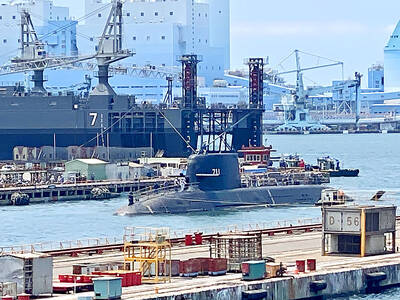
AGING: While Japan has 22 submarines, Taiwan only operates four, two of which were commissioned by the US in 1945 and 1946, and transferred to Taiwan in 1973 Taiwan would need at least 12 submarines to reach modern fleet capabilities, CSBC Corp, Taiwan chairman Chen Cheng-hung (陳政宏) said in an interview broadcast on Friday, citing a US assessment. CSBC is testing the nation’s first indigenous defense submarine, the Hai Kun (海鯤, Narwhal), which is scheduled to be delivered to the navy next month or in July. The Hai Kun has completed torpedo-firing tests and is scheduled to undergo overnight sea trials, Chen said on an SET TV military affairs program. Taiwan would require at least 12 submarines to establish a modern submarine force after assessing the nation’s operational environment and defense

A white king snake that frightened passengers and caused a stir on a Taipei MRT train on Friday evening has been claimed by its owner, who would be fined, Taipei Rapid Transit Corp (TRTC) said yesterday. A person on Threads posted that he thought he was lucky to find an empty row of seats on Friday after boarding a train on the Bannan (Blue) Line, only to spot a white snake with black stripes after sitting down. Startled, he jumped up, he wrote, describing the encounter as “terrifying.” “Taipei’s rat control plan: Release snakes on the metro,” one person wrote in reply, referring
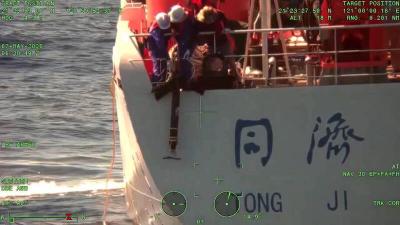
The coast guard today said that it had disrupted "illegal" operations by a Chinese research ship in waters close to the nation and driven it away, part of what Taipei sees a provocative pattern of China's stepped up maritime activities. The coast guard said that it on Thursday last week detected the Chinese ship Tongji (同濟號), which was commissioned only last year, 29 nautical miles (54km) southeast of the southern tip of Taiwan, although just outside restricted waters. The ship was observed lowering ropes into the water, suspected to be the deployment of scientific instruments for "illegal" survey operations, and the coast
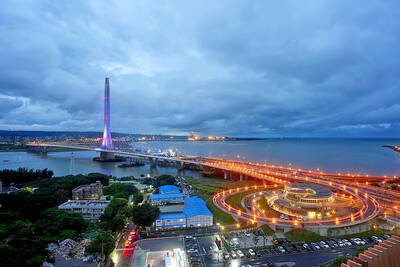
An inauguration ceremony was held yesterday for the Danjiang Bridge, the world’s longest single-mast asymmetric cable-stayed bridge, ahead of its official opening to traffic on Tuesday, marking a major milestone after nearly three decades of planning and construction. At the ceremony in New Taipei City attended by President William Lai (賴清德), Premier Cho Jung-tai (卓榮泰), Minister of Transportation and Communications Chen Shih-kai (陳世凱) and New Taipei City Mayor Hou Yu-ih (侯友宜), the bridge was hailed as both an engineering landmark and a long-awaited regional transport link connecting Tamsui (淡水) and Bali (八里)


 RSS
RSS