


Chinese Nationalist Party (KMT) presidential candidate Hung Hsiu-chu (洪秀柱) yesterday said it would not reflect well on any party member — especially the chairman — if her election campaign ends in a drubbing.
The deputy legislative speaker said on a political talk show on Monday night that if she loses by a landslide in the Jan. 16 election “it would not look good for [KMT Chairman] Eric Chu (朱立倫) either.”
Hung denied that the statement was a threat to the KMT chairman, as some media pundits have interpreted it.
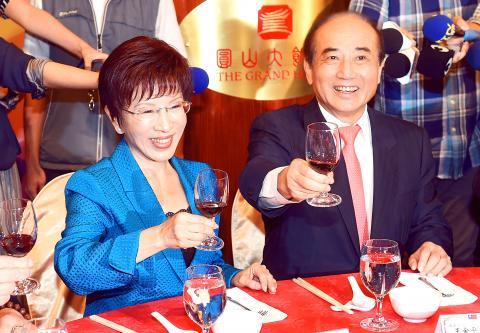
Photo: Chang Chia-ming, Taipei Times
“If I do not fare well in the election, I believe that it would leave many in the party who are strongly committed to this country feeling frustrated. Is it wrong to say that if I lose, all party comrades and supporters would feel bad?” Hung said.
Legislative Speaker Wang Jin-pyng (王金平), who was also at a lunch hosted by the World Taiwanese Chambers of Commerce, an annual event attended by the legislative and deputy legislative speakers, agreed, saying: “If the election result is not good, certainly everyone [in the party] would be upset.”
Both were also asked about reports that a pro-localization faction of the KMT is planning to found a “Taiwan Nationalist Party Alliance” to force party headquarters to replace Hung as presidential candidate.
Hung said that Taiwan is too small for the KMT to divide into different factions.
“Everyone is a member of local factions, as we were all born and raised locally. There would be nothing left if we continue to divide ourselves into more factions. Nothing is more crucial than party unity,” she said.
Wang, who is widely considered to be a key figure for the party’s local factions, dismissed the reports.
Wang said that senior presidential adviser Liao Liou-yi (廖了以) — who is rumored to be a key proponent of the alliance — had said “he would respond to the question as there is no such thing. What he has been working on has nothing to do with the so-called Taiwan Nationalist Party Alliance.”
Asked about Hung’s comment and its impact on Chu, KMT Legislator and caucus whip Lin Te-fu (林德福), who is running for re-election, said that the party respects Hung’s views, while stressing that Chu “has been supporting her with full force.”
“Chu has been present at many events with Hung to support her,” Lin said, adding that as a presidential candidate, Hung needs to learn to polish her remarks.
“What is most needed now is party solidarity,” Lin said.
Lin also rejected reports about the alliance, calling it “groundless” speculation.
KMT Legislator Lu Hsueh-chang (呂學樟) said Hung needs to let go of her “self-centeredness.”
“Since you are falling behind the Democratic Progressive Party’s Tsai Ing-wen (蔡英文), you have to conjure up a better strategy and discuss it with Chu and Wang for integration,” Lu said. “It’s not your own election. What you do affects the party’s legislative candidates. Hung needs to ask herself why she cannot increase her numbers in the polls.”
When asked what he meant by Hung’s “self-centeredness,” Lu said: “Her comments are made without prior discussion with the party, like the so-called ‘one China, same interpretation.’ When you cannot explain clearly what you’re saying, it is the whole party that is influenced.”

Considering that most countries issue more than five denominations of banknotes, the central bank has decided to redesign all five denominations, the bank said as it prepares for the first major overhaul of the banknotes in more than 24 years. Central bank Governor Yang Chin-lung (楊金龍) is expected to report to the Legislative Yuan today on the bank’s operations and the redesign’s progress. The bank in a report sent to the legislature ahead of today’s meeting said it had commissioned a survey on the public’s preferences. Survey results showed that NT$100 and NT$1,000 banknotes are the most commonly used, while NT$200 and NT$2,000

The Centers for Disease Control (CDC) yesterday reported the first case of a new COVID-19 subvariant — BA.3.2 — in a 10-year-old Singaporean girl who had a fever upon arrival in Taiwan and tested positive for the disease. The girl left Taiwan on March 20 and the case did not have a direct impact on the local community, it said. The WHO added the BA.3.2 strain to its list of Variants Under Monitoring in December last year, but this was the first imported case of the COVID-19 variant in Taiwan, CDC Deputy Director-General Lin Ming-cheng (林明誠) said. The girl arrived in Taiwan on

South Korea is planning to revise its controversial electronic arrival card, a step Taiwanese officials said prompted them to hold off on planned retaliatory measures, a South Korean media report said yesterday. A Yonhap News Agency report said that the South Korean Ministry of Foreign Affairs is planning to remove the “previous departure place” and “next destination” fields from its e-arrival card system. The plan, reached after interagency consultations, is under review and aims to simplify entry procedures and align the electronic form with the paper version, a South Korean ministry official said. The fields — which appeared only on the electronic form

The Ministry of Foreign Affairs (MOFA) is suspending retaliation measures against South Korea that were set to take effect tomorrow, after Seoul said it is updating its e-arrival system, MOFA said today. The measures were to be a new round of retaliation after Taiwan on March 1 changed South Korea's designation on government-issued alien resident certificates held by South Korean nationals to "South Korea” from the "Republic of Korea," the country’s official name. The move came after months of protests to Seoul over its listing of Taiwan as "China (Taiwan)" in dropdown menus on its new online immigration entry system. MOFA last week


 RSS
RSS