


Two student-rights advocates returned to the main site of protests over high-school curriculum guideline changes yesterday, completing a national walking tour to highlight the issue.
Hsu Kuan-tse (許冠澤) and Chou Tzu-hsiang (周子翔) led a parade of students and rights advocates in front of the Ministry of Education building for the final leg of the tour, shouting: “Reject black box procedures”; “Oppose brain-washing education”; and “Students are not idiots” as they marched in pouring rain to the ministry gates.
“I have already given up on ministry officials — no matter what you say, they do not listen,” Hsu said. “Eventually, when we grow up, we will take over [their] positions and do a better job.”
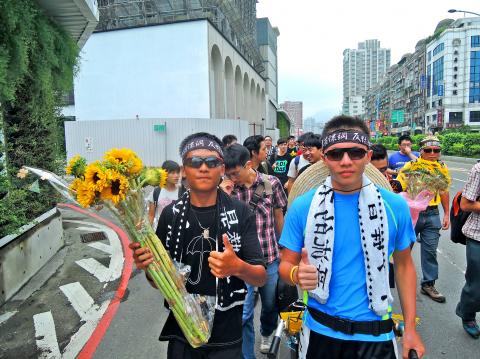
Photo: Weng Yu-huang, Taipei Times
Hsu said that while he had kept his word, finishing a nationwide walk, Minister of Education Wu Se-hwa (吳思華) had broken his promise to publicize the names of members of the committee that approved controversial “fine-tuning” of social studies guidelines.
At an Aug. 3 meeting with student leaders, Wu said he would publicize the names within 10 days, if the committee members gave their consent.
Hsu last week attempted to meet Wu at a summer school promotional event Wu was to attend at an elementary school in Jian Township (吉安) in Hualien, but Wu canceled his participation after hearing that student-rights advocates would be there.
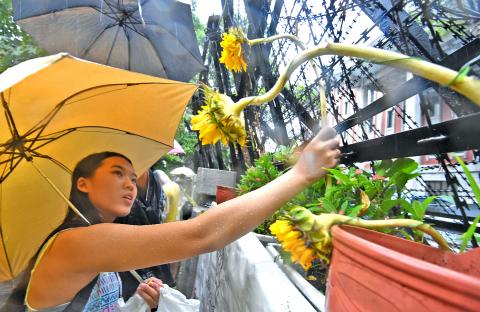
Photo: Photo: Liu Hsin-de, Taipei Times
Chou said that after completing the tour he feels like he has “fully experienced life’s hardships,” adding that he plans to focus on promoting student activism in schools and prepare for college entrance exams next year.
The pair began their tour from the ministry’s gate on July 23, walking an average of 10 to 14 hours a day, covering 1,100km, they said, adding that they presented petitions to city and county governments to oppose the guidelines.
According to media reports, they were followed by police throughout their tour, during which they staged protests, including the disruption of a ceremony for National Kaohsiung Normal University president Wu Lien-shang (吳連賞), who was reportedly on the committee that approved the guidelines.

ANOTHER EMERGES: The CWA yesterday said this year’s fourth storm of the typhoon season had formed in the South China Sea, but was not expected to affect Taiwan Tropical Storm Gaemi has intensified slightly as it heads toward Taiwan, where it is expected to affect the country in the coming days, the Central Weather Administration (CWA) said yesterday. As of 8am yesterday, the 120km-radius storm was 800km southeast of Oluanpi (鵝鑾鼻), Taiwan’s southernmost tip, moving at 9kph northwest, the agency said. A sea warning for Gaemi could be issued tonight at the earliest, it said, adding that the storm is projected to be closest to Taiwan on Wednesday or Thursday. Gaemi’s potential effect on Taiwan remains unclear, as that would depend on its direction, radius and intensity, forecasters said. Former Weather Forecast

As COVID-19 cases in Japan have been increasing for 10 consecutive weeks, people should get vaccinated before visiting the nation, the Centers for Disease Control (CDC) said. The centers reported 773 hospitalizations and 124 deaths related to COVID-19 in Taiwan last week. CDC Epidemic Intelligence Center Director Guo Hung-wei (郭宏偉) on Tuesday said the number of weekly COVID-19 cases reported in Japan has been increasing since mid-May and surpassed 55,000 cases from July 8 to July 14. The average number of COVID-19 patients at Japan’s healthcare facilities that week was also 1.39 times that of the week before and KP.3 is the dominant

The Chinese Communist Party’s (CCP) working group for Taiwan-related policies is likely to be upgraded to a committee-level body, a report commissioned by the Mainland Affairs Council (MAC) said. As Chinese President Xi Jinping (習近平) is increasingly likely to upgrade the CCP’s Central Leading Group for Taiwan Affairs, Taiwanese authorities should prepare by researching Xi and the CCP, the report said. At the third plenary session of the 20th Central Committee of the CCP, which ended on Thursday last week, the party set a target of 2029 for the completion of some tasks, meaning that Xi is likely preparing to

US-CHINA TRADE DISPUTE: Despite Beijing’s offer of preferential treatment, the lure of China has dimmed as Taiwanese and international investors move out Japan and the US have become the favored destinations for Taiwanese graduates as China’s attraction has waned over the years, the Ministry of Labor said. According to the ministry’s latest income and employment advisory published this month, 3,215 Taiwanese university graduates from the class of 2020 went to Japan, surpassing for the first time the 2,881 graduates who went to China. A total of 2,300 graduates from the class of 2021 went to the US, compared with the 2,262 who went to China, the document showed. The trend continued for the class of 2023, of whom 1,460 went to Japan, 1,334 went to


 RSS
RSS