

Scores of Amis women went to great lengths to survey historical data and interview older members of the Amis Aboriginal people to reconstruct traditional Amis clothing in its original color: black — the staple color of Amis clothes until red took over for its perceived festiveness and compatibility with ethno-tourism.
A workshop held by the Hualien City Office aimed at reviving traditional Amis garments and headdresses saw participants piece together historical materials and oral history to return traditional Amis clothing to its original color, the workshop organizer said.
The workshop held a completion ceremony on Tuesday, with participants clad in traditional black costumes and floral headpieces, singing and dancing to celebrate their accomplishment, the workshop organizer said.
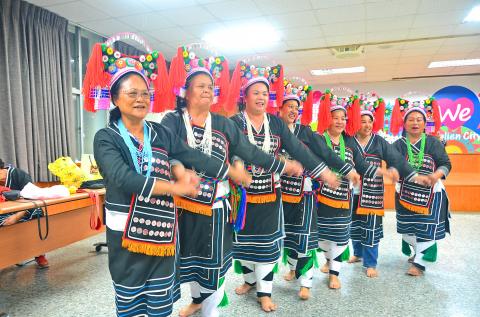
Photo: Wang Chin-i, Taipei Times
In full traditional Amis outfit, Chang Mei-hui (張美慧), wife of Hualien Mayor Tien Chih-hsuan (田智宣), attended the ceremony, saying that she urged the participants to keep reconnecting with their cultural roots and re-establishing the Amis legacy.
The city office said that it would help cement Aboriginal culture and restore lost traditional rituals.
The traditional Amis floral headdress was adorned with fresh flowers, but today, that is generally replaced with strings of beads and sequins, office section head Chang Ching-lien (張金蓮) said, adding that the coloring of necklaces serve to distinguish different Amis communities.
There have been Amis women donning traditional black garments and headdresses at harvest festivals held by different communities across Hualien County, Chang Ching-lien said.
Those certified workshop members — 40 Amis women from three different communities — are prospective teachers to spread the revitalization of traditional Amis clothing to make the clothing a mainstay of major harvest festivals at 12 Amis communities in the county in a spirit of re-energizing and transmitting a lost legacy to later generations, the office said.
Tracing the change of style provides a window to understanding the cultural development of Aborigines over the years, and such workshops aimed at cultural revitalization can enable Aborigines to better reconnect with their past and consolidate Aboriginal identity, the office said.
“It was the first time that I had my own traditional Amis clothing and I hand-sewed every seam of it,” one 50-year old workshop member said. “The black garment is a symbol of restoring the essence of traditional culture.”

The National Police Agency’s Third Special Police Corps yesterday said that from May to July, it intercepted five smuggling operations from China, seizing more than 70,000 counterfeit Beyblades with an estimated infringement value of NT$34.45 million (US$1.08 million). It added that any bootleg unit that reached the local market could present hidden health hazards to players. Beyblades, a line of spinning toy tops used in competitive gaming and developed in Japan by toy company Takara Tomy, have become popular in Taiwan, making them a target for fraudsters. The Third Special Police Corps, dedicated to safeguarding maritime borders and trade lines,

Five customers who made purchases at 7-Eleven stores across Taiwan won the top NT$10 million (US$313,716) special prize in the July-August uniform invoice lottery, including one who spent just NT$27 on photocopying, the convenience store chain said today. The five special prize winners made their purchases at stores in Taoyuan, Taipei, Taichung and Kaohsiung, 7-Eleven operator President Chain Store Corp said. The five winning purchases included NT$29 spent on snacks at a store in Taoyuan's Zhongli District (中壢), NT$27 on photocopying at a store in Taipei's Zhongzheng District (中正), NT$139 on City Cafe coffee and daily necessities at a store in Taipei's
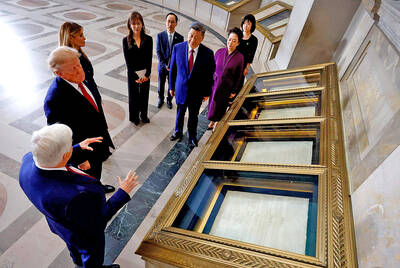
Chinese President Xi Jinping (習近平) reportedly cut short his visit to the National Archives in Washington after the Chinese delegation objected to plans to view the Treaty of San Francisco, sources in Washington’s media circles said. Xi and his wife, Peng Liyuan (彭麗媛), concluded their three-day state visit to the US on Friday after having tea with US President Donald Trump and first lady Melania Trump at the White House and visiting the archives. Chinese democracy advocates and members of pro-China groups gathered outside the venue during Xi’s visit, with the two groups exchanging competing slogans while police kept them separated. The US

TRICKY ISSUE: Taiwan’s defense of the ROC in WWII could conflict with the government’s narrative on Taiwanese history and identity, an academic said Chinese President Xi Jinping (習近平) had no standing to discuss US-China relations in World War II (WWII), as the People’s Republic of China did not exist at that time, Mainland Affairs Council (MAC) Deputy Minister Shen Yu-chung (沈有忠) said yesterday. Taipei would ensure that Washington has a clear understanding that it was the Republic of China (ROC), not the People’s Republic of China (PRC), that was a steadfast ally of the US in WWII, Shen said. Shen was referring to a White House fact sheet released on Friday about Xi’s meeting with US President Donald Trump in Washington. It said that “the two


 RSS
RSS