


An exhibition that opened on Wednesday in New Taipei City is focusing on the lesser-known stories of women during the White Terror era, a period of political persecution in Taiwan that lasted from 1949 to 1987.
Titled “A Jail Beyond the Prison Walls,” the exhibition features displays such as letters written by political prisoners to their families, and video interviews with White Terror victims, their wives, daughters and sisters. Also on display are photographs, artworks, personal notes and court verdicts, all pertaining to political prisoners during the White Terror era.
“For many years, the discussion on the White Terror era was focused on the political victims themselves — how and why they were imprisoned and their lives after prison — but we cannot exclude the stories of their families if we wish to gain a comprehensive understanding of the collective pain and suffering of our society,” National Human Rights Museum Preparatory Office director Wang Yi-chun (王逸群) said.
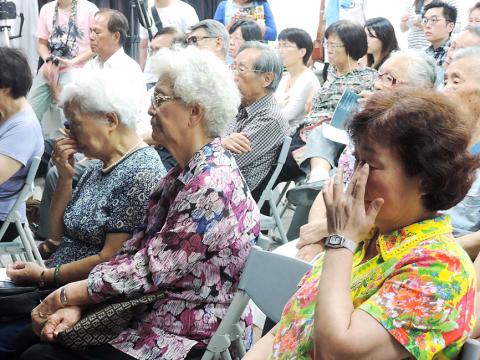
Photo: Weng Yu-huang, Taipei Times
Among the items on display is a seashell painting that political prisoner Tseng Meng-lan (曾夢蘭) made in prison for his daughter Tseng Yu-pin (曾玉霦). The painting features two white cranes on a tree and is signed “from father.”
In a written account, Tseng Yu-pin said her father’s imprisonment had deeply affected her family and her relationships with men.
She once turned down the attentions of a young man because she did not want to get him into trouble, she said.
“Ten years of imprisonment had damaged my father, body and soul. How could he start over again?” she said.
Meanwhile, Ho Ying-hung (何穎紅) spoke of his mother’s enduring love for his father Ho Chuan (何川), a school teacher who was executed during the White Terror period.
“Each year, before the anniversary of my father’s death, my mother would spend over a week writing a letter to him, telling him about our lives and how the children were doing at school,” said Ho Ying-hung, whose father was killed on June 17, 1951.
“If all of those letters had been kept, they would’ve been a great collection of work,” he said.
Last month, the National Human Rights Museum Preparatory Office and Academia Sinica’s Institute of Taiwan History jointly published the oral history collection A Jail Beyond the Prison Walls: Untold Stories by Female Family Members of White Terror Victims.
Through the exhibition and publication, Wang said, he hopes young people can learn more about the painful period in Taiwan’s history and safeguard the country’s hard-won democracy.
“Only if every young person and visitor is willing to understand their own history will these same mistakes be prevented,” he said.
The White Terror refers to the suppression of political dissidents in Taiwan following the 228 Incident, an anti-government uprising in 1947 and the subsequent brutal crackdown by the then-authoritarian regime of the then-Chinese Nationalist Party (KMT). During the White Terror period, many people were killed and 140,000 to 200,000 people — many of them intellectuals and social elites — were imprisoned. The White Terror era lasted until the lifting of martial law in Taiwan in 1987. The exhibition will run until Dec. 30 at the Jing-Mei Human Rights Memorial and Cultural Park.

ANOTHER EMERGES: The CWA yesterday said this year’s fourth storm of the typhoon season had formed in the South China Sea, but was not expected to affect Taiwan Tropical Storm Gaemi has intensified slightly as it heads toward Taiwan, where it is expected to affect the country in the coming days, the Central Weather Administration (CWA) said yesterday. As of 8am yesterday, the 120km-radius storm was 800km southeast of Oluanpi (鵝鑾鼻), Taiwan’s southernmost tip, moving at 9kph northwest, the agency said. A sea warning for Gaemi could be issued tonight at the earliest, it said, adding that the storm is projected to be closest to Taiwan on Wednesday or Thursday. Gaemi’s potential effect on Taiwan remains unclear, as that would depend on its direction, radius and intensity, forecasters said. Former Weather Forecast

As COVID-19 cases in Japan have been increasing for 10 consecutive weeks, people should get vaccinated before visiting the nation, the Centers for Disease Control (CDC) said. The centers reported 773 hospitalizations and 124 deaths related to COVID-19 in Taiwan last week. CDC Epidemic Intelligence Center Director Guo Hung-wei (郭宏偉) on Tuesday said the number of weekly COVID-19 cases reported in Japan has been increasing since mid-May and surpassed 55,000 cases from July 8 to July 14. The average number of COVID-19 patients at Japan’s healthcare facilities that week was also 1.39 times that of the week before and KP.3 is the dominant

The Chinese Communist Party’s (CCP) working group for Taiwan-related policies is likely to be upgraded to a committee-level body, a report commissioned by the Mainland Affairs Council (MAC) said. As Chinese President Xi Jinping (習近平) is increasingly likely to upgrade the CCP’s Central Leading Group for Taiwan Affairs, Taiwanese authorities should prepare by researching Xi and the CCP, the report said. At the third plenary session of the 20th Central Committee of the CCP, which ended on Thursday last week, the party set a target of 2029 for the completion of some tasks, meaning that Xi is likely preparing to

US-CHINA TRADE DISPUTE: Despite Beijing’s offer of preferential treatment, the lure of China has dimmed as Taiwanese and international investors move out Japan and the US have become the favored destinations for Taiwanese graduates as China’s attraction has waned over the years, the Ministry of Labor said. According to the ministry’s latest income and employment advisory published this month, 3,215 Taiwanese university graduates from the class of 2020 went to Japan, surpassing for the first time the 2,881 graduates who went to China. A total of 2,300 graduates from the class of 2021 went to the US, compared with the 2,262 who went to China, the document showed. The trend continued for the class of 2023, of whom 1,460 went to Japan, 1,334 went to


 RSS
RSS