


The armed forces on Thursday unveiled a next-generation assault rifle developed by the Armament Bureau’s 205th Armory.
The gold-plated model XT-105 rifle displayed at a press event in Kaohsiung was the first off the production line. The 205th Armory started developing the weapon in 2012.
The rifle is designed to meet the stringent tactical requirements of modern urban warfare, counterterrorism and close quarters combat, the armory said.
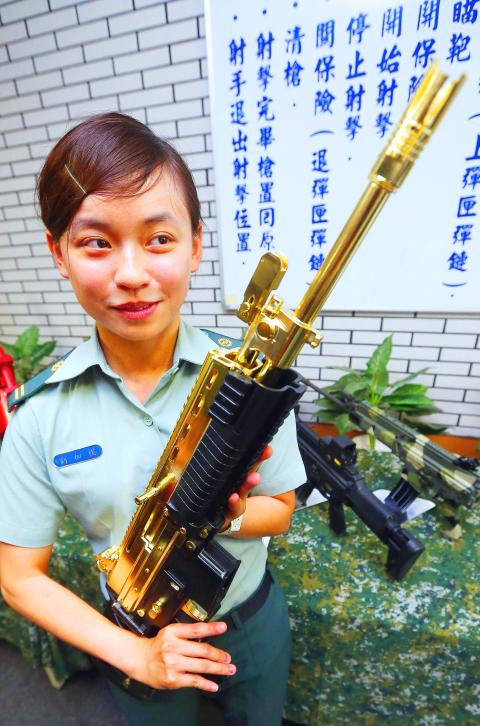
Photo: CNA
Dubbed a multiutilization special rifle (MSR), the 5.56mm by 45mm weapon is designed for versatility and can be fitted with barrels of three different lengths — 300mm, 360mm and 450mm.
It can also be outfitted with attachments, sights and optical scopes without the need for additional gun mounts and railing systems.
The weapon ejects spent shells forward to the right so there is no danger of burns to the operator.
The next-generation weapon features high accuracy and low recoil, an ambidextrous design and a collapsible stock for easy handling.
The weapon also forgoes the three-round burst firing mode, allowing for a more manageable fully automatic mode at a lower rate of fire.
Although the 205th Armory declined to give details, it said it may consider export of the X105, which can be customized to buyers’ needs.
The 205th Armory also showcased the XT-104, a 9mm sub-machine gun with low recoil that can be easily operated, even by novices; the K1 pistol with a laser-guided sight; and a close quarters combat version of the armed forces’ mainstay T-91 rifle, with a shorter barrel.
The 205th Armory traces its roots to the Qing Dynasty, when it was known as the Suzhou Western Artillery Bureau under imperial rule.
It moved to Kaohsiung as part of the retreat to Taiwan in 1949 after the Nationalists were defeated by Chinese Communist forces in the Chinese Civil War.
Since then, the 205th Armory has developed a number of weapons for the armed forces, including the T65 and T91 assault rifles, the T-75 20mm cannon, and various other small arms.

FUKUOKA SITUATION: Japanese media reported that the pathogen is expected to be identified by the summer, while the CDC downplayed the idea that it was hMPV A “mysterious cold-like illness” reported in Japan’s Fukuoka Prefecture does not seem to be a new disease, but Japanese authorities have been asked about the situation, the Centers for Disease Control (CDC) said yesterday. The Fukuoka Prefectural Medical Association on Wednesday told a news conference that a “mystery cold” that has become a hot topic on social media is “highly likely to be caused by some kind of viral infection,” Japan’s KBC News reported. “Many people are experiencing symptoms starting with a sore throat, followed by a runny nose, phlegm and a severe cough,” KBC News reported, citing association officials. Health authorities are

Nvidia Corp CEO Jensen Huang (黃仁勳) arrived in Taiwan yesterday ahead of upcoming AI and technology events, saying he plans to meet with clients and Taiwan Semiconductor Manufacturing Co Chairman C.C. Wei (魏哲家) during his visit. After landing at Taipei Songshan Airport, Huang posed for photos with fans and handed out Yakult drinks to reporters and supporters waiting at the scene, saying he has “a lot to do” during the trip. Asked about reports that Nvidia’s planned headquarters site in Taipei’s Beitou Shilin Technology Park could break ground on May 27, Huang said that if the company holds an event, he would

Carrefour Taiwan is to begin using a new name from the start of July, but it cannot divulge the name until then, the chairman of the supermarket chain's parent company said today. President Chain Store Co chairman Lo Chih-hsien (羅智先) was asked by reporters after a shareholders' meeting to confirm whether the company has settled on a new name for the supermarket brand. In March, the government-registered name of two Carrefour Taiwan branches was quietly changed to "Le Chia Kang" (樂家康) in Chinese, raising speculation that has been selected as the name. Lo said that because of local regulations and contractual obligations, the

The Philippines would likely be involved in any conflict over Taiwan due to its proximity to the democracy claimed by China, President Ferdinand Marcos Jr said, reiterating a stance that risks angering Beijing. “In the Philippines, we do not have a choice because Taiwan is so close to the Philippines and we have almost 200,000 Filipino nationals living and working in Taiwan,” Marcos said in an interview with Japanese media in Manila on Monday. The Philippine leader’s comments come ahead of a state visit to Japan next week, where he is to meet with Japanese Prime Minister Sanae Takaichi to discuss security


 RSS
RSS