


Foot-and-mouth disease has been found on a Kinmen County cattle farm, the Council of Agriculture (COA) said yesterday, adding that all infected cattle have been euthanized. The council said the virus might have originated in China, as the strain detected is a 99 percent match to that found in China’s Guangdong Province in 2013. Council officials said it is the first time that strain has been found in Taiwan.
Council Deputy Minister Wang Cheng-teng (王政騰) said routine examinations conducted on April 17 turned up positive test results for foot-and-mouth disease and the council took immediate steps to contain the disease on the farm.
On April 23 two more cows on the farm tested positive for the disease and council staff took blood and pharyngeal fluid specimens from 15 others to test. The results released on Friday last week showed one of the 15 tested positive for the disease and the cow was euthanized on Saturday, Wang said.
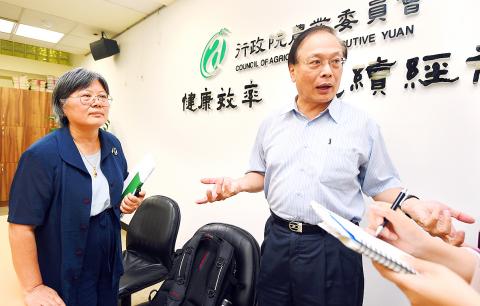
Photo: Liao Chen-huei, Taipei Times
Foot-and-mouth disease can be a severe blow to farmers, Wang said, citing a 1997 outbreak of type O foot-and-mouth among swine in the nation that led to the slaughter of 3 million pigs.
The type A foot-and-mouth disease found in Kinmen is different from the type O Southeast Asia strain and the type O pan-Asia strain, Animal Health Research Institute director Tsai Hsiang-jung (蔡向榮) said.
As the virus can be spread through the air, disease prevention measures include testing all livestock farms within a radius of 1km of an infected site and on-site inspections for farms within a 1km to 3km radius, Bureau of Animal and Plant Health Inspection and Quarantine Director-General Chang Su-san (張淑賢) said.
Humans can also become virus carriers and pass the disease on to hoofed animals, academics said.
The bureau called in experts on Thursday to discuss whether it was necessary to enlarge containment parameters, Chang said, adding that the bureau had forwarded the information to the World Organization for Animal Health.
The remaining 175 cows on the farm where the disease was originally found were put down after Thursday’s meeting, Chang said.
Wang said authorities will step up quarantine inspection at ports of entry as part of the efforts to prevent the spread of the disease.
He said the virus may have been transported to Kinmen via the “small three links” from China’s Fujian Province.
The council has banned fresh-meat imports from Kinmen County to Taiwan proper as well as processed foodstuffs that are subject to high-temperature treatment, such as beef jerky.
Kinmen beef jerky is one of the island’s most popular food products.
Wang said Kinmen has more than 15,000 livestock.

Taipei has once again made it to the top 100 in Oxford Economics’ Global Cities Index 2025 report, moving up five places from last year to 60. The annual index, which was published last month, evaluated 1,000 of the most populated metropolises based on five indices — economics, human capital, quality of life, environment and governance. New York maintained its top spot this year, placing first in the economics index thanks to the strength of its vibrant financial industry and economic stability. Taipei ranked 263rd in economics, 44th in human capital, 15th in quality of life, 284th for environment and 75th in governance,

The Sports Administration yesterday demanded an apology from the national table tennis association for barring 17-year-old Yeh Yi-tian (葉伊恬) from competing in the upcoming World Table Tennis (WTT) United States Smash tournament in Las Vegas this July. The sports agency said in a statement that the Chinese Taipei Table Tennis Association (CTTTA) must explain to the public why it withdrew Yeh from the WTT tournament in Las Vegas. The sports agency said it contacted the association to express its disapproval of the decision-making process after receiving a complaint from Yeh’s coach, Chuang
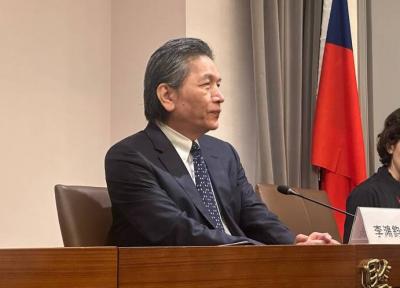
Control Yuan Secretary-General Lee Chun-yi (李俊俋) tendered his resignation last night, admitting that he had misused a government vehicle, as reported by media. His resignation was immediately accepted by the Control Yuan. In a statement explaining why he had resigned, Lee apologized for using a Control Yuan vehicle to transport his dog to a pet grooming salon on May 20. The issue first came to light late last month, when TVBS News reported that Lee had instructed his driver to take the dog to the salon. The news channel broadcast photos that it said were taken by an unnamed whistle-blower, which purportedly showed the
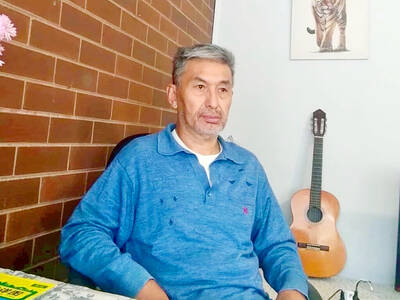
A former officer in China’s People’s Liberation Army (PLA) who witnessed the aftermath of the 1989 Tiananmen Square massacre has warned that Taiwan could face a similar fate if China attempts to unify the country by force. Li Xiaoming (李曉明), who was deployed to Beijing as a junior officer during the crackdown, said Taiwanese people should study the massacre carefully, because it offers a glimpse of what Beijing is willing to do to suppress dissent. “What happened in Tiananmen Square could happen in Taiwan too,” Li told CNA in a May 22 interview, ahead of the massacre’s 36th anniversary. “If Taiwanese students or


 RSS
RSS