


The Taipei Veterans General Hospital yesterday touted the efficacy of liver transplants for people with metabolic liver diseases, which include an array of different, sometimes rare, conditions that often lead to lifelong medication and meticulous dietary management.
“Metabolic liver diseases mainly involve patients whose liver is unable to sufficiently produce a certain type of enzyme to metabolize body waste because of genetic disorders, causing a number of nervous system and vascular conditions,” hospital director of surgery Lin Jen-kou (林楨國) told a news conference in Taipei.
Lin said that while some of the diseases can be managed with medications and special diets, others cannot and can cause irreversible damage to the body, which prompted the hospital’s rare condition center a few years ago to explore abnother approach that could eradicate the disease and improve patients’ quality of life.
Hospital Department of Pediatric Surgery physician Liu Chin-su (劉君恕) said the team then decided to opt for liver transplants and has since used the procedure to significantly improve the symptoms of 21 patients with metabolic liver diseases, with an overall success rate of 95 percent.
“Among them were three people with ornithine transcarbamylase deficiency, a genetic disorder of the urea cycle that occurs in about one out of every 80,000 people; 10 cases with methylmalonic acidemia, an inherited illness that affects one out of every 50,000 people and in which the body is unable to properly process certain proteins; and one patient with the extremely rare disorder of homocystinuria,” Liu said.
Lin said the latter case is a 28-year-old man surnamed Chen (陳) who is the first documented Asian case in medical history of homocystinuria detected through newborn screening.
Homocystinuria is a rare inherited metabolic disorder caused by cystathionine beta synthase deficiency, which affects about one out of 500,000 men in Taiwan, Lin said.
Lin added that affected people can experience abnormal accumulation of homocysteine, detachment of the crystalline lens inside the eye, a sunken chest and mental disability.
“Chen had sought to control the disorder via medicines and stringent dietary management for the first 22 years of his life, but the approach not only greatly impeded his academic and job performances, but also failed to prevent him from developing dislocation of the crystalline lens, which meant he had to undergo two surgical procedures in 2000,” Lin said.
After Chen and his family learned that liver transplantation could put an end to his misery, Lin said he readily agreed to the idea and received a donated liver in November 2009.
Now, Chen has broken free of dependence on medicine and dietary control and is planning to open his own coffee shop, Lin said.

UPGRADE: The Kang Ding-class frigate is replacing its Chaparall missiles with Tien Chien II and Hua Yang VLS, which would provide it with long-range, 360° air defense Taiwan plans to produce 1,200 to 1,376 Hai Chien II missiles (海劍二, Sea Sword II) — also known as TC-2N — to serve as the standard air defense system of the navy’s surface combatant fleet, a source said yesterday. Last week, the Hai Chien II, the naval version of the Tien Kung II missile (天劍二, Sky Sword II), completed a live-fire test in waters off the National Chungshan Institute of Science and Technology’s Jiupeng facility (九鵬) in Pingtung County’s Manjhou Township (滿州). The MIM72 Chaparral and other dated air defense missiles that currently arm Taiwanese ships have inadequate range to combat Chinese

REASONS FOR TRAVEL: An assistant professor said that proposed amendments to penalize drivers if they used drugs overseas would not deter people from traveling People who operate a motor vehicle under the influence of marijuana would have their driver’s license revoked, even if they used the substance while overseas, the Ministry of Transportation and Communications said yesterday, citing proposed amendments to the Road Traffic Management and Penalty Act (道路交通管理處罰條例). The amendments would also authorize the government to revoke the licenses of people determined to have used Category 1 or Category 2 narcotics, even if they were not operating a vehicle while under the influence of drugs, as well as ban them from taking the license test for three years, the ministry said. People aged 18 or

HEAVY WEATHER: Typhoon Jangmi is due to crash straight into the Ryukyus as airlines look to shift flights to larger aircraft or cancel flights to Okinawa entirely Taiwan’s international air carriers announced flight adjustments over the weekend as Typhoon Jangmi is forecast to hit the Ryukyu Islands today and tomorrow. The Central Weather Administration (CWA) upgraded Jangmi from a tropical storm to a typhoon at 8am yesterday, with the eye located 580km south of Naha city. It was moving north at 19kph. Today, China Airlines’ CI-120, CI-121, CI-122 and CI-123 flights between Taoyuan and Naha, Okinawa, have been canceled as well as CI-132 and CI-133 between Kaohsiung and Naha. EVA Air’s BR-112, BR-113, BR-186 and BR-185 flights between Taoyuan and Naha are also canceled. Low-cost carrier Tigerair Taiwan canceled IT-230,
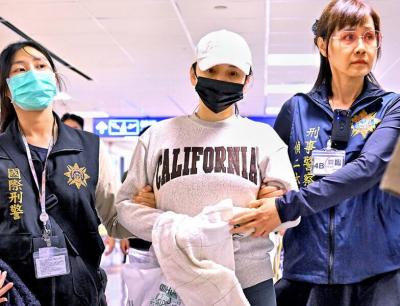
Johanne Liou (劉喬安), a Taiwanese woman who shot to unwanted fame during the Sunflower movement protests in 2014, returned to Taiwan last night after being deported from the US. She is to stand trial in Taiwan for charges involving embezzlement, fraud and drug crimes. The Criminal Investigation Bureau (CIB) said it took her into custody at Taiwan Taoyuan International Airport and would first question her before transferring her to the New Taipei District Prosecutors’ Office. She was arrested upon disembarking a flight from San Francisco that landed shortly before 7pm. Liou absconded to the US in 2019 after jumping bail


 RSS
RSS