


TransAsia Airways Flight GE222, which crashed during bad weather on July 23, was set to face a sudden drop in visibility as it came in to land, but was not alerted to the issue by air traffic control, the Aviation Safety Council said yesterday.
The council also acknowledged that Magong Airport might have had an equipment problem that prevented the control tower from getting accurate visibility data to the arriving aircraft in time.
The revelations were part of the council’s initial report on the crash titled the GE222 Occurrence Investigation Factual Data Collection Group Report. The aircraft crashed just outside the main airport on Penghu Island after aborting a prior landing attempt because of harsh weather caused by Typhoon Matmo.
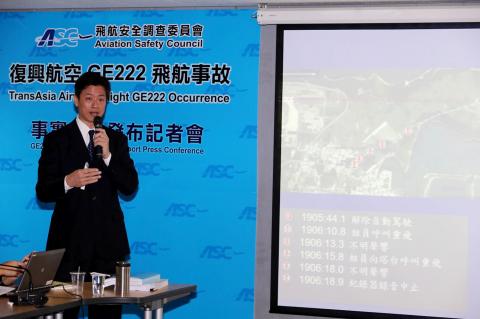
Photo: CNA
Of the 58 passengers and crew on board, 48 were killed.
In the report, the council did not try to explain the cause of the accident, but rather gave details of the circumstances leading up to the crash at 7:06pm.
According to the council, a cloud band with thunderstorms approached Magong Airport at about 7pm, just as the aricraft was heading toward it as it was thought there was an opening in the weather.
Visibility readings abruptly dropped below 1,600m, the minimum standard for landings at the airport.
Airport runway instruments showed runway visual range — the distance over which a pilot of an aircraft on the centerline of the runway can see the runway surface — plummeting to 600m at 7:02pm and close to 400m just before the crash, the report said. However, as the weather changed, there was some debate among air traffic controllers over whether the data were accurate, and they decided not to pass on the information to the pilots of the ill-fated aircraft, instead giving them the green light to land at 7:03pm.
At the same time, the control tower decided to record visibility manually, but that took time and did not yield a visibility reading of 800m until 7:10pm.
By then it was too late.
“There were indeed problems concerning the controllers’ decision in choosing which data to offer,” council managing director Thomas Wang (王興中) said.
They had doubts about the instrument’s accuracy, the council said, because its readings had not been consistent with the controllers’ visual observations during the day.
Visibility fell to 800m in the wake of Typhoon Matmo between 5:30pm and 6:30pm, but improved to 1,600m between 6:40pm and 7pm. However, during that hour instruments put runway visual range at more than 2,000m.
Still, the council said that the pilots themselves were best-placed to make judgements on visibility, and added that if the pilots could not see the runway, they should have aborted the landing.
They did in fact try to abort the landing. After being given the go-ahead to land, they reached a designated missed approach point — a predetermined point that informs pilots that a landing should be aborted — just seconds after taking over manual control of the plane at 7:05pm.
The plane crashed about a minute later when the pilots tried to go around after being unable to spot the runway.
The Aviation Safety Council said a final report on the crash would be published in October next year.
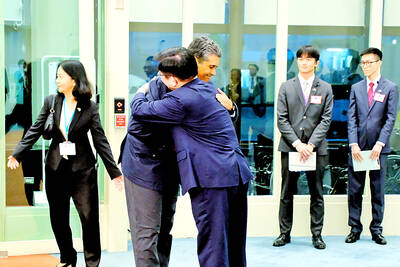
Palauan President Surangel Whipps Jr arrived in Taiwan last night to kick off his first visit to the country since beginning his second term earlier this year. After arriving at Taoyuan International Airport at around 6:30 pm, Whipps and his delegation were welcomed by Minister of Foreign Affairs Lin Chia-lung (林佳龍). Speaking to gathered media, the Palauan leader said he was excited and honored to be back in Taiwan on his first state visit to Taiwan since he was sworn in this January. Among those traveling with Whipps is Minister of State Gustav N. Aitaro, Public Infrastructure
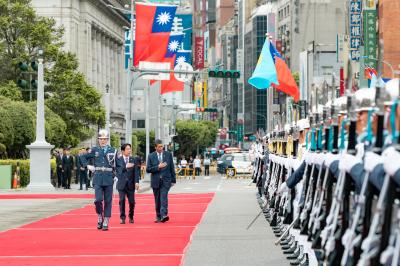
President William Lai (賴清德) yesterday thanked Palau for its continued support of Taiwan's international participation, as Taipei was once again excluded from the World Health Assembly (WHA) currently taking place in Switzerland. "Palau has never stopped voicing support for Taiwan" in the UN General Assembly, the WHO and other UN-affiliated agencies, Lai said during a bilateral meeting with visiting Palau President Surangel Whipps Jr. "We have been profoundly touched by these endorsements," Lai said, praising the Pacific island nation's firm support as "courageous." Lai's remarks came as Taiwan was excluded for the ninth consecutive year from the WHA, which is being held in
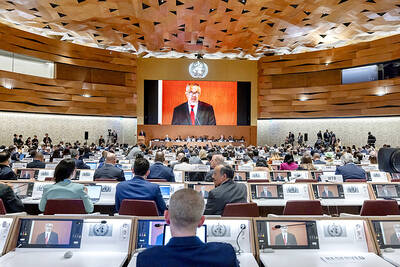
RESOLUTIONS DEBATE: Taiwan’s allies said that UN and WHA resolutions cited by China and other nations ‘do not determine Taiwan’s participation in WHO activities’ A proposal to invite Taiwan to this year’s World Health Assembly (WHA) was rejected on Monday, resulting in Taipei’s absence from the annual meeting for a ninth consecutive year, although partners spoke up for Taiwan’s participation at the first day of the meeting. The first agenda item after the opening was a “two-on-two debate” on a proposal to invite Taiwan to participate at the WHA as an observer. Similar to previous years, two countries made statements in favor of the proposal, while two others expressed their opposition. Philippine Secretary of Health Teodoro Herbosa, president of the 78th WHA, accepted the WHA General Committee’s
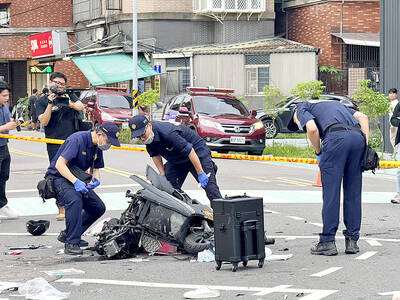
At least three people died and more than a dozen were injured yesterday afternoon when a vehicle struck a group of pedestrians in New Taipei City’s Sansia District (三峽). The incident happened at about 4pm when a car rammed into pedestrians at an intersection near Bei Da Elementary School. Witnesses said the sedan, being driven at a high speed, ran a red light, knocking scooters out of the way and hitting students crossing the road before careening into a median near the intersection of Guocheng and Guoguang streets. The incident resulted in three deaths and 13 injuries, including the driver, a 78-year-old man


 RSS
RSS