


Independent Taipei mayor-elect Ko Wen-je (柯文哲) yesterday announced that People First Party Chairman James Soong (宋楚瑜) has accepted his offer to become his top policy adviser.
“Soong’s administrative team during his term as Taiwan provincial governor has always been considered the most efficient team, and I have a lot to learn from him,” Ko told a press conference immediately after his more-than-an-hour-long meeting with Soong yesterday morning.
“Soong talked about a lot of things during the meeting, but I feel that I still have much to learn from him, therefore I would like to invite him to be my top policy adviser,” Ko said.
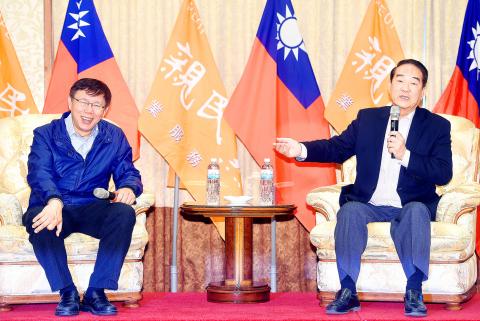
Photo: Fang Pin-chao, Taipei Times
Ko then repeated the invitation three times, saying that as a first-time mayor, he does not know what challenges are ahead and therefore needs an experienced political leader to give him advice.
Soong gladly accepted the offer, saying that he does not care about the title, but would like to help as much as he can. He added that he would accept the position without pay and promised that he would not interfere in Ko’s appointment of officials.
He then told Ko that “there is no other way to handle public affairs, but to always have the public in mind and to be patient.”
Commenting on the controversies that Ko has triggered with his recent remarks on certain policy projects, Soong said that he admires Ko for his honesty and being himself.
“Are these not the personality traits that attracted voters and led to his election?” Soong asked.
However, Soong added that as a mayor, Ko should also try not to talk too fast and advised that Ko should have at least three types of assistants by his side.
“The first is a troubleshooter who is able to identify problems and help solve them; the second is someone who can take down promises or complaints that Ko makes or receives when meeting with people, and follow up on these issues afterwards,” Soong said. “And the third is a spokesperson who has to take part in meetings and understands what Ko thinks, so that he or she may serve as a buffer for Ko.”
Asked if he agrees with Ko on cross-strait relations, as Ko believes Taiwan and China are two separate countries, while Soong supports a “one China” policy, Soong said that they are actually on the same page, as at the core, both of them believe that cross-strait relations should develop peacefully and in a moderate way.

ANOTHER EMERGES: The CWA yesterday said this year’s fourth storm of the typhoon season had formed in the South China Sea, but was not expected to affect Taiwan Tropical Storm Gaemi has intensified slightly as it heads toward Taiwan, where it is expected to affect the country in the coming days, the Central Weather Administration (CWA) said yesterday. As of 8am yesterday, the 120km-radius storm was 800km southeast of Oluanpi (鵝鑾鼻), Taiwan’s southernmost tip, moving at 9kph northwest, the agency said. A sea warning for Gaemi could be issued tonight at the earliest, it said, adding that the storm is projected to be closest to Taiwan on Wednesday or Thursday. Gaemi’s potential effect on Taiwan remains unclear, as that would depend on its direction, radius and intensity, forecasters said. Former Weather Forecast

As COVID-19 cases in Japan have been increasing for 10 consecutive weeks, people should get vaccinated before visiting the nation, the Centers for Disease Control (CDC) said. The centers reported 773 hospitalizations and 124 deaths related to COVID-19 in Taiwan last week. CDC Epidemic Intelligence Center Director Guo Hung-wei (郭宏偉) on Tuesday said the number of weekly COVID-19 cases reported in Japan has been increasing since mid-May and surpassed 55,000 cases from July 8 to July 14. The average number of COVID-19 patients at Japan’s healthcare facilities that week was also 1.39 times that of the week before and KP.3 is the dominant

The Chinese Communist Party’s (CCP) working group for Taiwan-related policies is likely to be upgraded to a committee-level body, a report commissioned by the Mainland Affairs Council (MAC) said. As Chinese President Xi Jinping (習近平) is increasingly likely to upgrade the CCP’s Central Leading Group for Taiwan Affairs, Taiwanese authorities should prepare by researching Xi and the CCP, the report said. At the third plenary session of the 20th Central Committee of the CCP, which ended on Thursday last week, the party set a target of 2029 for the completion of some tasks, meaning that Xi is likely preparing to

US-CHINA TRADE DISPUTE: Despite Beijing’s offer of preferential treatment, the lure of China has dimmed as Taiwanese and international investors move out Japan and the US have become the favored destinations for Taiwanese graduates as China’s attraction has waned over the years, the Ministry of Labor said. According to the ministry’s latest income and employment advisory published this month, 3,215 Taiwanese university graduates from the class of 2020 went to Japan, surpassing for the first time the 2,881 graduates who went to China. A total of 2,300 graduates from the class of 2021 went to the US, compared with the 2,262 who went to China, the document showed. The trend continued for the class of 2023, of whom 1,460 went to Japan, 1,334 went to


 RSS
RSS