


The government’s free economic pilot zone policy is not simply about lifting the ban on 830 Chinese agricultural products, but is aimed at broadening Taiwan’s global reach, Council of Agriculture Minister Chen Bao-ji (陳保基) said yesterday.
With the legislature expected to review the draft bill on the pilot zones during the last week of the three-week-long legislative extraordinary session, Chen, accompanied by Chinese Nationalist Party (KMT) legislators, called on the public and opposition lawmakers to support the policy.
Chen described the bill as a far-seeing policy aimed at enabling “Taiwan’s [food] processing techniques to shine” on the global stage.
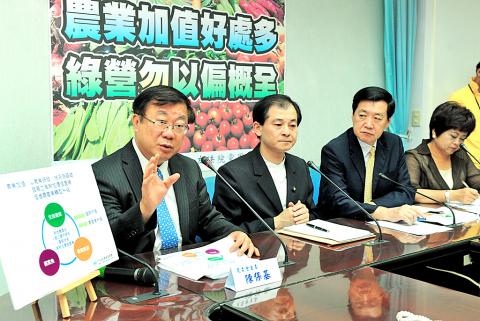
Photo: Lo Pei-der, Taipei Times
The draft bill’s Article 42 has long been the target of criticism by civic groups and opposition parties, which contend that it would allow the import of currently banned Chinese agricultural products to the pilot zones for processing and be exported with the label “Made in Taiwan.”
Chen said that imported raw materials would be examined for food safety in accordance with existing regulations before being processed in the pilot zones. End products that fall under a restricted list can only be exported.
“The policy says nothing about sanctioning the import of banned Chinese agricultural products into the domestic market,” he said, adding that products made in the zone that are not on the restricted list would be taxed before being placed on domestic shelves.
Chen cited the local peanut butter-making industry as a potential beneficiary of the policy. He said that local makers might be forced to exit the market or move abroad if they are not allowed to process Chinese-grown peanuts, one of the currently banned Chinese agricultural products, in the pilot zones and profit from the export of “made in Taiwan” peanut butter.
The minister also underscored the notion of “value-adding,” saying that Taiwan could turn raw agricultural materials from other countries into high-priced products, “just like Switzerland’s chocolate industry and the US’ Starbucks.”
However, academics and Democratic Progressive Party (DPP) legislators have said that processors at the pilot zones could favor cheaper imported agricultural products, thus posing a threat to the domestic agricultural industry.
The DPP yesterday said that the policy would only “support Chinese agriculture” and nip Taiwanese agriculture in the bud.
National Taiwan University professor Wu Jung-chieh (吳榮杰) told a press conference in the legislature on Monday that allowing 830 types of agricultural products from China into the pilot zones would be like “punishing those factories that specialize in processing local agricultural products.”
Wu added that “value-added agriculture” would only benefit a few people.
National Chung Hsing University economist Chen Chi-chung (陳吉仲) said that peanut butter made with Chinese-grown peanuts would not be restricted from domestic sales, and it remains a problem how they would be taxed if they were labeled “Made in Taiwan.”
Taiwan Rural Front secretary-general Frida Tsai (蔡培慧) said that citing insufficient local supply as a reason for allowing agricultural imports does not hold since “there are 270,000 hectares of agricultural fields lying fallow.”
The academics demanded a public debate with the Council of Agriculture.
Chen yesterday said he was willing to accept the invitation if the party caucuses call one.

ANOTHER EMERGES: The CWA yesterday said this year’s fourth storm of the typhoon season had formed in the South China Sea, but was not expected to affect Taiwan Tropical Storm Gaemi has intensified slightly as it heads toward Taiwan, where it is expected to affect the country in the coming days, the Central Weather Administration (CWA) said yesterday. As of 8am yesterday, the 120km-radius storm was 800km southeast of Oluanpi (鵝鑾鼻), Taiwan’s southernmost tip, moving at 9kph northwest, the agency said. A sea warning for Gaemi could be issued tonight at the earliest, it said, adding that the storm is projected to be closest to Taiwan on Wednesday or Thursday. Gaemi’s potential effect on Taiwan remains unclear, as that would depend on its direction, radius and intensity, forecasters said. Former Weather Forecast

As COVID-19 cases in Japan have been increasing for 10 consecutive weeks, people should get vaccinated before visiting the nation, the Centers for Disease Control (CDC) said. The centers reported 773 hospitalizations and 124 deaths related to COVID-19 in Taiwan last week. CDC Epidemic Intelligence Center Director Guo Hung-wei (郭宏偉) on Tuesday said the number of weekly COVID-19 cases reported in Japan has been increasing since mid-May and surpassed 55,000 cases from July 8 to July 14. The average number of COVID-19 patients at Japan’s healthcare facilities that week was also 1.39 times that of the week before and KP.3 is the dominant

The Chinese Communist Party’s (CCP) working group for Taiwan-related policies is likely to be upgraded to a committee-level body, a report commissioned by the Mainland Affairs Council (MAC) said. As Chinese President Xi Jinping (習近平) is increasingly likely to upgrade the CCP’s Central Leading Group for Taiwan Affairs, Taiwanese authorities should prepare by researching Xi and the CCP, the report said. At the third plenary session of the 20th Central Committee of the CCP, which ended on Thursday last week, the party set a target of 2029 for the completion of some tasks, meaning that Xi is likely preparing to

US-CHINA TRADE DISPUTE: Despite Beijing’s offer of preferential treatment, the lure of China has dimmed as Taiwanese and international investors move out Japan and the US have become the favored destinations for Taiwanese graduates as China’s attraction has waned over the years, the Ministry of Labor said. According to the ministry’s latest income and employment advisory published this month, 3,215 Taiwanese university graduates from the class of 2020 went to Japan, surpassing for the first time the 2,881 graduates who went to China. A total of 2,300 graduates from the class of 2021 went to the US, compared with the 2,262 who went to China, the document showed. The trend continued for the class of 2023, of whom 1,460 went to Japan, 1,334 went to


 RSS
RSS