


Lawmakers are gearing up for battle today at the Legislative Yuan over who should preside over a joint committee meeting to screen the controversial cross-strait service trade agreement and whether the pact should be reviewed line-by-line, as stated in a previous consensus.
The Democratic Progressive Party (DPP) and the Chinese Nationalist Party (KMT) have been arguing over who should serve as the convener of the meeting, which includes all eight legislative committees. The convener, who will also serve as chairman, is expected to gain the upper hand in dictating the meeting’s procedure.
Based on a previous interparty consensus, DPP Legislator Chen Chi-mai (陳其邁) should be the designated convener because he was the convener of the last public hearing on Monday, the DPP argues.
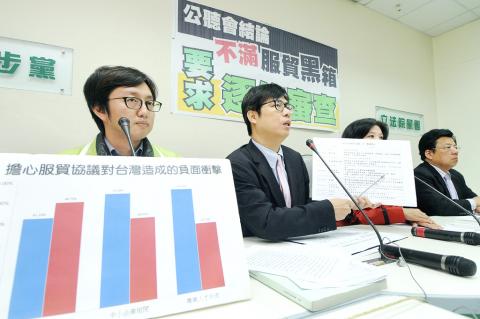
Photo: Liao Chen-huei, Taipei Times
However, the KMT caucus says that it should be given the convener’s seat because it was the party that initiated the motion last year for a review of the agreement.
To prevent a potential KMT “ambush,” the DPP, which says it does not oppose the pact, but wants the agreement renegotiated, sent several lawmakers, including Chen, to occupy the meeting room yesterday evening.
According to a consensus reached during interparty negotiations in June last year, the legislature is to review the pact clause-by-clause after the conclusion of 20 public hearings to solicit opinions from various sectors of industry about the agreement’s potential impact.
However, the KMT has said that it could declare the pact effective immediately on the basis of Article 61 of the Act Governing the Legislative Yuan’s Powers (立法院職權行使法), which states that any executive order that fails to complete a committee review within three months of the plenary session assigning it to the committee shall be deemed passed and effective immediately.
KMT whip Lin Hung-chih (林鴻池) accused Chen of usurping his post as convener, adding that the DPP tried to take over the meeting so that the agreement would not pass.
Speaking at a press conference yesterday morning, Chen pledged that he would preside over the meeting fairly and professionally.
He added that the proposed service trade pact is a quasi-agreement between two countries and should be reviewed by the Legislative Yuan as most democratic countries do with their free-trade agreements.
“The Ma Ying-jeou (馬英九) administration wants the keep the DPP on the sidelines [of the joint meeting] because of its insistence that not one single clause of the pact should be altered,” he said.
Chen added that Article 61 does not apply to the service trade agreement because it is not an executive order.
Chen’s office released a survey of 185 academics, union representatives and non-governmental organization representatives who attended at least one of the 20 public hearings, and said the results showed widespread public suspicion about the trade agreement.
According to the survey, 56.2 percent of respondents said the negotiation process for the agreement was “opaque,” 45.4 percent did not support signing the agreement and 60.5 percent supported a clause-by-clause review.
The respondents were mainly concerned about three potential impacts of the agreement: an influx of Chinese workers (42.1 percent), effect on Taiwan’s small and medium enterprises (53.5 percent) and an acceleration of the outflow of talent to China (55.1 percent), said Chiang Chao-kuo (江肇國), director of Chen’s office.

Considering that most countries issue more than five denominations of banknotes, the central bank has decided to redesign all five denominations, the bank said as it prepares for the first major overhaul of the banknotes in more than 24 years. Central bank Governor Yang Chin-lung (楊金龍) is expected to report to the Legislative Yuan today on the bank’s operations and the redesign’s progress. The bank in a report sent to the legislature ahead of today’s meeting said it had commissioned a survey on the public’s preferences. Survey results showed that NT$100 and NT$1,000 banknotes are the most commonly used, while NT$200 and NT$2,000

The Centers for Disease Control (CDC) yesterday reported the first case of a new COVID-19 subvariant — BA.3.2 — in a 10-year-old Singaporean girl who had a fever upon arrival in Taiwan and tested positive for the disease. The girl left Taiwan on March 20 and the case did not have a direct impact on the local community, it said. The WHO added the BA.3.2 strain to its list of Variants Under Monitoring in December last year, but this was the first imported case of the COVID-19 variant in Taiwan, CDC Deputy Director-General Lin Ming-cheng (林明誠) said. The girl arrived in Taiwan on

South Korea is planning to revise its controversial electronic arrival card, a step Taiwanese officials said prompted them to hold off on planned retaliatory measures, a South Korean media report said yesterday. A Yonhap News Agency report said that the South Korean Ministry of Foreign Affairs is planning to remove the “previous departure place” and “next destination” fields from its e-arrival card system. The plan, reached after interagency consultations, is under review and aims to simplify entry procedures and align the electronic form with the paper version, a South Korean ministry official said. The fields — which appeared only on the electronic form

The Ministry of Foreign Affairs (MOFA) is suspending retaliation measures against South Korea that were set to take effect tomorrow, after Seoul said it is updating its e-arrival system, MOFA said today. The measures were to be a new round of retaliation after Taiwan on March 1 changed South Korea's designation on government-issued alien resident certificates held by South Korean nationals to "South Korea” from the "Republic of Korea," the country’s official name. The move came after months of protests to Seoul over its listing of Taiwan as "China (Taiwan)" in dropdown menus on its new online immigration entry system. MOFA last week


 RSS
RSS